
Quick Answer: Recruitment process automation cuts time-to-hire by removing manual bottlenecks in screening, scheduling, and evaluation. Adaptive AI interviews assess every applicant within hours instead of weeks, and structured, explainable scoring means faster decisions don't mean lower-quality ones. The biggest mistake employers make: automating scheduling but leaving screening manual, which keeps the funnel just as slow.
A hiring manager in Bangalore posts a Senior Software Engineer role on Monday. By Friday, 400 applications are sitting in the inbox, and the recruiter has actually gotten through maybe 60 of them. The other 340? Still waiting. And somewhere in that unread pile is probably the one candidate who'd have taken the offer from a faster competitor if only someone had opened their application in time.
That's the real cost of manual recruiting. It's not bad judgment on the recruiter's part; it's just slow throughput. Recruitment process automation exists to fix that throughput problem, without handing the decision itself over to a system nobody can explain. Done right, it screens every single applicant instead of a sampled fraction, and it does so with a documented reason behind every score.
How Does Recruitment Process Automation Work?
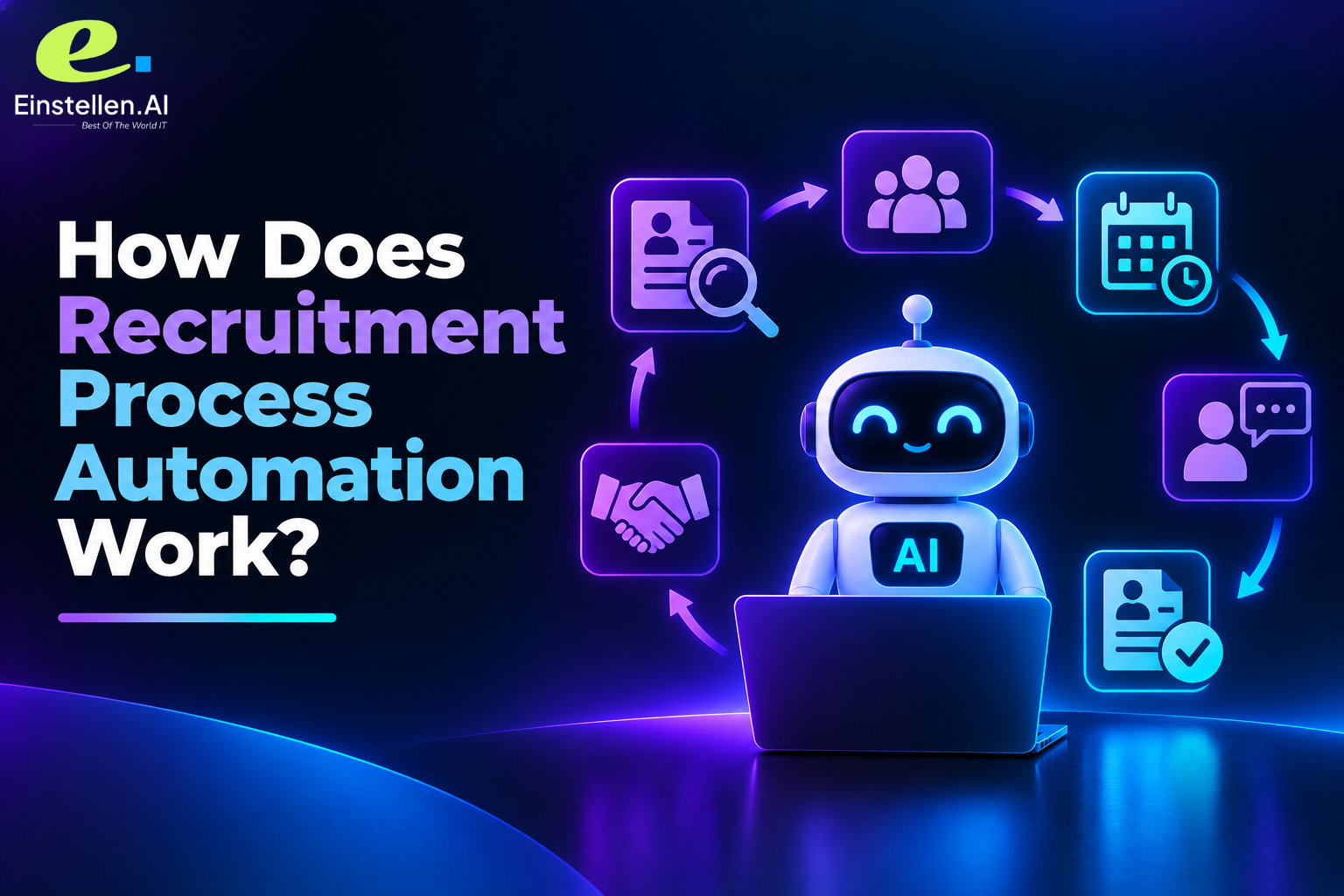
Recruitment process automation software takes what used to be sequential, manual steps and runs them in parallel instead. A recruiter reading resumes one at a time, then scheduling calls one at a time, then typing up notes one at a time, Einstellen.AI's platform replaces that whole chain with a workflow where intake, screening, interviewing, and scoring fire automatically the moment a candidate hits apply.
On Einstellen.AI, this runs on Magic OS. A candidate applies, humAIn kicks off an adaptive AI interview, and the MAGIC OS model has produced a structured, justified score before the recruiter has even opened their laptop the next morning. There's no scheduling back-and-forth to speak of, because the interview itself happens on demand.
Here's the distinction that actually matters: this isn't some chatbot filtering for keywords. It's an adaptive interview engine that builds each follow-up question out of what the candidate just said in their previous answer. Closer to how a sharp human interviewer would probe a response, honestly, than anything close to a fixed-script screening call.
What Does Recruitment Process Automation Actually Cover?
Not every stage of recruiting gets the same benefit from automation. The stages that eat the most manual hours, and where automation pays off most obviously, are these:
Screening and shortlisting. This is where most of the hours vanish in a manual process. AI recruitment automation puts every applicant through the same adaptive interview and scoring model, so the funnel is no longer capped by how many resumes one tired recruiter can get through in a day.
Interview scheduling. On-demand AI interviews cut out the multi-day email chain that's usually needed just to find a slot both sides can make, a delay that routinely tacks a week or more onto time-to-hire.
Scoring and comparison. Structured justification reports let a hiring manager compare 50 candidates against the same criteria, instead of trying to make sense of 50 different sets of inconsistent interviewer notes.
ATS handoff. A complete recruitment process automation stack integrates with your ATS at no additional cost. Magic OS integrates with any ATS at no additional cost, so candidate data and scores flow straight into the existing system rather than getting typed in twice.
What doesn't get automated: the final call on who gets hired. The system hands over evidence. A person still makes the decision.
How Can Automation Reduce Time-to-Hire?
Time-to-hire is really just the sum of every wait period between application and offer. Recruitment process automation goes after each of those wait periods directly, rather than trying to squeeze speed out of one single step.
Manual screening alone can take one to two weeks for a role that pulls in hundreds of applicants. SHRM's 2025 Talent Acquisition Benchmarking data puts average time-to-fill at 42 days, with screening delays as the primary contributor, simply because a human is reading through them one after another. An adaptive AI interview, by contrast, evaluates a candidate the same day they apply. And since interviews run in parallel across the whole pool at once, a shortlist that used to take two weeks can be sitting ready in a matter of days.
Read More: How to Reduce Time to Hire with an AI Recruitment Platform
Scheduling delay disappears for basically the same reason: the candidate interviews whenever it suits them, not whenever a shared calendar happens to line up. And because the MAGIC OS model's scoring is structured and comparable across candidates, hiring managers spend a lot less time in debrief meetings arguing over "Why did this candidate score higher than that one?" The justification report already answers that.
And it compounds. Every day you shave off screening and scheduling is a day that requisition isn't sitting open, and a day a rival offer doesn't quietly get accepted instead.
Does Recruitment Process Automation Reduce Hiring Costs?
The cost savings from recruitment process automation come less from cutting headcount and more from cutting wasted recruiter hours and avoiding mis-hires. A recruiter who isn't burning hours manually screening unqualified applicants can simply run more requisitions at once, which is real money saved even if nobody's role gets eliminated.
The higher cost, though, is one most companies barely track: a bad hire that came out of an unreliable evaluation process. Talent acquisition heads describe this black-box scoring pattern over and over. AI interview scores from systems nobody can explain simply don't correlate with how the person actually performs on the job, and the company ends up paying for that mismatch later in turnover and rehiring costs. Structured justification scoring exists specifically to close that gap. A hiring manager can look at which parts of an answer drove the score and actually judge whether the reasoning holds up.
ATS integration at no added cost is a smaller line item, but it's a real one. Plenty of platforms charge extra for it, and when prospects find out Einstellen.AI just includes it as standard, the reaction is usually plain disbelief, because the rest of the market has quietly trained everyone to expect a surcharge.
Read More: AI-Based Hiring Platform ROI: A Model for CFOs and Founders
Can Automated Recruitment Improve Candidate Experience?
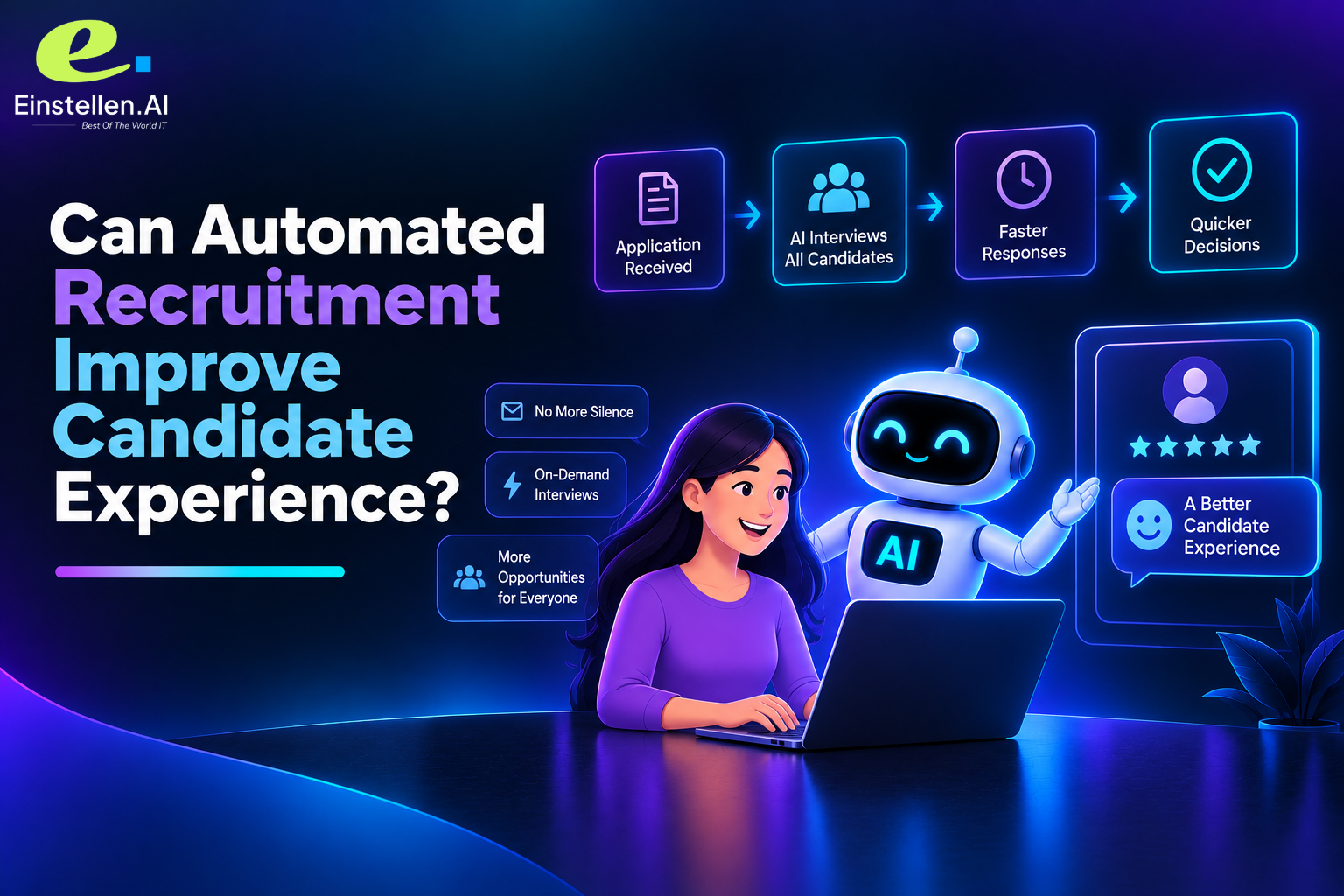
Candidates almost never complain about automation itself. What they complain about is silence. A manual process where 340 of 400 applicants never hear back, or wait three weeks just for a first response, that's what wrecks an employer's reputation. Not the AI.
Recruitment process automation interviews every applicant rather than a sampled slice, which means more people get an actual interview instead of a silent auto-rejection triggered by missing keywords on a resume. And because interviews are on-demand, nobody's stuck waiting around for a recruiter's calendar to free up. For a fresher applying to dozens of roles at once, a same-day interview and a fast decision are a genuinely better experience than what most job boards deliver right now.
Recruitment Process Automation Impact at a Glance
| Recruiting Stage | Manual Process | Automated Process (Einstellen.AI) |
|---|---|---|
| Resume screening | Sequential, hours per batch | Every applicant interviewed via humAIn |
| Interview scheduling | Multi-day email back-and-forth | On-demand, candidate-initiated |
| Scoring | Inconsistent interviewer notes | MAGIC OS model structured justification report |
| ATS handoff | Manual re-entry or paid add-on | Integrated at no additional cost |
| Interview volume (platform-wide) | - | 150,000+ AI interviews conducted |
Based on Einstellen.AI platform data and current market practice.
Proof Point: Einstellen.AI has conducted 150,000+ AI interviews across 1,200+ institutions, backed by IIM Lucknow and NASSCOM. MediAssist's enterprise deployment on the platform produced 92.5% fewer screening interviews required, 15-day average fulfillment, 100% position closure rate, and 60% interview-to-deployment conversion; every score was delivered with a structured justification report so hiring managers could see exactly what drove every result.
FAQ
How does recruitment process automation reduce time-to-hire?
Recruitment process automation removes the sequential wait periods in screening and scheduling. Adaptive AI interviews evaluate candidates the same day they apply, running in parallel across the whole pool, so a shortlist that took two weeks manually can be ready in days, without skipping anyone.
Can recruitment automation improve hiring quality?
Yes, but only when the scoring is explainable. The MAGIC OS model produces a structured, justified score for every interview, showing exactly which parts of a candidate's answers drove the result. That's the real difference between automation that just speeds up guessing and automation that speeds up evidence-based decisions.
What can be automated in the recruitment process?
Screening, interview scheduling, scoring, and ATS data handoff are where the payoff is biggest. Adaptive AI interviews via humAIn handle screening and evaluation, and Magic OS plugs into any ATS at no extra cost. The final hiring decision, though, stays with a human.
How does recruitment process automation handle candidate screening?
Every applicant gets routed into an adaptive AI interview on humAIn instead of getting a manual resume skim. The interview builds follow-up questions out of the candidate's actual answers, and the MAGIC OS model scores the result with a justification report attached, so screening scales to the entire applicant pool instead of just a sampled fraction.
Post Your Next Role on Einstellen.AI
Recruitment process automation done right loses you neither. Slow screening loses you candidates. Unexplained AI scores lose you candidates too, just in a different way. Einstellen.AI runs adaptive interviews through humAIn and scores every candidate with the MAGIC OS model's structured justification report, so you cut time-to-hire without trading away evaluation quality. ATS integration is included at no extra cost, no matter which system you're running.
Post your role on Einstellen.AI and see structured, explainable candidate scores within hours of your listing going live.









Leave a Comment
Share your perspective. Comments are moderated before publishing.