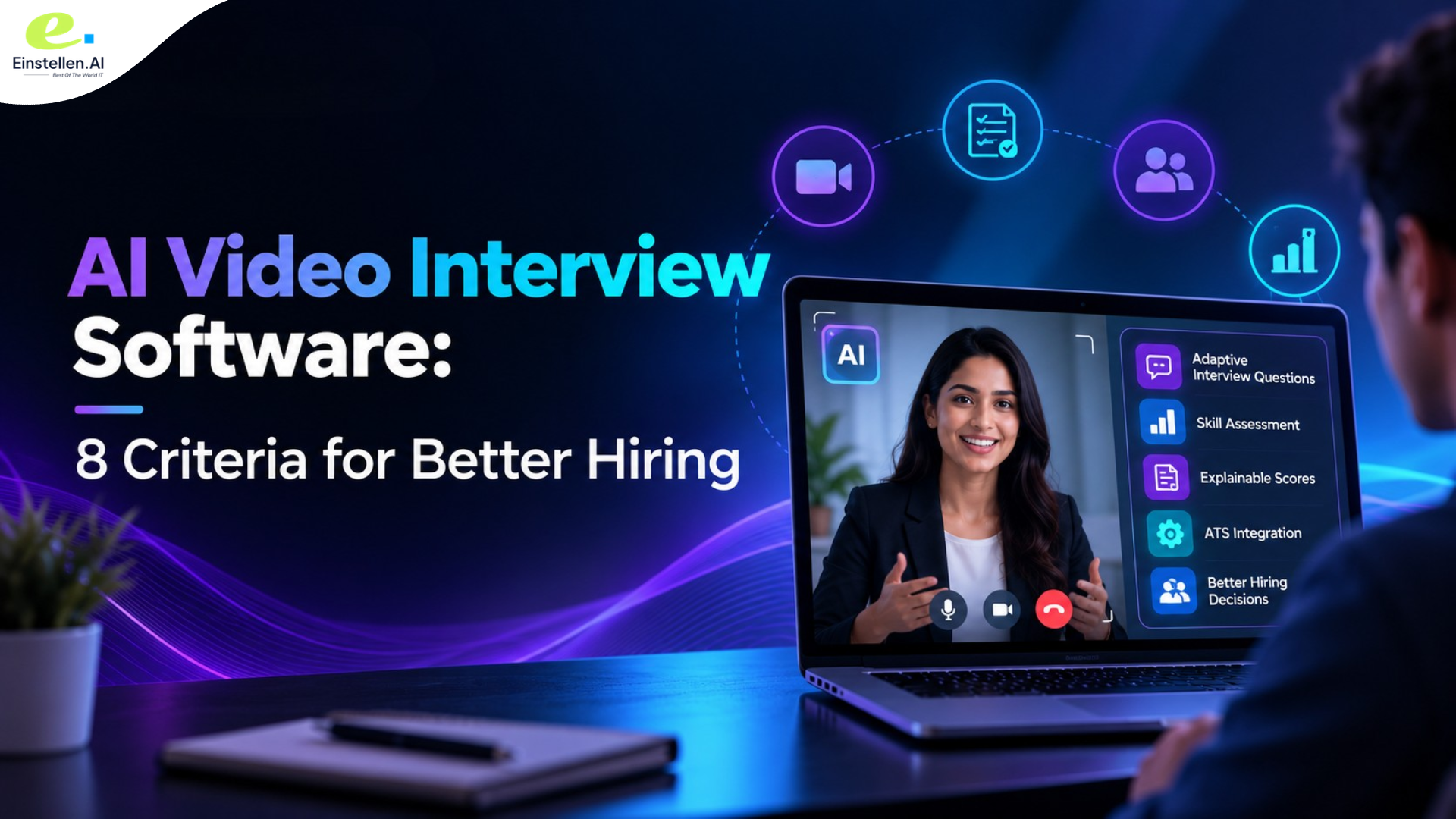
AI Video Interview Software helps enterprise hiring teams assess candidates more consistently, manage screening volume, and make better-informed decisions. But not every platform delivers the same capabilities. Some AI video interview platforms record candidate responses for recruiters to review later. Others use AI to summarize interviews, evaluate answers, or conduct adaptive interviews independently.
Choosing the wrong AI interview assessment software can add another layer of technology without solving the underlying hiring problem.
For enterprise talent acquisition teams, the decision should go beyond recording quality and automated summaries. The right AI video interview platform should support structured evaluation, explainable scoring, ATS integration, candidate accessibility, and responsible human oversight.
This guide explains eight criteria to evaluate before investing in AI video interview software. It also covers pricing models, implementation considerations, and questions to ask vendors before making a decision.
Quick Answer: What Should Enterprise Teams Look in an AI Video Interview Software?
AI video interview software enables organizations to conduct, record, analyze, or automate candidate interviews through digital workflows. The best solution depends on hiring volume, assessment requirements, integration needs, and the level of automation required.
Before selecting an automated video interview software, evaluate these eight criteria:
- Interview format: Live, one-way recorded, or adaptive conversational interviews.
- Assessment quality: Job-related questions and consistent evaluation criteria.
- Explainability: Scores supported by evidence and structured reasoning.
- ATS integration: Reliable movement of candidate data between systems.
- Security and governance: Clear policies for data access, retention, and AI use.
- Candidate experience: Accessible, understandable, and convenient interviews.
- Scalability: Consistent performance across roles, teams, and hiring volumes.
- Pricing and ROI: Transparent costs aligned with actual interview usage.
The goal is not to automate every hiring decision. It is to make candidate assessment more consistent, efficient, and auditable while keeping hiring teams accountable.
Read More: AI Interview vs Video Interview: What's Actually Different
1. AI Video Interview Software: Understand the Interview Format
The first evaluation criterion is the type of interview the platform supports. This determines what the technology can actually accomplish in your hiring workflow.
One-way recorded video interviews: Candidates receive predefined questions and record their responses independently. Recruiters review the recordings later, often using playback, transcripts, or summaries.
This format works well when scheduling large numbers of candidates is difficult. However, the interview itself generally follows a predefined structure. This kind of video interview platform does not necessarily ask follow-up questions based on each response.
AI-assisted interview review: These kinds of AI video interview software/platforms help recruiters process interviews more efficiently. Features may include transcription, summaries, answer highlights, and structured feedback.
The human interviewer still conducts the conversation. AI supports the review process rather than independently interviewing candidates.
Autonomous or adaptive AI interviews: An AI interviewer conducts the conversation, asks role-specific questions, and adapts follow-up questions based on candidate responses. Depending on the platform, it may also produce transcripts, competency scores, and structured evaluation reports.
This kind of AI video interview software can help organizations standardize initial screening across large candidate pools. Einstellen.AI's Magic OS uses humAIn Advance that conducts adaptive AI interviews, asking relevant follow-up questions based on candidates' responses and generating structured reports with skill assessments, scoring rationale, and interview transcripts.
What to ask vendors: Does the AI actually conduct the interview, or does it only analyze a recording? Can it ask relevant follow-up questions? Can hiring teams configure the interview around specific role requirements?
If you have any of these questions in your mind regarding hiring through an AI interview platform like Einstellen.AI, feel free to contact us.
These distinctions matter because a recording tool, an interview assistant, and an autonomous interviewer address different operational needs.
For example, a company reviewing a small number of senior executive interviews may prefer human-led conversations with AI-assisted notes. A technology organization screening hundreds of engineering applicants may benefit more from structured, adaptive first-round interviews.
Choose the interview format based on the hiring problem, not the most impressive product demonstration.
2. AI Interview Assessment: Evaluate Consistency and Explainability
A recorded interview is only useful when the resulting assessment helps hiring teams understand a candidate’s capabilities.
The second criterion is how the platform evaluates responses. Look beyond an overall score or a simple recommendation. Understand the evidence supporting each assessment.
Criterion 2: Role-specific assessment
A strong platform should support questions and evaluation criteria aligned with the role.
Engineering candidates, sales professionals, and customer support specialists require different competencies. Their interviews should reflect those differences.
Ask whether the enterprise AI video interview software supports configurable interview questions, competency frameworks, role-specific rubrics, and consistent assessment criteria. Also establish how hiring teams can review or update those criteria.
Criterion 3: Explainable scoring
AI-generated scores should not be treated as self-explanatory. A useful assessment report connects each competency score to the candidate’s actual response. The AI video interview software/platform should help reviewers understand what the candidate demonstrated, what remains unclear, and why a particular rating was assigned.
For example, a technical candidate might receive separate assessments for problem-solving, technical knowledge, and communication. Reviewers should be able to inspect the relevant answers and supporting reasoning.
Einstellen.AI produces structured interview reports with competency scores and explicit reasoning. Its reports also include transcripts and interview recordings, helping hiring teams examine the evidence behind an assessment.
When evaluating any provider, ask whether the scoring logic is documented, whether reports distinguish evidence from inference, and whether reviewers can challenge an assessment.
The objective is not to eliminate professional judgment. It is to give that judgment better evidence.
Criterion 4: Human oversight and responsible evaluation
AI should support hiring decisions rather than become an unquestioned authority.
Hiring teams need a defined process for reviewing unusual results, correcting inaccurate information, and escalating concerns. They should also understand whether the platform makes recommendations or takes actions automatically.
The U.S. Equal Employment Opportunity Commission’s guidance on AI and disability discrimination explains that employment technologies can create discrimination risks when they disadvantage applicants with disabilities.
Use that guidance as a starting point, then assess the requirements applicable to your own hiring locations.
Ask vendors how they test assessment systems, document limitations, support accommodations, and help employers monitor potential adverse impacts. Avoid relying on unsupported claims that an AI system is completely unbiased.
3. AI Video Interview Platform Integration, Security, and Governance
Enterprise hiring rarely happens in a single application. Candidate information may move between an applicant tracking system, assessment tools, recruiter workflows, and reporting dashboards.
Your AI video interview platform must fit this environment without creating unnecessary manual work or governance gaps. Enterprise hiring teams can get benefits from Einstellen.AI as it integrates with their existing ATS, bringing interview scores, transcripts, and MAGIC Reports into candidate records. This helps hiring teams maintain their existing workflows while making recruitment smoother and more productive.
Criterion 5: ATS integration and workflow compatibility
An applicant tracking system (ATS) manages candidate records and hiring stages. Integrating AI video interview software with an ATS can reduce repetitive data entry and keep assessment information connected to the recruitment process.
However, the phrase “ATS integration” can mean different things.
Some providers offer direct integrations. Others rely on APIs, webhooks, exports, or manual uploads. These approaches have different implementation and maintenance requirements.
During a product demonstration, ask:
- Which ATS platforms are supported today?
- Does the integration transfer candidate details, interview links, reports, and status updates?
- Can recruiters access assessment information without switching between multiple systems?
- What happens when a synchronization fails?
- Are custom integrations included in the quoted price?
Request a demonstration using your actual recruitment workflow. Confirm how candidate records are matched and how duplicate records are handled.
Read More: Implementing an AI Hiring Platform Without Disrupting Your ATS
Einstellen.AI positions Magic OS for integration with existing ATS workflows. Enterprise buyers should validate the specific integration method and requirements for their own environment before procurement.
Criterion 6: Security, privacy, and governance
AI video interviews can contain personal information, employment history, spoken responses, and other sensitive candidate data. Organizations need to understand how that information is handled.
Review the vendor’s security documentation and privacy policies. Establish who can access recordings, where data is processed, how long information is retained, and how deletion requests are handled.
Also clarify whether candidate data is used to train models, whether sub processors are involved, and how access is logged.
A useful procurement checklist includes:
- Data storage and processing locations.
- Encryption and access-control practices.
- Retention, deletion, and export procedures.
- Security incident response and notification.
- Subprocessor disclosures and contractual safeguards.
- Candidate notices, consent requirements, and accommodation processes.
- Documentation supporting applicable legal and regulatory obligations.
Do not assume a vendor meets every legal requirement simply because it advertises enterprise security.
Your legal, privacy, and security teams should review the relevant documentation before deployment. Requirements vary by jurisdiction, industry, and intended use.
Einstellen.AI prioritizes enterprise trust through security, privacy, and compliance controls. Explore the Einstellen.AI Trust Center for details on its security practices and compliance resources.
Read More: AI-Based Hiring Platform Data Security: What Enterprises Must Verify
4. Candidate Experience, Scalability, and Hiring ROI
An AI video interview platform can automate interviews and still create a poor hiring experience. Enterprise buyers must assess whether it works for candidates and recruiters at the same time.
Criterion 7: Candidate experience and operational scalability
Candidates should understand what the interview involves, how their information will be used, and what happens after they finish.
Test the candidate journey on different devices and connection speeds. Check the instructions, accessibility options, interview duration, support channels, and ability to request reasonable accommodations.
Consider whether candidates can complete AI video interviews at convenient times. Also examine how the system handles interrupted sessions, technical failures, and incomplete responses.
For enterprise teams, scalability involves more than processing a large number of interviews. The enterprise AI video interview software or platform should support multiple roles, departments, hiring managers, and evaluation frameworks without making administration unnecessarily complex.
Ask vendors to demonstrate how they manage high-volume recruitment, configure interview templates, assign permissions, and review results across teams.
Measure practical outcomes such as recruiter review time, candidate completion rates, assessment turnaround, and the number of candidates progressing through each stage. Establish a baseline before deployment so that improvements can be evaluated meaningfully.
Criterion 8: Transparent pricing and measurable ROI
AI video interview software may use subscriptions, per-user licensing, per-role pricing, annual contracts, or pay-per-interview credits.
The cheapest headline price is not necessarily the lowest total cost. A platform with a low entry fee may require additional spending on integrations, implementation, assessments, support, or usage limits.
Compare vendors using your expected interview volume and actual workflow.
Include the following in your cost model:
- Platform fees and interview usage.
- Setup, integration, and implementation costs.
- Recruiter training and administration.
- Additional assessment or reporting charges.
- Support, service levels, and contract commitments.
- Time saved across screening and review.
Calculate cost per completed interview and cost per qualified candidate progressing to the next stage. Where possible, compare these figures with your existing process.
Einstellen.AI lists Magic OS interview credits at ₹249 per interview, with a pay-as-you-go model and no monthly subscription or volume commitment. Its pricing page describes interview recordings, transcripts, competency scores, and a MAGIC Intelligence Report as included capabilities.
Review the current Einstellen.AI pricing page for the latest terms and confirm any requirements relevant to your organization.
ROI should be measured against agreed operational outcomes, not assumed from automation alone.
AI Video Interview Software Comparison: What Should You Choose?
The right category depends on what your recruitment team needs to improve. Use this comparison to narrow your shortlist before evaluating individual providers.
| Capability | One-way video tool | AI-assisted review tool | Adaptive AI interviewer |
|---|---|---|---|
| Candidate records responses independently | Yes | Depends on workflow | Depends on implementation |
| Supports human-led interviews | Sometimes | Often | May complement them |
| Produces transcripts or summaries | Product-dependent | Common capability | Product-dependent |
| Asks adaptive follow-up questions | Generally no | Generally no | Core capability |
| Provides structured AI assessment | Varies | Varies | Depends on platform |
| Best suited to | Asynchronous screening | Faster review of human-led interviews | Standardized initial screening at scale |
| Main evaluation priority | Recording and review workflow | Evidence quality and reviewer usability | Interview quality, explainability, and oversight |
These are category-level distinctions, not universal guarantees. Features vary by vendor and product tier, so verify every requirement against current documentation.
Where does Einstellen.AI fit?
Einstellen.AI offers Magic OS, an AI video interview software or hiring operating system that includes humAIn, its AI interviewer. The platform supports adaptive interviewing and produces structured reports with competency scores, reasoning, transcripts, and recordings.
For teams evaluating AI-led screening, these capabilities provide a basis for assessing how interview automation can fit into an existing hiring workflow.
Before making a decision, compare the AI video interview platform against your role requirements, integration needs, governance standards, and expected interview volume. A product demonstration should establish whether the workflow fits your organization rather than simply showcase individual features.
Frequently Asked Questions
What is AI video interview software?
AI video interview software helps employers conduct, record, transcribe, assess, or automate candidate interviews. Depending on the product, AI may summarize recorded responses, support human interviewers, or conduct adaptive interviews. Buyers should verify which capabilities are included rather than assuming every platform offers the same functionality.
How does AI video interview software work?
The workflow depends on the interview format. In a one-way interview, candidates record responses to predefined questions. AI-assisted tools may transcribe or summarize those responses. An adaptive AI interviewer can ask follow-up questions based on a candidate’s answers and generate a structured report. Hiring teams should review the assessment evidence before making decisions.
Can AI interview software integrate with an ATS?
Many interview platforms offer integrations or other methods of connecting with applicant tracking systems. The depth of integration varies. Confirm whether candidate details, interview links, transcripts, reports, and hiring-stage updates transfer automatically. Validate the specific connector, configuration, and associated costs with your chosen vendor.
How much does AI video interview software cost?
Pricing varies by subscription, usage, number of roles, enterprise requirements, and integration needs. Einstellen.AI lists Magic OS interview credits at ₹249 per interview under a pay-as-you-go model. Check the current pricing page and calculate the total cost using your expected interview volume before committing.
Is AI interview scoring fair and explainable?
Fairness depends on the system’s design, assessment criteria, validation, and use. No vendor should be assumed unbiased simply because it uses AI. Look for documented scoring criteria, evidence-linked reports, clear limitations, human review processes, and support for accessibility. Employers remain responsible for evaluating the suitability of hiring tools for their processes.
Choose AI Video Interview Software That Improves Decisions
AI Video Interview Software should do more than move interviews online. It should help hiring teams evaluate candidates consistently, review evidence efficiently, and maintain appropriate human oversight.
Start by identifying the bottleneck in your hiring process. Then compare interview formats, assessment explainability, ATS integration, governance, candidate experience, scalability, and total cost.
For organizations exploring adaptive interviews and structured assessment reports, Einstellen.AI’s Magic OS is worth evaluating against those requirements.
Ready to assess your hiring workflow? Explore Einstellen.AI for employers or review the Magic OS pricing model to understand how pay-per-interview screening could fit your recruitment process.






Leave a Comment
Share your perspective. Comments are moderated before publishing.