
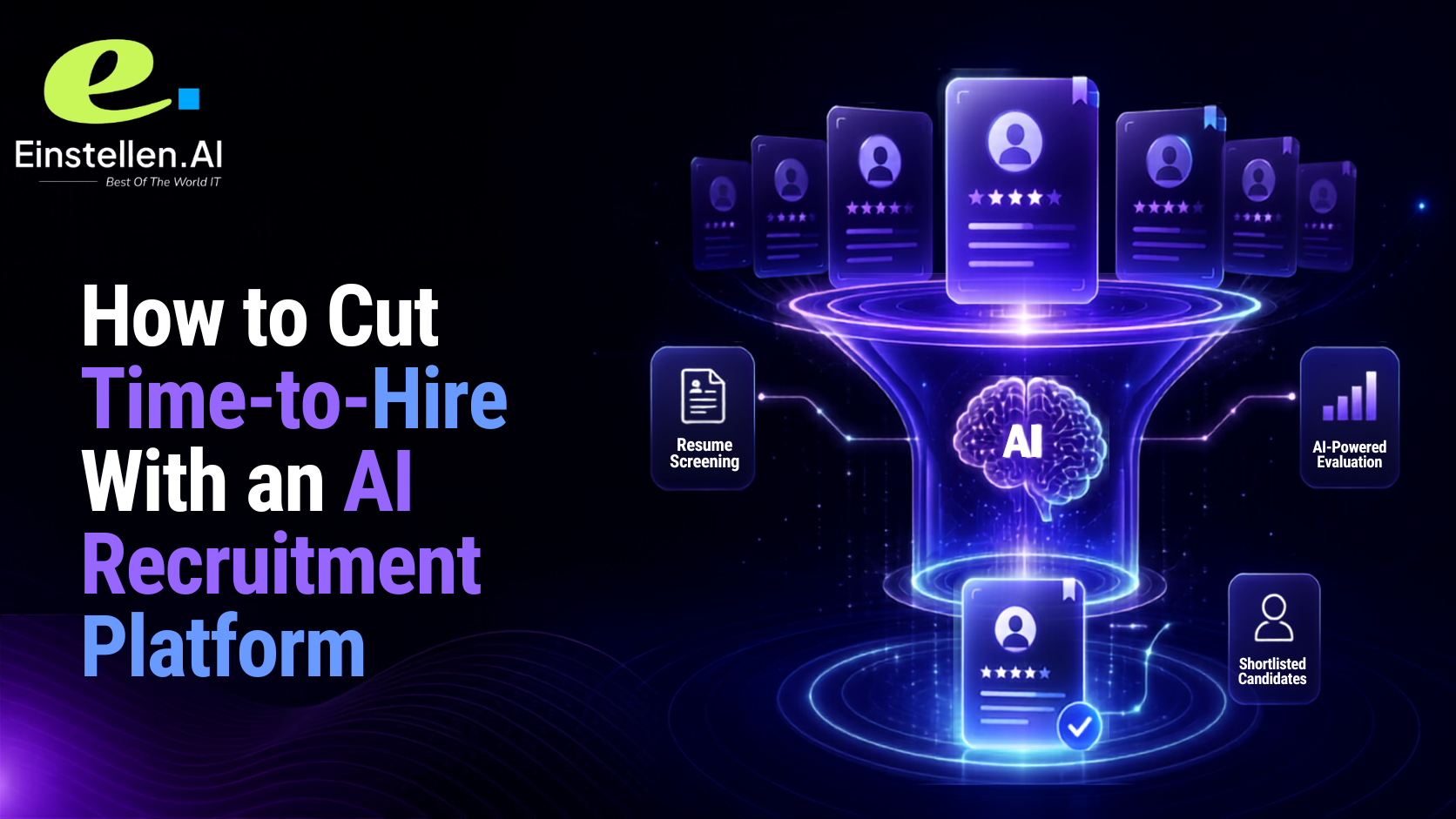
Quick Answer: If an organization wants to reduce its time to hire with an AI recruitment platform, they need to automate four bottlenecks: resume screening, interview scheduling, first-round evaluation, and reporting. According to SHRM's study, the average time-to-hire is around 44 days. Platforms with adaptive interviewing and explainable scoring cut the evaluation stage specifically, without sacrificing a defensible, reviewable hiring decision.
A hiring manager in Bangalore posts a Senior Software Engineer role on Monday. By Friday, 200 applications are sitting in the inbox, and a real candidate who three competitors are also courting has already taken an offer somewhere else. That's the actual cost of a slow funnel. Not a delayed hire. A lost one. SHRM puts average time-to-hire at 42-44 days, and most of that stretch is dead air: manual resume review, scheduling back-and-forth, not real evaluation. An AI recruitment platform goes after exactly that dead air. The real question before you adopt one isn't whether it's fast. It's whether the speed still leaves you with a decision you can defend to a candidate, a legal team, or your own CEO.
Step 1- AI Recruitment Platform: What Actually Moves the Needle
Currently, most of the AI recruitment platforms that are present in the market automate one of three stages: sourcing, screening, or scheduling. Sourcing tools surface candidates faster. Scheduling bots kill the calendar back-and-forth. Screening tools filter resumes against keywords.
None of these three, on their own, touch the stage that actually eats up the most manager time: figuring out whether a shortlisted candidate is actually good. Magic OS, the platform behind Einstellen.AI's product set, runs the AI interview engine (humAIn) and the MAGIC scoring model on the same system. Screening and evaluation happen in one pass instead of three tools stitched together with duct tape.
That matters more than it sounds like on paper. A hiring manager juggling a keyword filter, a scheduling bot, and a separate interview tool is still doing manual reconciliation across three data sources before they can even make a call. Put screening and adaptive interviewing on one platform and that reconciliation step just disappears. That's where a real chunk of calendar time goes missing in a typical hiring cycle.

Step 2- Reduce Time to Hire: Where the Days Actually Go
According to a 2024 study by IBS Center for Management Research, after an effective shift from traditional hiring to an AI-driven hiring process, Unilever has experienced a reduced recruitment processing time by 75%. However, in a recent report, NHS Management reduced its time-to-hire to 5 days from 15 days. It happened after an impressive rollout of an AI-powered recruitment platform, as per AltHire.ai.
Worth flagging: these are third-party, vendor-specific results, not Einstellen.AI numbers. But the pattern holds across both. The reduction comes almost entirely from cutting manual review and scheduling delay, not from any change to the interview itself.
That's the part most vendors conveniently skip. Compress the funnel without improving what actually happens in the interview, and all you've done is make a bad hiring decision arrive faster. Real time-to-hire reduction has to pair funnel speed with interview quality. Otherwise the days you saved get spent later, cleaning up a mis-hire.
Step 3- AI Candidate Screening vs. Automated Candidate Screening: The Real Distinction
"Automated candidate screening" usually just means keyword matching against a resume. A filter, not a judgment. "AI candidate screening" implies something closer to actual evaluation, but here's the catch: most tools in this category still run a fixed-script interview. Same five questions, no matter what the candidate says.
humAIn, Einstellen.AI's interview engine, doesn't work that way. The AI interview engine listens to the answers of candidates and generates next questions based on their response. Therefore, it adapts responses and takes the interview instead of marching through a script. For instance, if a candidate gives a vague answer about a specific project to humAIn, it probes that project further instead of jumping to an unrelated scripted question. That's the literal mechanism behind "adaptive" and "agentic" here, not a marketing label glued on top of a static test.
The output isn't a bare ranking either. Every humAIn interview produces a per-answer scored report with a full transcript, so a hiring manager can see exactly which answer drove which part of the score before making a call. Direct competitors in this category, including HireVue, Intervue.io, Spark Hire, and Mercer Mettl, are typically associated with a candidate ranking that shows up without any of that reviewable justification attached.
Step 4- AI Interview Scheduling and AI Recruiting ROI
Scheduling delay is quieter than resume screening as a time-sink, but it's real. Every round of "does Tuesday at 3 pm work" between recruiter and candidate adds a day, sometimes two, especially across time zones or when three interviewers need their calendars aligned.
On ROI: 81% of surveyed companies said they plan to invest in AI-driven recruiting solutions, according to SmartRecruiters' 2024 research, and separate research from Fit Small Business found AI-powered recruiting linked to time savings for 85.3% of adopters and cost savings for 77.9%. Again, these are industry-wide, third-party figures. Useful context for what buyers are seeing broadly, not a claim about any single vendor's results.
The ROI case gets a lot stronger when integration is free instead of a line item. Magic OS integrates with any ATS a company is already using, including Greenhouse, Lever, and Workday as named, natively synced examples, at no additional cost. Charging extra for ATS connectivity has been standard practice across this category for long enough that when it isn't, buyers are often genuinely surprised it's even possible.
Step 5- AI Hiring Bias and AI Recruiting Compliance
Only about 26% of applicants trust AI to evaluate them fairly. That's a recurring objection, and honestly, it's a rational one when the tool underneath is a black box. A ranking with no visible reasoning invites suspicion, deserved or not, simply because there's nothing to check it against.
Structured justification is the direct counter to that. When a report shows exactly which answer drove which part of a score, both the hiring manager and, where it matters, the candidate have something concrete to look at instead of a number they're just supposed to trust. This also feeds into compliance conversations tied to frameworks like the EU AI Act and NYC Local Law 144, which increasingly expect employers to explain automated hiring decisions rather than just assert they're fair. Magic OS also builds fraud and proxy detection into the interview process itself, which matters for any high-volume hiring round where interview integrity at scale is a real operational concern, not a theoretical one.
Step 6- Time to Hire vs. Time to Fill: Why the Distinction Matters for AI ROI
Time-to-fill has a broader perspective, covering the full span from job requisition to accepted offer. On the other hand, Time-to-hire is much narrower, which incorporates first application or contact through acceptance. Additionally, the biggest leverage point of an AI recruitment platform is that it sits inside time-to-hire specifically. Moreover, the screening-to-decision stretch is also a positive point of an AI recruitment platform.
Furthermore, jumbling the two metrics is a common reporting mistake, which is worth watching. If a company reports a "50% reduction" without saying which metric moved, that number is nearly impossible to check against SHRM's 42-44 day time-to-hire benchmark or against your own historical baseline.
| Metric | Typical Range | What It Captures |
|---|---|---|
| Time to hire (SHRM benchmark) | 42-44 days | First contact to acceptance |
| Time to fill | Longer than time-to-hire | Requisition open to acceptance |
| AI-linked time savings (adopters) | 85.3% report time savings | Fit Small Business, 2024 |
| AI-linked cost savings (adopters) | 77.9% report cost savings | Fit Small Business, 2024 |
| AI adoption intent | 81% planning investment | SmartRecruiters, 2024 |
Proof point: Medi Assist stands as Einstellen.AI's flagship enterprise deployment case, the platform's core proof point for screening and contractor deployment at real enterprise scale, not a hypothetical use case.
FAQ
What is an AI recruitment platform?
An AI recruitment platform automates parts of the hiring funnel, typically sourcing, screening, interview scheduling, and candidate evaluation. Einstellen.AI's version runs on Magic OS, pairing an adaptive AI interview engine (humAIn) with structured, justified scoring (the MAGIC model), instead of treating screening and interviewing as two disconnected tools bolted together.
How does an AI recruitment platform reduce time to hire?
It clears out manual bottlenecks at the screening, scheduling, and evaluation stages. Adaptive interviewing that digs deeper into what a candidate actually says, rather than running a fixed script, also gets you to a confident decision faster, since the hiring manager isn't stitching together data from three separate tools.
How much does an AI recruitment platform cost?
Pricing varies a lot by vendor and contract structure. Einstellen.AI's publicly stated model is pay-per-use, no subscriptions, no volume commitments, built specifically as a counter to the demo-gated, opaque pricing common across this category. Check the pricing page directly for current rates before you budget.
Is AI recruitment fair to candidates?
Only about 26% of applicants currently trust AI to evaluate them fairly. It's a real objection and a common one. The fix isn't insisting the tool is fair; it's structural: a report showing exactly which answer drove which part of a score gives hiring managers and candidates something concrete to review, instead of an unexplained ranking they're expected to just accept.
Post Your Role and See the Difference
A slow, opaque hiring funnel costs you the candidates you actually want. Einstellen.AI combines adaptive AI interviewing with structured, justified scoring, ATS integration at no added cost, and fraud/proxy detection built into the interview process itself.
Post your role on Einstellen.AI and run your next screening round on a platform built to show its work, not just its speed.
Post your job on Einstellen.ai and start reviewing justified, explainable candidate reports this week.







Leave a Comment
Share your perspective. Comments are moderated before publishing.