
Quick Answer: The best AI recruiting tool is the one that shows its work: explainable scoring, adaptive interviews instead of fixed scripts, ATS integration at no extra cost, and pricing you can exit anytime. Avoid tools that hand you a ranking with no justification or lock you into annual contracts before you've seen a single result.
An AI recruiting tool is supposed to make hiring faster, not bolt a new mystery onto the process. But here's what actually happens: a hiring manager adopts one, gets a candidate score of "82," and has no idea what drove it. Then a founder or CFO asks the obvious question: why this candidate over the other one, and there's nothing to point to. That gap between a number and a reason is the single biggest reason AI hiring tools get shelved six months after purchase.
This guide focuses on the two things vendor "best of" lists almost never test: whether the tool can actually justify its scores, and whether you can stop paying if it doesn't deliver. We'll also get into sourcing, screening, ATS integration, and pricing - the usual categories every buyer's guide covers - but with the specifics that decide whether a tool survives contact with your actual hiring team.
What Is an AI Recruiting Tool?
An AI recruiting tool automates one or more stages of hiring: sourcing candidates, screening resumes, conducting interviews, or scoring fit. Most vendors bundle two or three of these together. And the category has consolidated fast over the last two years. Workday acquired Paradox in October 2025, after picking up HiredScore in 2024. SAP acquired SmartRecruiters. ServiceNow acquired Moveworks. That matters more than it sounds like it should, because several "top 15" lists still floating around online name products that are now just embedded features inside a large HCM suite, not standalone tools you can actually buy and cancel on your own terms.
Before you shortlist anything, confirm the tool is still sold independently, at what commitment level, and whether the vendor will even exist as a standalone product 18 months from now. An AI sourcing tool that scrapes candidate databases is a completely different animal from an AI interview engine scoring live conversations. Figure out which problem you're actually solving before you compare vendors on features they don't really share.
AI for Recruiters: Sourcing vs. Screening vs. Interviewing
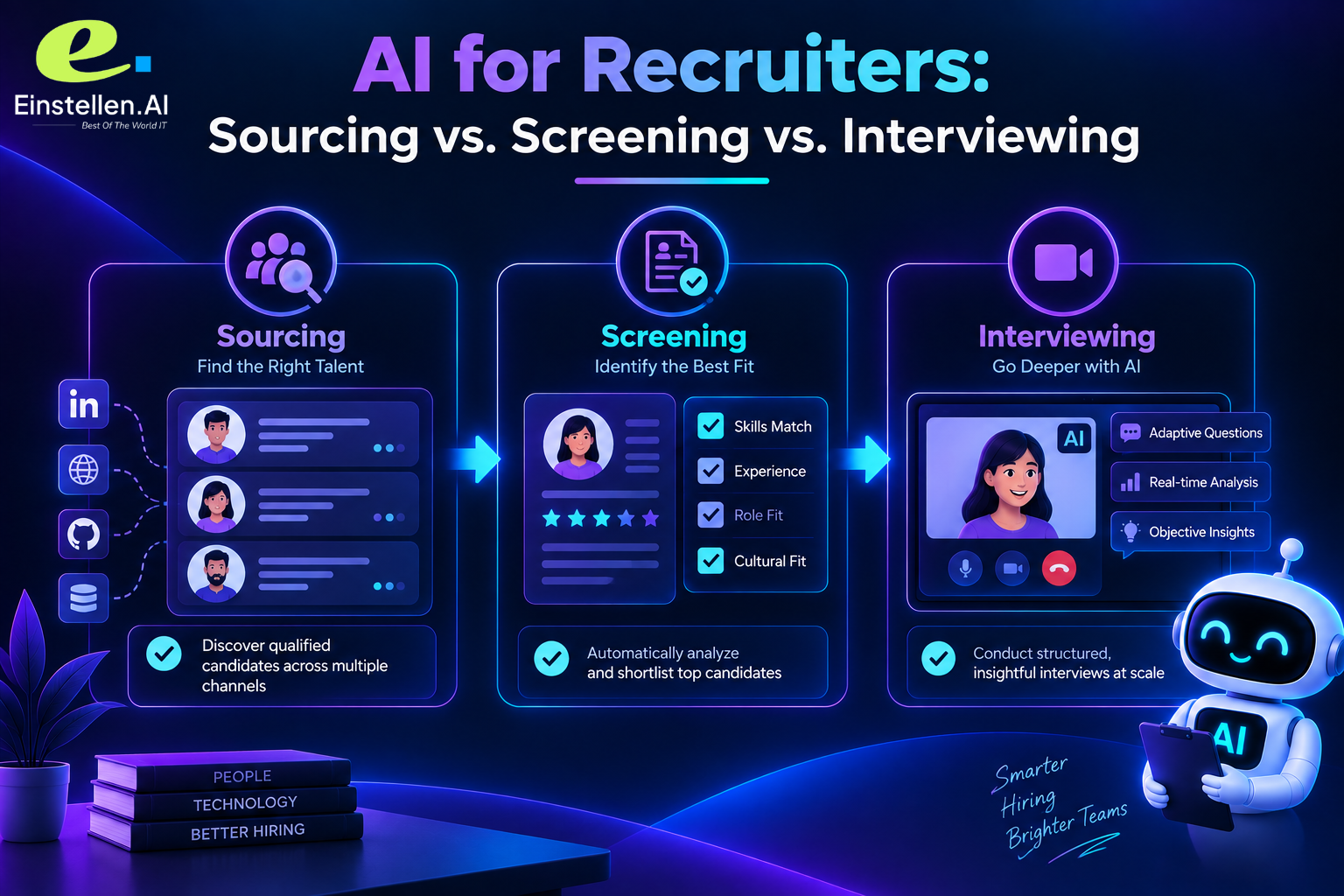
Recruiters conflate three distinct AI capabilities all the time, and vendors let them. Sourcing tools search and rank existing candidate databases. Screening tools filter resumes against a job description using keyword or semantic matching. Interview tools conduct or score live conversations. A platform that's strong at one is often weak, or completely absent, at another.
This distinction matters most at the interview stage, where most "AI interview" coverage treats the whole category like a monolith: candidate answers fixed questions on video, algorithm scores tone and word choice, done. That model hasn't changed in years for a lot of vendors. An adaptive approach works differently - it generates each follow-up question from what the candidate just said, digging deeper where the answer is thin and moving on where it's strong. Einstellen.AI's humAIn engine works this way, driven by the MAGIC OS model instead of a static script.
For employers, this changes what you're actually buying. A fixed-script tool tells you a candidate hit certain keywords. An adaptive tool tells you whether that candidate could defend their answer under a real follow-up - and that correlates far more closely with job performance than script adherence ever did.
Explainable Scoring: What It Actually Looks Like
Nearly every buyer's guide lists "explainable AI" as a checkbox criterion. Almost none show you what that looks like on screen. So here's the concrete version: a structured justification report that maps specific parts of a candidate's answer to specific parts of the score, so a hiring manager can see exactly which response drove which result.
That's a different thing entirely from a black-box ranking with a confidence percentage slapped on top. TA Heads bring up the same complaint again and again - scores from other AI interview platforms just don't correlate with how the candidate actually performs on the job. That's a complaint about missing explainability, not about AI interviewing as an idea. And the fix isn't a smarter algorithm. It's a report you can actually open, read, and defend in a hiring committee meeting without guessing at what the number means.
Before signing with any vendor, ask them to show you an actual sample score report - not a marketing screenshot. If they can't produce one that a non-technical hiring manager can read in under a minute, that's a disqualifying answer right there.
Read More: Automated Candidate Screening: Why Explainable Scores Beat Black-Box Rankings
Pricing: What AI Recruiting Software Actually Costs
Most vendor pricing pages hide the number completely and push you toward "contact sales," which usually means a per-seat annual contract sized for enterprise budgets. That works against small businesses and startups who just want to test a tool on a handful of real requisitions before committing a year of spend.
Einstellen.AI prices at a flat ₹249 per interview, pay-as-you-go, with no subscriptions, no contracts, no volume tiers. Credits don't expire either. If a tool isn't producing better hires, you just stop buying interviews instead of waiting out a contract term. That's the real answer to the "best AI recruiting tool for small businesses" question: look for usage-based pricing you can turn off, not an annual commitment you can't exit when the tool underperforms in month two.
Integration With Your Existing HR Systems
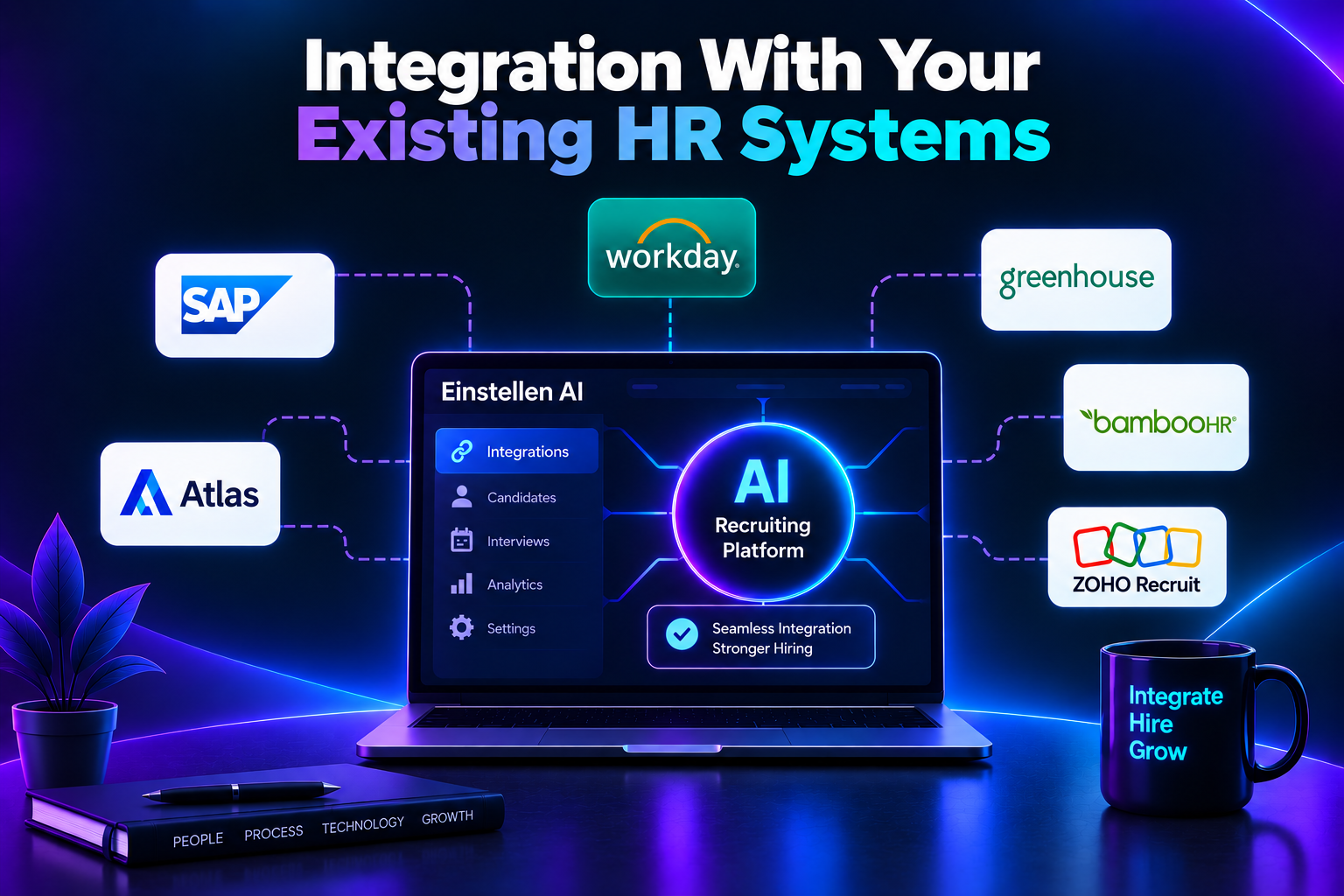
An AI recruiting tool that doesn't talk to your ATS creates double data entry and a second system nobody trusts. So ask any vendor two direct questions: does this integrate with the ATS you already run, and is that integration an extra cost or included?
Magic OS integrates with any ATS at no additional cost, including native, bi-directionally synced connections to Greenhouse, Lever, and Workday. A lot of vendors treat ATS integration as a premium add-on, and buyers have been conditioned to just accept that surcharge as normal. When you tell an HR Manager it's actually included, the usual reaction isn't mild interest - it's disbelief. That tells you how unusual a no-surcharge model still is in this market.
Read More: AI Hiring Platform Implementation Without Disrupting Your ATS
Comparing the Core Buying Criteria
| Criterion | What to Check | Why It Matters |
|---|---|---|
| Scoring explainability | Ask for a sample structured justification report | Scores without reasons don't hold up in hiring committee reviews |
| Interview format | Fixed script vs. adaptive follow-up questions | Adaptive questioning surfaces depth a script cannot |
| ATS integration | Included or billed as a surcharge | Surcharges add hidden cost and slow adoption |
| Pricing model | Per-seat contract vs. pay-as-you-go | Usage-based pricing limits risk if the tool underperforms |
| Vendor stability | Standalone product vs. absorbed into an HCM suite post-acquisition | Recent M\&A (Workday–Paradox, SAP–SmartRecruiters) has stranded buyers on discontinued tools |
Proof Point: Einstellen.AI has conducted 150,000+ AI interviews across 1,200+ institutions, backed by IIM Lucknow and NASSCOM. MediAssist's enterprise deployment on the platform produced 92.5% fewer screening interviews required, 15-day average fulfillment, 100% position closure rate, and 60% interview-to-deployment conversion; every score delivered with a structured justification report a hiring manager can read directly.
FAQ
What is AI recruiting software?
AI recruiting software automates parts of hiring: sourcing candidates, screening resumes, or conducting and scoring interviews. The category runs the gamut from simple database search tools to full adaptive interview engines. Coverage varies a lot, so confirm exactly which stage of hiring a given tool actually automates before you compare it to a different type of tool entirely.
Is AI recruitment fair? Does AI hiring reduce bias?
It really comes down to whether the tool explains its scoring. A ranking with no justification can't be audited for bias - that's the core complaint TA Heads raise about a lot of AI interview platforms. A structured justification report, on the other hand, lets a hiring manager see exactly which answer content drove the score, which makes bias much easier to spot and challenge.
How much does AI recruiting software cost?
Costs vary a lot, and plenty of vendors don't publish pricing publicly at all. Einstellen.AI charges a flat ₹249 per interview, pay-as-you-go, with no subscriptions, contracts, or volume tiers, and credits never expire. Compare any vendor's pricing model against one question: can you stop paying immediately if results disappoint?
Can AI recruiting tools integrate with my existing ATS?
Yes, when they're actually built for it. Magic OS integrates with any ATS at no additional cost, with native bi-directional sync confirmed for Greenhouse, Lever, and Workday. Always confirm integration is included in the base price rather than billed as a separate add-on - a lot of vendors still treat it as premium.
Ready to See an Explainable Score for Yourself?
Korn Ferry's 12th Annual Talent Acquisition Trends survey of 1,674 global talent leaders found that 52% plan to add autonomous AI agents to their recruiting teams in 2026, making explainable scoring a compliance and defensibility requirement, not just a feature. An AI recruiting tool is supposed to close that gap, not stack a black box on top of it.
Post your first role on Einstellen.AI and see a MAGIC OS model-structured justification report on a real candidate, at ₹249 per interview with no contract required. Explore how the adaptive interview engine and ATS integration work together end to end.





Leave a Comment
Share your perspective. Comments are moderated before publishing.