
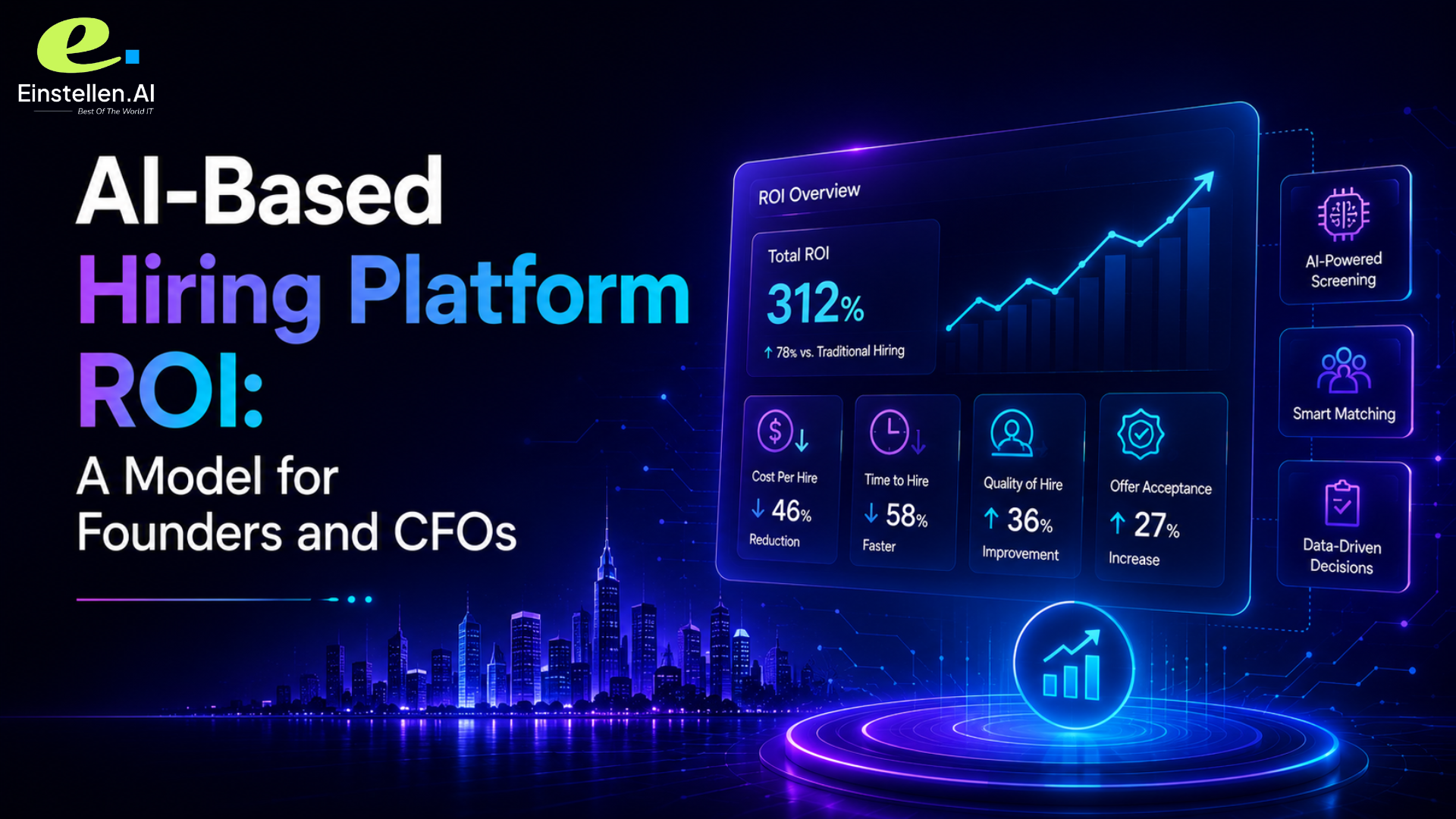
Quick Answer: AI-based hiring platform ROI is calculated as (cost savings from reduced time-to-hire + reduced mis-hire cost + recruiter hours reclaimed) minus (platform cost + implementation cost), divided by total cost. At Einstellen.AI's flat ₹249-per-interview model with no subscription, most employers see payback within a single hiring quarter, provable through a 90-day pilot rather than a year-long contract.
Here's the question a CFO actually asks, and it's rarely the one the sales deck prepares for: what happens to this ROI number if we only run 200 interviews this quarter instead of the 2,000 the vendor priced for? Most AI hiring platform contracts are built around annual subscriptions and volume commitments. That setup turns the ROI math into a guess that looks like a forecast. If you're a founder trying to build a real AI-based hiring platform ROI case, you need a model that holds up whether your hiring volume is high or low that quarter, not a spreadsheet that only works if the vendor's projection happens to be right.
This article walks through the actual formula, a cost-per-hire benchmark table, what AI recruiting implementation really costs in year one, and a 90-day pilot structure you can run before signing anything longer.
Recruiting ROI Formula Calculation
The formula itself isn't complicated. ROI= (Total Savings−Total Cost)÷Total Cost, expressed as a percentage. Where it gets messy is deciding what actually counts on each side.
Total Savings should include three things: reduced time-to-hire (recruiter hours saved times loaded recruiter cost per hour), reduced mis-hire cost (catching a bad hire before an offer instead of six months into salary and onboarding sunk cost), and recruiter hours reclaimed from manual first-round screening that an adaptive AI interview now handles instead.
Total Cost should include platform spend, any implementation or integration costs, and the training time required for a hiring team to actually trust and use the new scoring output. Leave any of these out and your ROI number will look better on paper than it performs in practice.
The variable most companies get wrong is mis-hire cost. A candidate ranking with no accessible reasoning behind it, which is the pattern across a lot of AI interview tools on the market, leaves hiring managers in a bad spot. They either override the score without knowing why, or they trust a number that turns out not to correlate with real job performance. Einstellen.AI's structured justification report exists for exactly this reason: a hiring manager looking at a borderline candidate can see which answer drove which part of the score, not just a final number. That's what makes the "reduced mis-hire cost" line in this formula something you can actually defend, not just hope for.
Read More: Where AI-based hiring platforms are headed in 2026
Cost Per Hire Benchmark 2026
Cost per hire is the number every recruiting ROI model needs, and it swings a lot depending on role seniority and city. A single blended industry average hides the product-vs-service-company gap that matters enormously in Indian tech hiring, so let's break it down by what you're actually trying to fill.
Take a Bangalore-based product company hiring a mid-level Software Engineer, 3-6 years of experience. That market runs ₹18-35L CTC for the band; illustrative CTC range, actual offers vary by company size, location, and experience. Every week that requisition sits open past the typical timeline, the effective cost per hire climbs, because recruiter hours, hiring manager interview time, and lost productivity from the empty seat all stack up together.
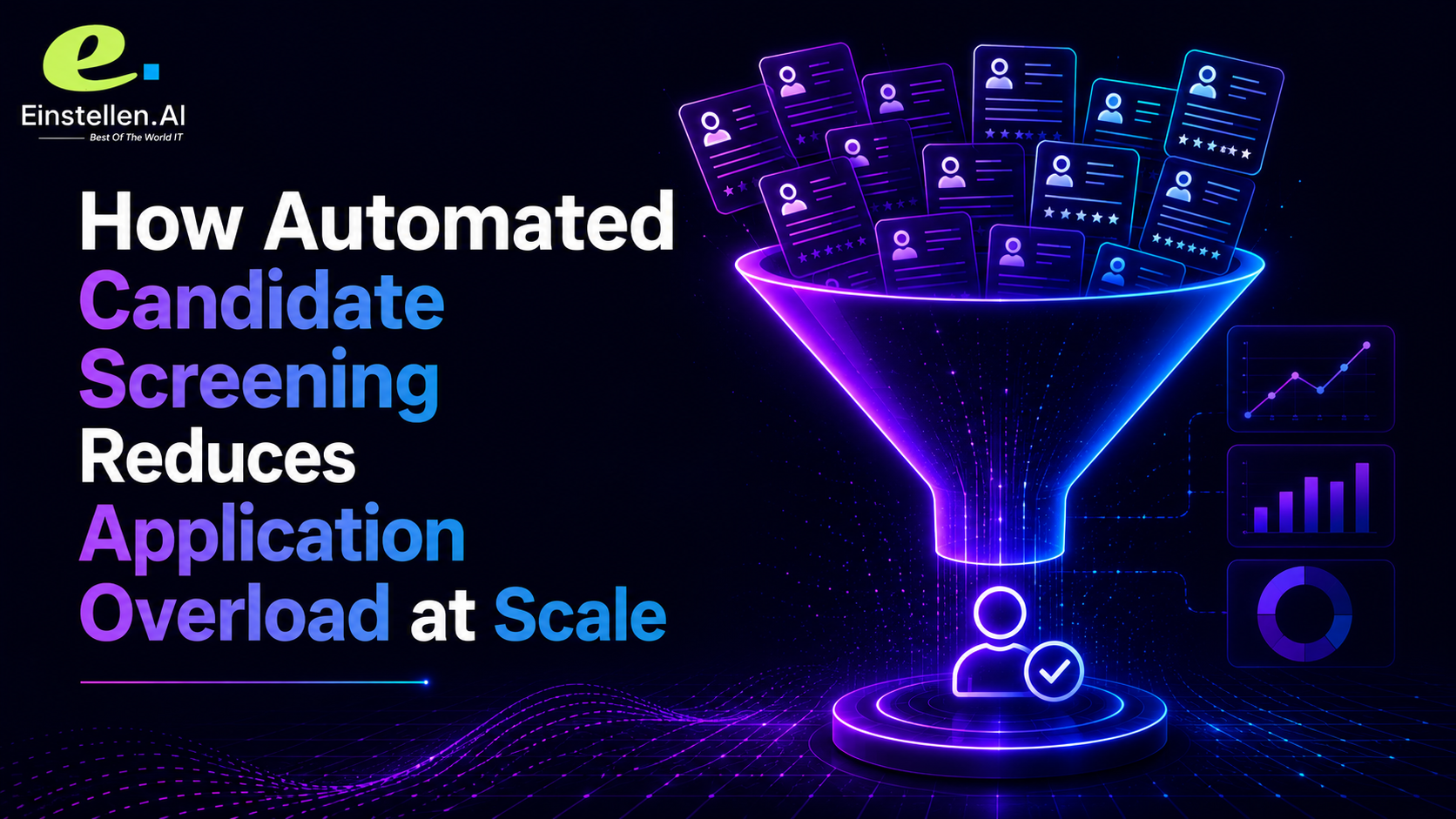
Where the AI interview layer actually changes the cost-per-hire equation is at the screening stage. Picture a recruiter facing 200 applications for one role, which is a routine headache in India's high-volume tech hiring market. Instead of manually screening all of them, an adaptive interview engine handles the first round and hands back scored, justified reports the recruiter reviews, rather than a stack of raw resumes. Cost per hire shifts away from recruiter hours burned on volume and toward hours spent on final-round judgment, which is where recruiter time is genuinely worth spending.
AI Recruiting Implementation Cost Year One
Year-one cost has two pieces that founders tend to mix up: the per-use platform cost, and the one-time implementation cost. Confusing the two is probably the single most common reason an ROI projection turns out wrong six months in.
Einstellen.AI's public pricing removes a lot of that uncertainty by design. It's a flat ₹249 per interview, pay-as-you-go, no subscription, no volume commitment, and it's the same price whether a client runs 1 interview or 10,000. Credits never expire. The full MAGIC Report, meaning video, transcript, skill scoring, and fraud detection, is included in that single price. No premium tier, no add-on charge.
The implementation cost most companies overlook entirely is ATS integration. Plenty of competitor platforms charge extra just to connect an AI interview tool to the applicant tracking system a company already runs, and that's a line item that quietly bloats year-one implementation budgets. Magic OS integrates with any ATS a company is already using, at no additional cost. For companies on Greenhouse, Lever, or Workday specifically, that integration is native and bi-directionally synced, so scores, transcripts, and reports flow straight into the existing candidate record. No retraining needed for the recruiting team's current workflow.
That one design choice, pricing ATS integration at zero, wipes out what's usually the largest hidden line item in a year-one AI recruiting budget.
90-Day ROI Pilot Recruiting AI
A 90-day pilot is the right unit of measurement here, not a 12-month contract, because it forces the model to prove itself against real hiring volume instead of a sales forecast.
Structure it around one open requisition category. Mid-level Software Engineers in Bangalore, say, or Data Engineers in Hyderabad. Run every candidate for that role through the AI interview engine for the full 90 days. Track three numbers weekly: interviews completed, average time from application to scored report, and the correlation between the AI-assigned scores and what the hiring manager concludes after a final-round assessment.
That third metric is the one that actually validates the whole ROI case. If the AI-generated score consistently tracks with the hiring manager's independent read after a human interview, the explainable scoring is doing real work. And if it doesn't track? The structured justification report still shows you exactly which answer drove the mismatch, which is diagnostic information a black-box score simply can't hand you.
Because there's no volume commitment in Einstellen.AI's pricing, a 90-day pilot at real hiring volume costs exactly what it costs per interview, ₹249 each, and nothing is owed if the pilot turns up something that needs fixing before you scale further.
Read More: How to implement an AI hiring platform without disrupting your ATS?
What This Looks Like in the Numbers
| Cost/Benefit Line | Traditional Manual Screening | AI-Based Hiring Platform (Einstellen.ai model) |
|---|---|---|
| Cost per interview/screen | Recruiter hourly cost × screening hours | Flat ₹249 per interview, all-inclusive |
| ATS integration cost | Often a separate paid add-on with competitor tools | Included at no additional cost, native for Greenhouse, Lever, Workday |
| Contract structure | Frequently annual, with volume minimums | Pay-as-you-go, no subscription, no contract, credits never expire |
| Scoring transparency | Recruiter judgment only, or opaque vendor score | Structured justification report with full transcript per candidate |
| Fraud/proxy risk at scale | Manual spot-checks, inconsistent | Built-in fraud and proxy detection on every interview |
Proof point: Einstellen.AI's public pricing page confirms a flat ₹249 per interview with no subscriptions, no contracts, no volume pricing tiers, and credits that never expire, with the full MAGIC Report included in every credit at no premium tier.
FAQ
How is AI hiring platform ROI different from traditional recruiting ROI?
Same basic structure, savings minus cost, divided by cost. What changes is what belongs in the savings line. Reduced mis-hire cost actually becomes measurable here, because the scores come with structured justification instead of an opaque ranking, so a hiring manager can check the score against real interview evidence instead of just trusting it.
Do I need a long contract to test an AI interview platform?
No. Einstellen.AI runs pay-as-you-go, no subscription, no contract, no volume commitment, which is exactly what a 90-day pilot needs. You pay ₹249 per interview and owe nothing beyond what you use. A pilot at real volume doesn't need a year-long commitment behind it to be worth running.
Does ATS integration add to the cost of an AI recruiting platform?
Not here. Magic OS integrates with any ATS a company already uses at no additional cost, and Greenhouse, Lever, and Workday are natively, bi-directionally synced with no retraining required for existing recruiter workflows. That removes a cost line that quietly inflates year-one budgets on platforms charging extra for integration.
How accurate is AI interview scoring for predicting job performance?
The more useful question for a CFO isn't accuracy; it's auditability. Every Einstellen.AI interview score comes with a structured justification report showing exactly which answer drove which part of the result. A hiring manager reviewing a borderline candidate sees the actual reasoning, not a number they're expected to trust without evidence.
Ready to Run the Numbers on Your Own Hiring Pipeline?
If you're building a business case for an AI-based hiring platform, the fastest way to validate it is a real pilot, not another spreadsheet built on vendor projections. Einstellen.AI's flat ₹249-per-interview pricing, zero-cost ATS integration, and structured justification reports mean you can test the ROI model against your actual open requisitions this quarter.
Post your first role and run a 90-day pilot on Einstellen.AI to see the explainable scoring and adaptive interview engine against your own hiring data before committing to anything larger.






Leave a Comment
Share your perspective. Comments are moderated before publishing.