
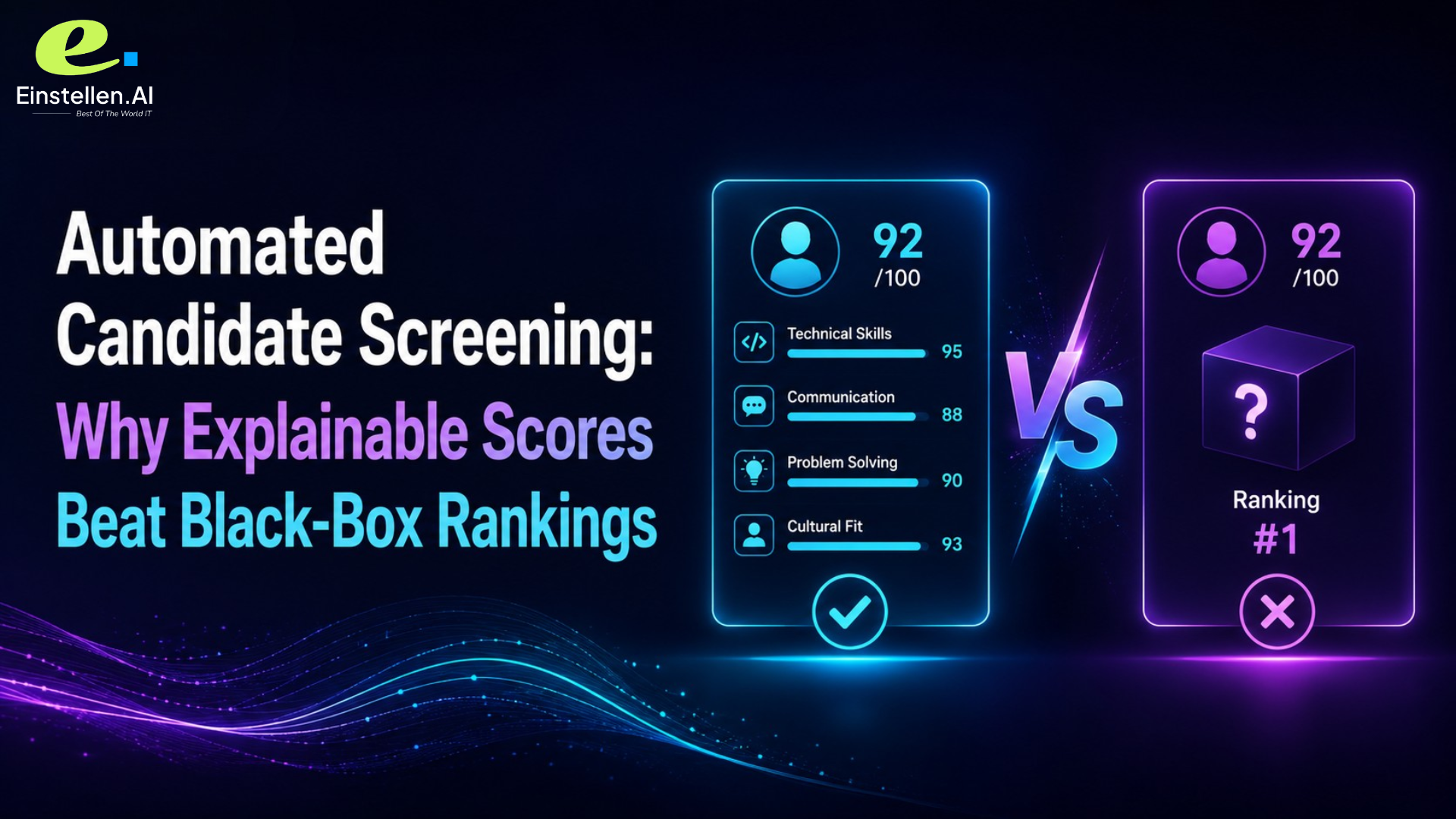
Quick Answer: Automated candidate screening works best when every score comes with a structured justification, not just a ranking. Explainable AI screening shows hiring managers which answers drove which part of a score, while adaptive questioning and fraud/proxy detection improve signal quality at scale. Black-box rankings without reasoning are the top complaint TA leaders raise about existing tools.
A Talent Acquisition head at a 300-person product company said something last month that we've heard, in one form or another, from dozens of hiring teams: their AI screening tool spat out a ranked list, and nobody could explain why candidate A beat candidate B. Half the time, the rejected candidates looked stronger on paper. The tool gave them a number. It didn't give them a reason.
That's really the whole problem with automated candidate screening as it's practiced today. Companies aren't skeptical of AI interviewing as an idea. They've just been burned by rankings that don't come with any accessible logic, and that often don't line up with how someone actually performs once they're hired. Closing that gap matters far more than piling on more automation. That's the line between a screening system that's genuinely useful and one that just rejects the wrong people faster.
AI Candidate Screening: What "Automated" Actually Means
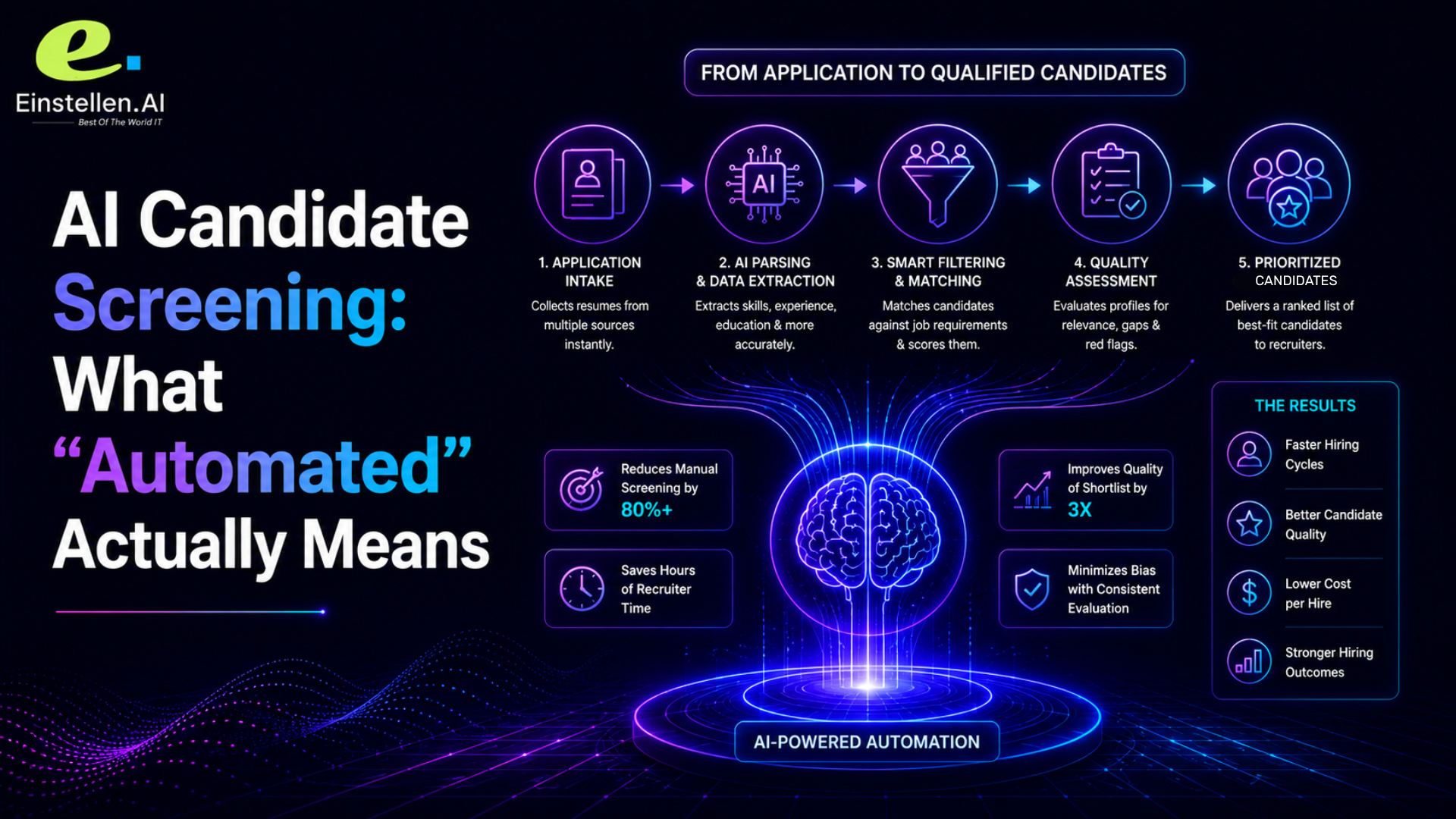
AI Candidate Screening What Automated Actually Means AI Candidate Screening What Automated Actually Means AI Candidate Screening What Automated Actually Means "Automated candidate screening" is used as an umbrella term for everything from resume keyword filters to full AI-driven video interviews. The label tells you almost nothing. What matters is the mechanism underneath it. A basic tool runs static rules, years of experience, keyword matches, and degree checks. It filters. It doesn't evaluate how someone actually thinks or communicates.
A more advanced system, like the interview engine behind Magic OS, runs an actual adaptive conversation. It listens to what a candidate says and builds the next question off that specific answer, instead of marching through a fixed script no matter what comes back. Say a candidate gives a vague answer about a project they worked on. The system doesn't shrug and move to the next scripted item; it probes deeper into that exact project.
That's the real difference between a checklist and an interview. A checklist-style tool asks every candidate the same five questions regardless of what they say. An adaptive system produces something closer to what a sharp human interviewer would pull out of a conversation because it goes deeper exactly where the answer reveals something worth exploring.
Explainable AI Hiring: The Core Differentiator
Most AI interview platforms on the market hand back a score or a ranking with no structured, reviewable justification behind it. A hiring manager sees a number. They don't see which answer produced it, or why.
Explainable AI hiring turns that around. Every interview run through Einstellen.AI's MAGIC OS model comes with a per-answer scored report and a full transcript, so if someone is reviewing a borderline candidate, they can see exactly which response drove which part of the score. That's a structured justification. Not a confidence interval bolted onto a mystery number.
This matters most at the margins, where it's easy to get wrong. Two candidates within a few points of each other are exactly the case where a hiring manager needs to understand the reasoning, not just take it on faith. A score without that justification isn't AI-powered hiring at all. It's a black box with a number stapled to it, and TA leaders are saying this out loud now, in sales calls and on industry forums alike, a pattern that lines up with the World Economic Forum's own findings on AI transparency in hiring decisions.
Recruitment Screening Automation at Scale: Where Fraud and Proxy Detection Matter
Recruitment screening automation earns its keep and carries its biggest risk at high volume. Think campus placement drives or bulk enterprise hiring rounds where hundreds or even thousands of interviews get run in a tight window. At that scale, nobody's manually reviewing every candidate. And wherever manual review disappears, the temptation to game the system creeps up.
That's exactly why fraud and proxy detection need to live inside the interview process itself, not sit off to the side as an optional extra. Einstellen.AI builds this into the interview flow directly, which matters most for the high-volume cases: campus placements across large institutional networks, bulk enterprise screening rounds, situations where one bad actor slipping through can distort the whole pipeline.
We keep the specific detection mechanism vague in public materials on purpose. Publish the exact logic, and you've just handed bad actors a blueprint for beating it, which defeats the point entirely. What a hiring manager evaluating a screening tool actually needs to confirm is simpler: does proxy detection live inside the interview itself, or is it a manual verification step someone bolted on afterward?

Talent Acquisition Automation Without a Black Box
Talent acquisition automation is only trustworthy if a hiring manager can turn around and defend a rejection to a candidate, a manager, or an auditor. An integration checklist doesn't get you there. You need an audit trail: what was asked, what was answered, and why that specific score came out the other end.
It should also plug into whatever tools a company is already paying for, without a surcharge tacked on. Magic OS integrates with any ATS a company already runs, with Greenhouse, Lever, and Workday named specifically as native, bi-directionally synced examples. Scores, transcripts, and reports flow straight into the existing candidate record. No retraining recruiters on a new workflow.
Charging extra for this kind of integration has somehow become the industry norm, and prospects genuinely look surprised when we tell them it's included by default rather than priced as an add-on. Honestly, that reaction says more about how low the bar has gotten elsewhere than anything else.
Hiring Bias Detection and Adaptive Interviews
Static, checklist-style AI interviews have a hidden bias problem built in: they reward whoever happened to prepare for the exact five questions on the script, regardless of whether they're actually good at the job. An adaptive interview cuts this risk down because it responds to what a candidate actually says, not to whether they guessed the question order in advance.
Hiring bias detection only works well when it's paired with explainability, because you can't fix a biased outcome unless you can see the reasoning that produced it in the first place. A ranking with no visible logic can't really be audited for bias; there's nothing to point at. A structured justification report, on the other hand, can be reviewed, challenged, and corrected if something looks off.
That's the practical case for adaptive, agentic interviewing over fixed-script AI tools: better signal, plus a reviewable trail that actually supports fairness instead of just claiming it.
| Metric | Figure |
|---|---|
| AI interviews conducted on Einstellen.AI | 150,000+ |
| Institutions using the platform | 1,200+ |
| Institutional backing | IIM Lucknow, NASSCOM |
| Interview pricing model | Flat ₹249 per interview, pay-as-you-go, no volume tiers |
| Native ATS integrations named publicly | Greenhouse, Lever, Workday |
Proof Point: Einstellen.AI has conducted 150,000+ AI interviews across 1,200+ institutions, backed by IIM Lucknow and NASSCOM. MediAssist's enterprise deployment on the platform produced 92.5% fewer screening interviews required, 15-day average fulfillment, 100% position closure rate, and 60% interview-to-deployment conversion; every score was delivered with a structured justification report so hiring managers could defend every shortlisting decision with documented evidence.
FAQ
How is scoring calculated in automated candidate screening?
Einstellen.AI's scoring runs on the MAGIC model, which produces a structured, justified score rather than an unexplained number. Every score comes with a report showing which specific parts of a candidate's answers drove which part of the result, so a hiring manager can trace the reasoning instead of just accepting a raw figure.
Can candidates cheat an automated AI interview?
The platform includes fraud and proxy detection within the interview process itself, which matters most for high-volume use cases like campus placements and bulk enterprise hiring rounds. We keep the exact detection mechanism general in public materials on purpose, so it can't easily be circumvented.
How is this different from a black-box AI screening tool?
Most competing platforms hand back a candidate ranking with no accessible reasoning behind it. Einstellen.AI's structured justification report shows exactly what was asked, what was answered, and why a particular score resulted, and the interview engine adapts to each answer instead of running through a fixed script.
Does automated screening integrate with our existing ATS?
Yes. Magic OS integrates with any ATS a company already uses, at no additional cost. Greenhouse, Lever, and Workday are publicly named as native, bi-directionally synced integrations, with scores and transcripts flowing directly into the existing candidate record.
Ready to Screen Candidates Without the Black Box?
If your hiring team keeps reviewing rankings, it can't explain to candidates or its own leadership that more automation isn't the fix. Automation that shows its work. Einstellen.AI's adaptive interview engine and structured justification reports give hiring managers a defensible reason behind every score, integrated with the ATS you're already running.
Post your role on Einstellen.AI and see a scored, justified candidate report instead of a raw ranking.








Leave a Comment
Share your perspective. Comments are moderated before publishing.