
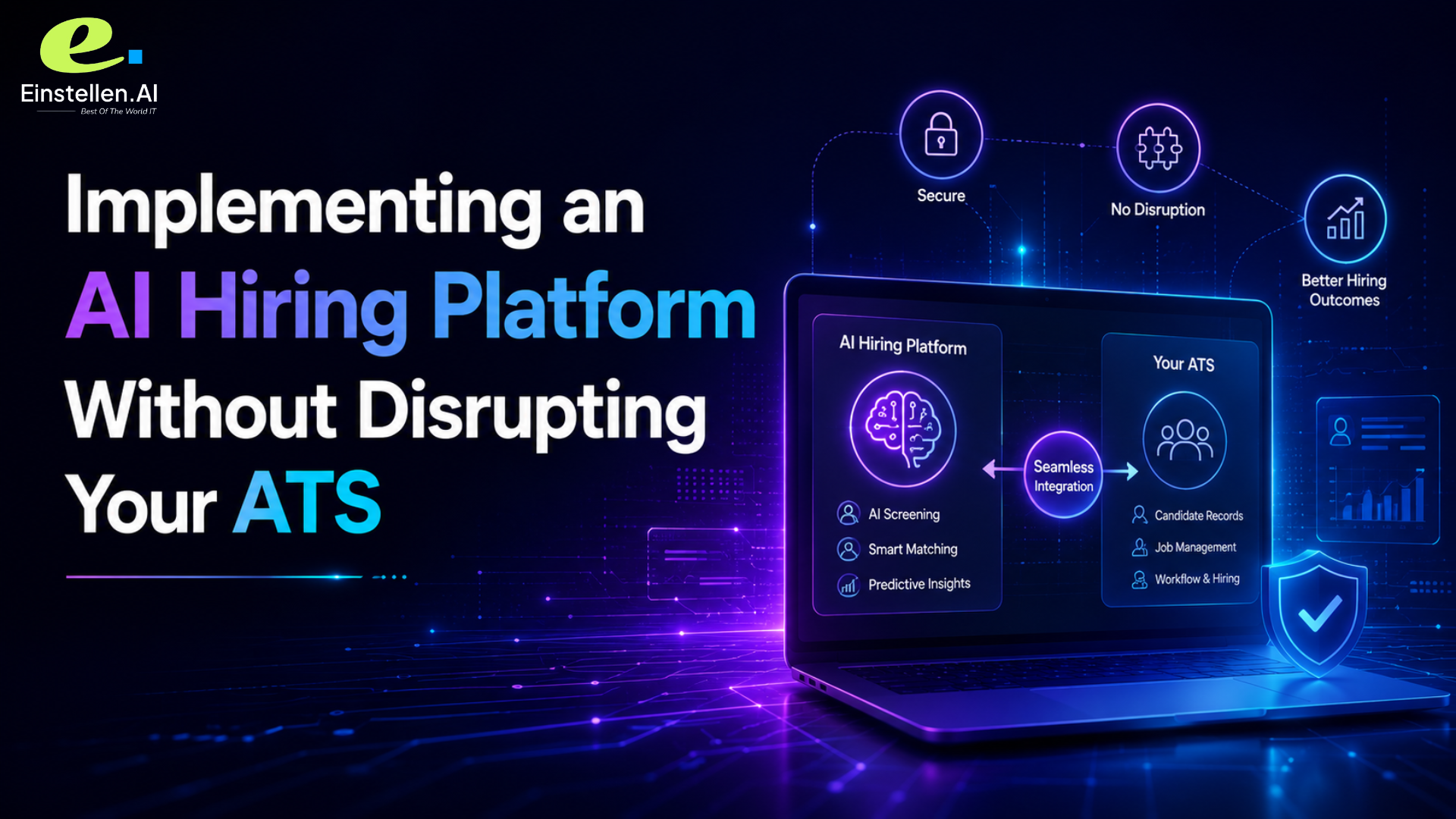
Quick Answer: Implementing an AI hiring platform without disrupting your ATS means treating the ATS as the system of record and the AI layer as a sourcing and screening add-on, synced through native integrations. Pilot on one requisition first. Einstellen.AI integrates with Greenhouse, Lever, Workday, or any existing ATS at no added cost, at ₹249 per interview, no contract required.
Your ATS is holding three years of candidate history, req approvals, and offer letters. It's the last place a TA head wants to introduce risk. So the fear is obvious: what if this new AI tool just creates a second, disconnected database of candidates that nobody trusts? That single worry is probably the biggest reason AI hiring platform rollouts stall at the pilot stage, or quietly die after one messy launch.
Here's the good news. This is a solved problem, as long as you sequence it right. The AI layer sits on top of your ATS. It doesn't replace it. Below is what that actually looks like day to day, where it tends to go wrong, and how to test the whole thing on a single requisition before you commit to anything wider.
Native ATS Marketplace Integration vs. Manual Workarounds
Most AI recruiting tools fall into one of two camps: a native marketplace connector, or manual CSV exports that someone on your TA team has to babysit every week. Native integration means the AI platform and your ATS trade candidate records, scores, and pipeline stage automatically, in both directions, with nobody re-keying anything.
Magic OS, the platform behind Einstellen.AI, integrates natively with Greenhouse, Lever, and Workday. It's bi-directionally synced, and scores, transcripts, and reports flow straight into the existing candidate record. Recruiters already working inside those systems don't need to relearn anything. Beyond those three named platforms, Magic OS also connects with any ATS an enterprise happens to be running already, at no extra cost.
That last part matters more than it sounds. Charging extra for ATS integration has become so normal in this category that when companies hear it's included free, the reaction is usually disbelief, not mild interest. We see that pattern come up again and again in conversations with TA leaders. And honestly, a tool that needs manual export and import work isn't really "integrated" at all. It's just a second system your recruiters now have to reconcile by hand.
Read More: AI-Based Hiring Platform Data Security: What Enterprises Must Verify
API and Webhook Sync: What Actually Needs to Flow Both Ways
A shallow AI integration only ever sees new applicants coming in. It has no visibility into req status changes, pipeline movement, or the candidate history already sitting in your ATS. The result is duplicated data entry and a siloed candidate record the moment anything changes on either side.
A proper sync has to move both ways: candidate profile and interview report from the AI platform into the ATS, and req status, pipeline stage, and disposition from the ATS back to the AI platform. Einstellen.AI's integration with Greenhouse, Lever, and Workday is built exactly this way. A recruiter working a requisition in their normal ATS view sees the AI interview score and full transcript sitting right inside the candidate record they already use. Not tucked into some separate tab they have to remember to open.
This is where explainability actually earns its keep, and not just as a nice trust story. When a hiring manager opens a candidate record inside the ATS and sees a score, the structured justification report behind it shows exactly which answer drove which part of that result. Compare that to a sync that just pushes a number into a custom field with no reasoning attached. Not the same thing at all.
AI Hiring Platform as Sourcing Layer: Keeping the ATS as System of Record
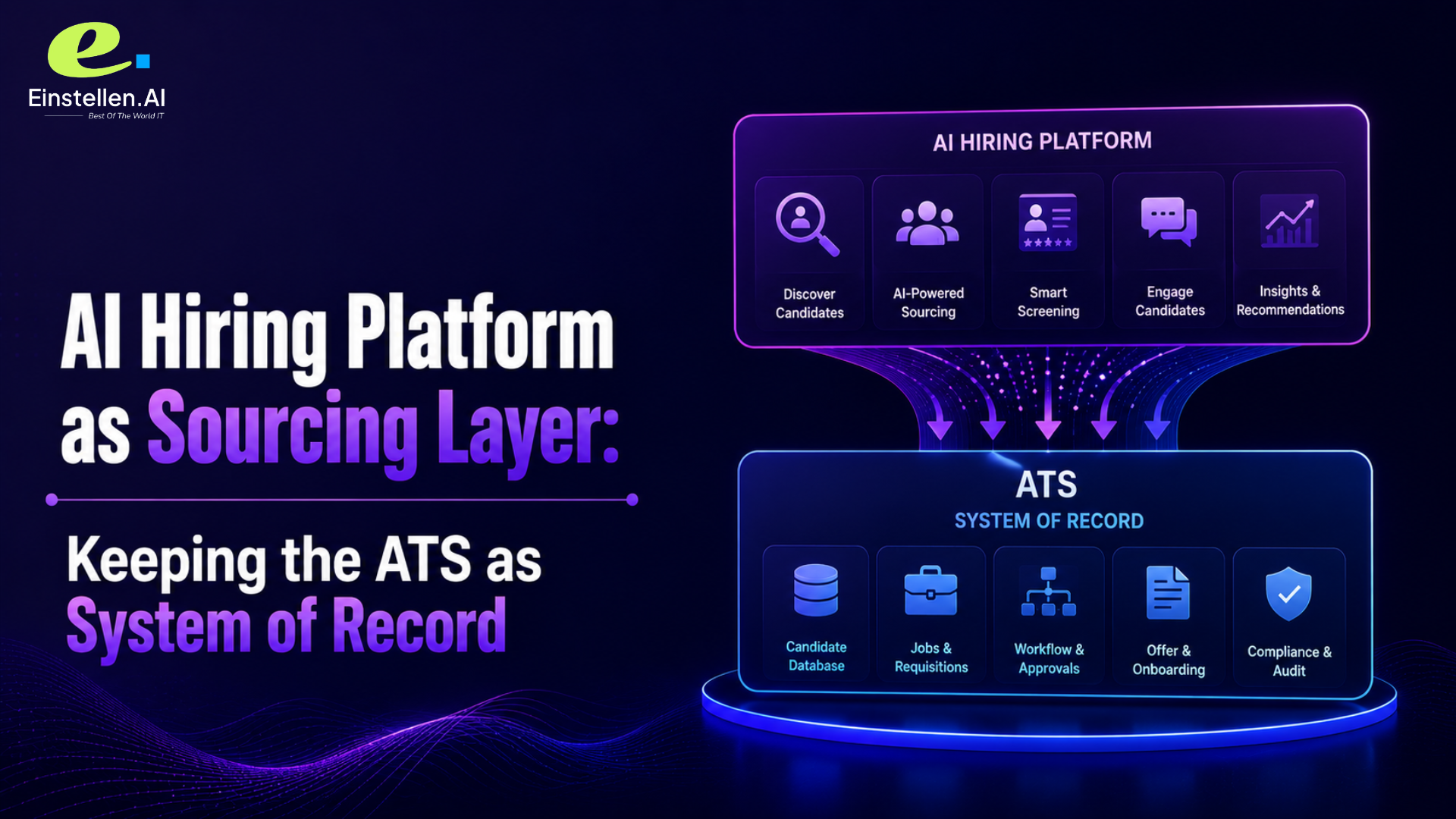
Most implementation headaches come down to one thing: confusion about what each system is actually for. The ATS stays the system of record. It owns the requisition, the offer, the compliance trail, and the long-term candidate history. The AI hiring platform is a sourcing and screening layer sitting on top of that, adding a curated pool of active candidates and an adaptive interview step your ATS was never built to run on its own.
Treating the AI platform like a replacement for the ATS, instead of a layer that feeds it, is the most common mistake we see. It creates two sources of truth, and now recruiters are checking two places for the same answer. Treat it as a layer instead, and the ATS keeps doing what it already does well, while the AI platform adds a curated, active candidate pool plus an adaptive interview engine that digs deeper on a vague answer rather than plowing through a fixed five-question script no matter what the candidate says.
That's also why a growing number of ATS platforms are adding AI functionality or connecting to it, rather than getting swapped out entirely. AI adoption in ATS platforms has accelerated sharply, SHRM's 2025 Talent Trends survey found recruitment remains the primary AI use case across HR functions, with teams reporting meaningful time-to-hire reductions when AI screening layers integrate cleanly with existing workflows.The AI is additive infrastructure here. It's not a rip-and-replace decision, and treating it like one is where teams get stuck.
Pilot Testing on One Requisition Before Full Rollout
Enterprise AI recruiting rollouts usually start the same way: an admin installs an app, reviews OAuth scopes, accepts the default field mappings, runs a short sync validation window, and only then lets it touch a live requisition. Fine for a large, multi-team deployment. Overkill if all you want to know is whether the AI interview scores are actually any good.
Einstellen.AI's pricing removes that friction for a pilot. The public rate is a flat ₹249 per interview, pay-per-use, no subscription, no contract, no volume commitment. Same price whether you run one interview or ten thousand. That means a hiring manager can run a full pilot on a single open requisition, look at the structured justification report for every candidate who came through it, and decide for themselves whether the scores line up with who they'd have hired anyway. All before anyone has the "should we roll this out company-wide" conversation.
This directly addresses something we hear a lot: TA heads describing AI interview tools where the ranking just didn't match actual job performance, and no way to see why a candidate scored the way they did. A one-requisition pilot, with a full transcript and justification report attached to every score, is the fastest way to test that concern yourself rather than taking a vendor's word for it.
Read More: 5 AI Hiring Platform Red Flags Enterprise TA Heads Keep Finding
Where Implementations Typically Break Down
Failed AI-ATS rollouts tend to come from a small handful of causes. Implementation failures in recruiting technology are well-documented, mismatched field mapping, poor change management, and choosing tools without piloting on a live requisition first account for most of them. The same risk shows up when you layer an AI platform on top: skipping the pilot step, mapping fields wrong at setup, or picking a tool with only shallow, one-way sync. Those three account for most of the failures we've seen or heard about.
Volume is part of why this matters right now, too. Recruiting teams are managing significantly more volume than they were five years ago, more open roles, more applications per role, and in many cases with leaner headcount than before. A screening layer that doesn't sync cleanly adds manual reconciliation work at exactly the moment teams have the least capacity to absorb it.
| Integration Pattern | Setup Speed | Data Flow | Risk if Done Wrong |
|---|---|---|---|
| Manual CSV export/import | Days to weeks, recurring effort | One-way, manual | Duplicate records, stale data |
| API/webhook custom build | 1-3 weeks | Bi-directional, engineering-dependent | Breaks on ATS updates without maintenance |
| Native marketplace connector (Greenhouse, Lever, Workday) | Same day to a few days | Bi-directional, automatic | Low, if vendor maintains the connector |
| Pilot on single requisition, pay-per-use | Same day | Bi-directional via native connector | Minimal — limited to one req before wider rollout |
Proof point: Einstellen.AI has conducted 30,000+ AI interviews across 1,200+ institutions, backed by IIM Lucknow and NASSCOM. Magic OS integrates natively with Greenhouse, Lever, and Workday, bi-directionally synced, no retraining required, and with any other ATS at no additional cost.
FAQ
How long does it take to implement an AI hiring platform with an existing ATS?
With a native marketplace connector, like the ones Einstellen.AI maintains for Greenhouse, Lever, and Workday, setup can happen the same day. Scores and transcripts start flowing into the existing candidate record right away. You can even start a pilot on one requisition without going through any broader procurement process, since there's no contract or subscription needed to begin.
Will an AI recruiting tool disrupt or duplicate data in my current ATS?
Not if the integration actually runs both ways. Shallow integrations that only see new applicants create duplicated work and siloed candidate data, which is exactly what you're trying to avoid. Einstellen.AI's native connectors sync candidate records, scores, and transcripts directly into the existing ATS record, so recruiters keep working from one place instead of reconciling two.
What's the difference between an AI hiring platform and an ATS?
The ATS is your system of record. It owns requisitions, offers, and long-term candidate history. An AI hiring platform is a sourcing and screening layer sitting on top of it, adding a curated pool of active candidates and an adaptive interview step. Einstellen.AI is built to feed that layer into your ATS, not replace it.
Can I pilot an AI hiring tool on just one requisition before rolling it out company-wide?
Yes, and it's honestly the smart way to do it. Einstellen.AI's public pricing is a flat ₹249 per interview, pay-per-use, no subscription, no volume commitment. So you can test the platform on a single open requisition, go through the structured justification reports for every candidate, and only then decide on a wider rollout.
Post Your Role and Test the Integration Yourself
If your ATS already runs on Greenhouse, Lever, or Workday, Einstellen.AI's native connectors mean there's no separate system to babysit and no OAuth review cycle to schedule before you see real results. Post one open requisition on an AI hiring platform built around explainable scoring, run the adaptive AI interview on real candidates, and look at the structured justification report behind every score before you decide on anything company-wide.
Post your role on Einstellen.AI and reach a curated, active candidate pool with explainable AI interview scoring built in, at ₹249 per interview, no contract required.






Leave a Comment
Share your perspective. Comments are moderated before publishing.