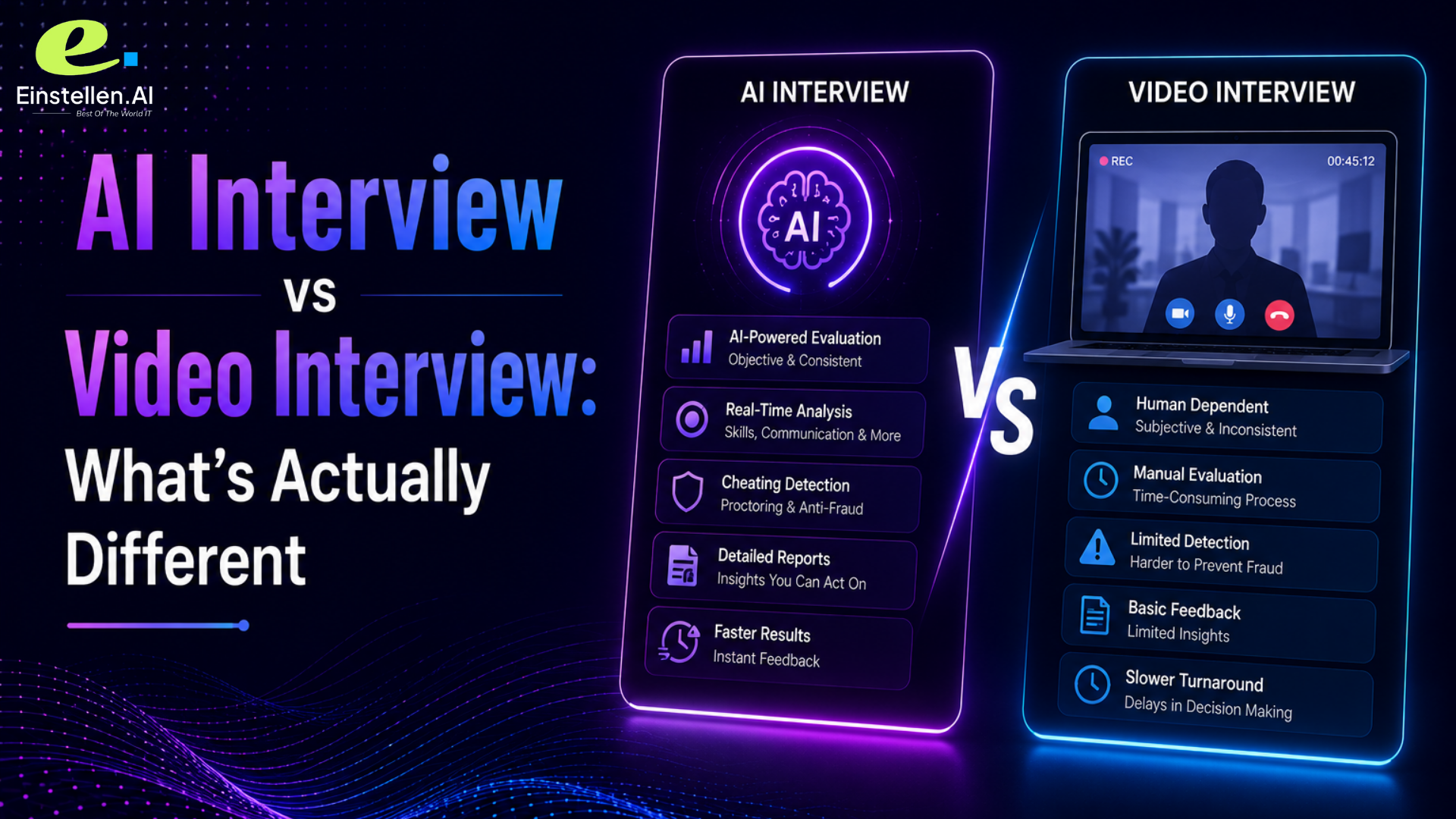
Quick Answer: A video interview digitizes the conversation; a human still watches and scores it. An AI interview automates the assessment itself. The real difference isn't the camera. It's whether the questioning is fixed (one-way video) or adaptive, with a structured, explainable score instead of a reviewer's subjective notes.
Picture a candidate finishing five preset questions on a one-way video platform. She hits submit and waits. Nobody adjusted a single question based on what she actually said. A recruiter somewhere will watch the clip later, maybe skim it at 1.5x speed, and jot down a gut-feel rating before moving to the next file in the queue.
That's the experience most people actually mean when they say "AI interview" - but it usually isn't one. It's a video interview with a scheduling layer bolted on top. The phrase "AI interview vs video interview" gets thrown around loosely online, and that confusion costs both hiring teams and candidates real signal quality. So let's draw the actual line: what changes when AI is doing the assessment, not just hosting the recording.
AI Interview Meaning: What Actually Changes
A video interview is a communication format, nothing more. A candidate records or streams responses, and evaluation happens afterward, usually by a human, sometimes with AI-assisted flags layered on top. The format itself doesn't ask a smarter follow-up question or produce a structured score. It's still just a recording waiting for someone to interpret it.
An AI interview means the AI conducts and scores the conversation itself. On Einstellen.AI's platform, the humAIn engine runs the interview using autonomous, adaptive questioning: it listens to what a candidate actually says and generates the next question based on that answer, rather than stepping through a fixed list no matter the response. The output isn't a video file for someone to sit through later. It's a per-answer scored report with a full transcript, showing exactly what was asked, what was answered, and why a given score was assigned.
That's the meaningful split. One is a container for a human decision. The other is the decision-making process itself, made visible.
Fixed-Script vs Adaptive Interview: Why the Difference Matters
A fixed-script AI interview, or a one-way video screen, asks the same set of questions no matter how a candidate answers the first one. Give a vague answer about a specific project, and the format moves on to the next scripted item anyway. Nothing digs deeper. Nothing notices.
An adaptive interview does the opposite. If a candidate's answer about a project is thin on detail, the system probes that specific project further instead of jumping to something unrelated. This is the literal mechanism behind "agentic" interviewing, not just marketing language: the next question is generated from the last answer, not pulled from a pre-written list.
The practical effect shows up in signal quality. A checklist-style interview extracts whatever the candidate happens to volunteer in a fixed window. An adaptive interview extracts what a skilled human interviewer would have chased down anyway - at scale, across every candidate, not just the ones a busy recruiter had time to probe personally. For high-volume enterprise hiring rounds, that consistency is the difference between a screening step and an actual evaluation step.
How Does an AI Interview Work: The Actual Process
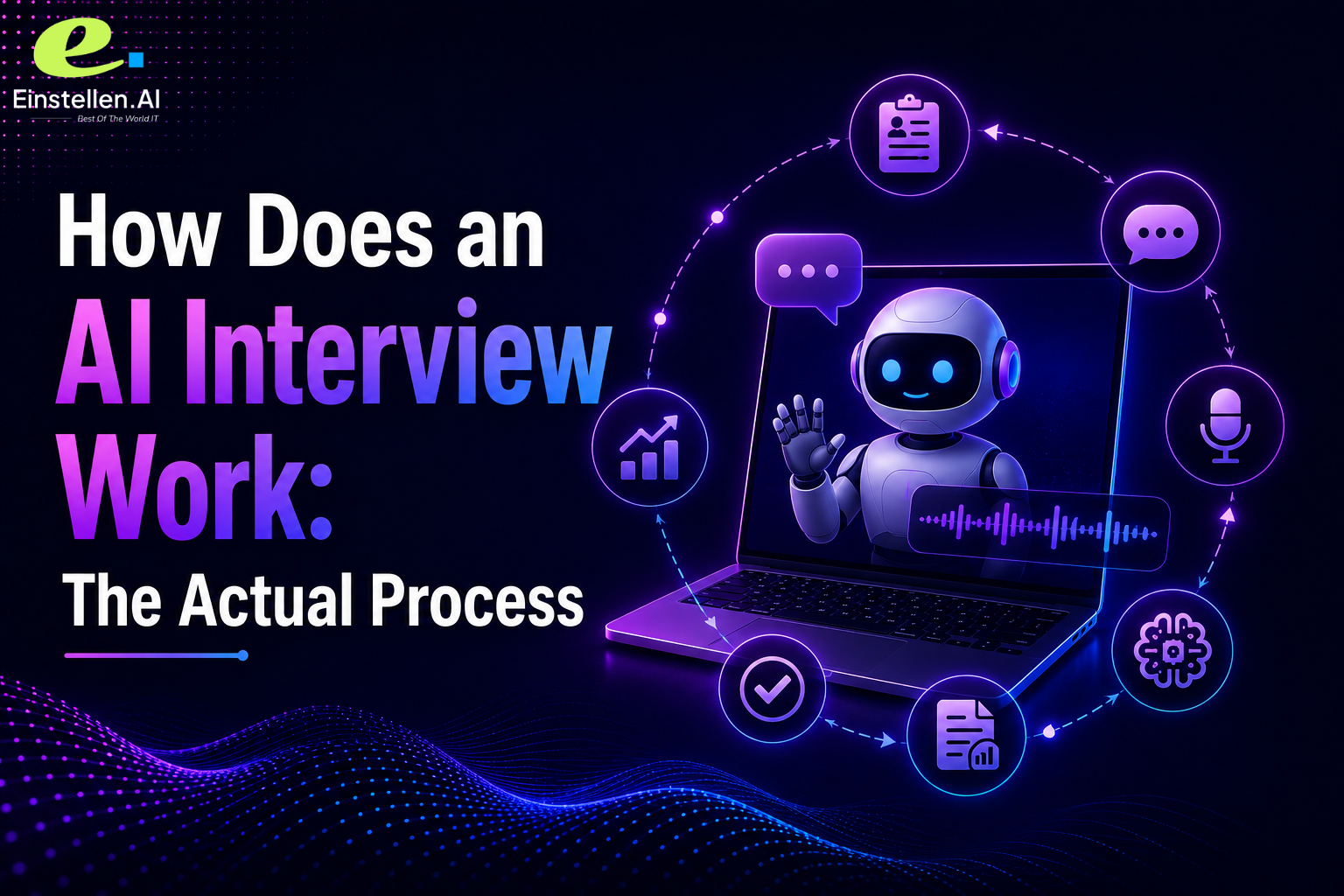
It starts when a candidate is invited into a screening round. The adaptive engine conducts the conversation in real time, asking follow-ups based on actual answers rather than running a static checklist. Underneath, the MAGIC model evaluates each response and produces a structured, justified score - not a single opaque number dropped at the end.
Fraud and proxy detection runs during the interview itself, which matters a lot for high-volume use cases like campus placement drives and bulk enterprise hiring rounds. Identity verification at that scale is a real operational headache, not some hypothetical edge case.
Once the interview ends, the hiring manager doesn't get handed a video file to sit through. They get a full transcript and a per-answer report showing which response drove which part of the score. That's the "what happens in an AI interview" answer most vendor content conveniently skips: the assessment is visible and reviewable, not just automated.
Explainability: The Gap Most Comparison Content Skips
Search results comparing AI interviews to video interviews keep repeating the same tired framing: AI "reduces bias" or "structures the assessment." Almost none explain how the scoring logic actually gets shown to anyone. That's a real gap, not a minor omission. Candidates and hiring managers both have legitimate reasons to want to see the reasoning, not just take it on faith.
Research backs this up directly. A ScienceDirect study found that human-in-the-loop decision-making is perceived as fairer than AI-only decisions, and that candidates with higher AI literacy consistently report more positive perceptions of fairness. Visibility into the process, not just its automation, is what actually changes how people experience the outcome.
This is where a structured justification report earns its place. It shows a hiring manager reviewing a borderline candidate the actual reasoning behind the score, not just a ranked list. That's a fundamentally different artifact than a one-way video recording a recruiter half-watched at double speed on a Friday afternoon.
Bias, Trust, and the Candidate Experience Problem
Adoption is already outrunning trust. Roughly 43% of companies have adopted AI somewhere in their hiring process, while 66% of candidates say they'd avoid employers who use AI in hiring decisions, per Pew Research. That gap is a trust problem. It is not an automation problem.
One-way video interviews carry their own version of this issue. Aggregated candidate sentiment from G2 and Reddit threads describes the format as "dehumanizing" or like "talking to the void." Nobody responds. Nothing adapts. The candidate has no idea whether a five-minute pause before answering just cost them the job.
 An adaptive, explainable interview addresses both complaints at once. The conversation responds to what the candidate actually says, which feels a lot less like performing for a camera, and the resulting report gives a defensible reason for the score instead of a black-box number.
Comparing the Two Formats
| Dimension | One-Way Video Interview | AI Interview (Adaptive) |
|---|---|---|
| Who evaluates | Human reviewer watches later | AI conducts and scores in real time |
| Question flow | Fixed script, same for every candidate | Adapts to each answer |
| Output | Video recording | Per-answer scored report + full transcript |
| Fraud detection | Rarely built in | Built into the interview process |
| Scalability for bulk hiring | Limited by reviewer time | Consistent at any volume |
Proof point: A preprint study published on arXiv (Bhattacharya & Verbert, May 2025) found that participants rated a multi-agent explainable hiring system as 40% fairer than conventional recruitment methods in a qualitative user study with 20 active job seekers. Note: this is a preprint — not yet peer-reviewed. Einstellen.AI has conducted 150,000+ AI interviews across 1,200+ institutions, with every score delivered as a structured justification report rather than an unexplained ranking, the same explainability principle the arXiv research identifies as the driver of candidate trust.
FAQ
What's the actual difference between an AI interview and a video interview?
A video interview is a recording format, evaluated afterward by a human. An AI interview means the AI conducts the conversation and scores it directly, using adaptive questioning and a structured justification report rather than a static clip waiting for someone to review it.
Are AI interviews the same as one-way video interviews?
No. One-way video interviews run a fixed script no matter how a candidate answers. A true AI interview, like Einstellen.AI's humAIn engine, listens to each answer and generates the next question based on what was actually said, producing a deeper, more consistent signal.
Do AI interviews replace human interviewers or assist them?
They handle the initial screening and structured evaluation, which frees up hiring managers to spend their time on shortlisted candidates instead. Einstellen.AI's reports provide hiring managers with full transcripts and per-answer justifications, so the human decision-maker can still review the actual reasoning before making a call.
Can candidates see or challenge how an AI interview scored them?
On Einstellen.AI, every score comes paired with a structured justification report showing exactly what was asked, what was answered, and which parts of the response drove the result. That's a direct counter to black-box platforms that spit out a ranking with no accessible reasoning behind it.
Ready to Hire With a Process You Can Actually Explain?
If your team is choosing between a one-way video screen and a real AI interview, the decision should come down to one question: can you explain a score to a candidate or a hiring manager, or can you only generate one? Einstellen.AI's adaptive interview engine and structured justification reports are built for exactly that.
Post your next role and see how a per-answer scored report changes borderline hiring decisions. At ₹249 per interview, flat! No subscription, no demo required, no contract. Post your job on Einstellen.AI and reach active, current candidates instead of a static resume database. Einstellen.AI is completely free for candidates: register, apply to live roles, and practise with AI interviews at no cost.





Leave a Comment
Share your perspective. Comments are moderated before publishing.