Quick Answer: Enterprises must verify five things before adopting an AI hiring platform: certifications (SOC 2, ISO 27001, GDPR), encryption for video/audio interview data, role-based access with audit logs, a clear Personal Data vs Usage Data retention policy, and explainable scoring that can be defended in an audit, not just a black-box ranking.
Here's a scene that plays out more often than vendors like to admit. A TA Head signs off on an AI interview vendor, rolls it out across three hiring rounds, and feels good about the decision. Then IT Security asks a question nobody prepared for: where exactly is the candidate video stored, who can access the transcript, and can you produce an audit trail if a rejected candidate disputes the decision? Silence. This is usually the moment an enterprise realizes its vendor selection process covered pricing and feature demos but skipped AI-based hiring platform data security entirely. Interview data isn't generic SaaS data. It includes biometric video and audio, protected personal information, and an evaluation record that regulators increasingly expect to be explainable, not just encrypted.
Candidate Data Breach Risk in AI Recruiting
AI recruiting tools touch a much wider surface of sensitive data than a typical applicant tracking system ever does: live video, voice recordings, transcripts, behavioral scoring signals, often across thousands of candidates in a single campus round or bulk hiring push. That volume is exactly why a candidate data breach AI recruiting scenario carries more downstream risk than your standard HR data leak. A single exposed interview archive isn't just a leaked resume. It can be hours of biometric footage.
What's the due diligence bar now? A documented security incident history covering the past 24 months, plus proof that access controls were actually tested, not just described in a sales deck. Ask any AI interview vendor for that history directly, and ask what changed operationally after any incident happened. A vendor that won't share this is telling you something, even if they never say it out loud.
Role-based access control matters more here than in most SaaS categories. Why? Because the people who should see a candidate's raw interview recording (the specific hiring panel, and only them) are a much smaller group than the people who typically get broad platform access by default in most HR tools. Verify that recordings and transcripts are restricted to designated hiring team members specifically, with a full audit log of who viewed what and when. Blanket access across an entire HR org is a red flag, not a convenience.
GDPR AI Hiring Data Retention: What "Compliant" Actually Requires
Article 35 of the GDPR requires a Data Protection Impact Assessment before AI-driven processing involving systematic profiling, automated decision-making, or large-scale sensitive data, a threshold most enterprise AI hiring deployments meet, per the UK Information Commissioner's Office's own AI guidance. Ask whether your vendor has completed a DPIA specific to interview data processing. A generic platform-level assessment doesn't count.
Retention policy is where most vendor claims start getting vague, fast. The honest answer splits data into two categories. Personal Data (interview transcripts, candidate recordings) is retained only as long as necessary for legal compliance, dispute resolution, and enforcing agreements. Usage Data (platform analytics) is a separate track, typically shorter, unless security or service-improvement needs justify holding it longer. If a vendor gives you one blanket "we keep data for X months" answer, they're oversimplifying a policy that should really have two distinct tracks.
Full GDPR readiness also means the vendor supports data subject access and deletion requests as a functioning process, not a theoretical right printed in a policy document somewhere. Ask to see the actual request workflow. Not a compliance statement. The workflow.
Biometric Data Video Interview Compliance
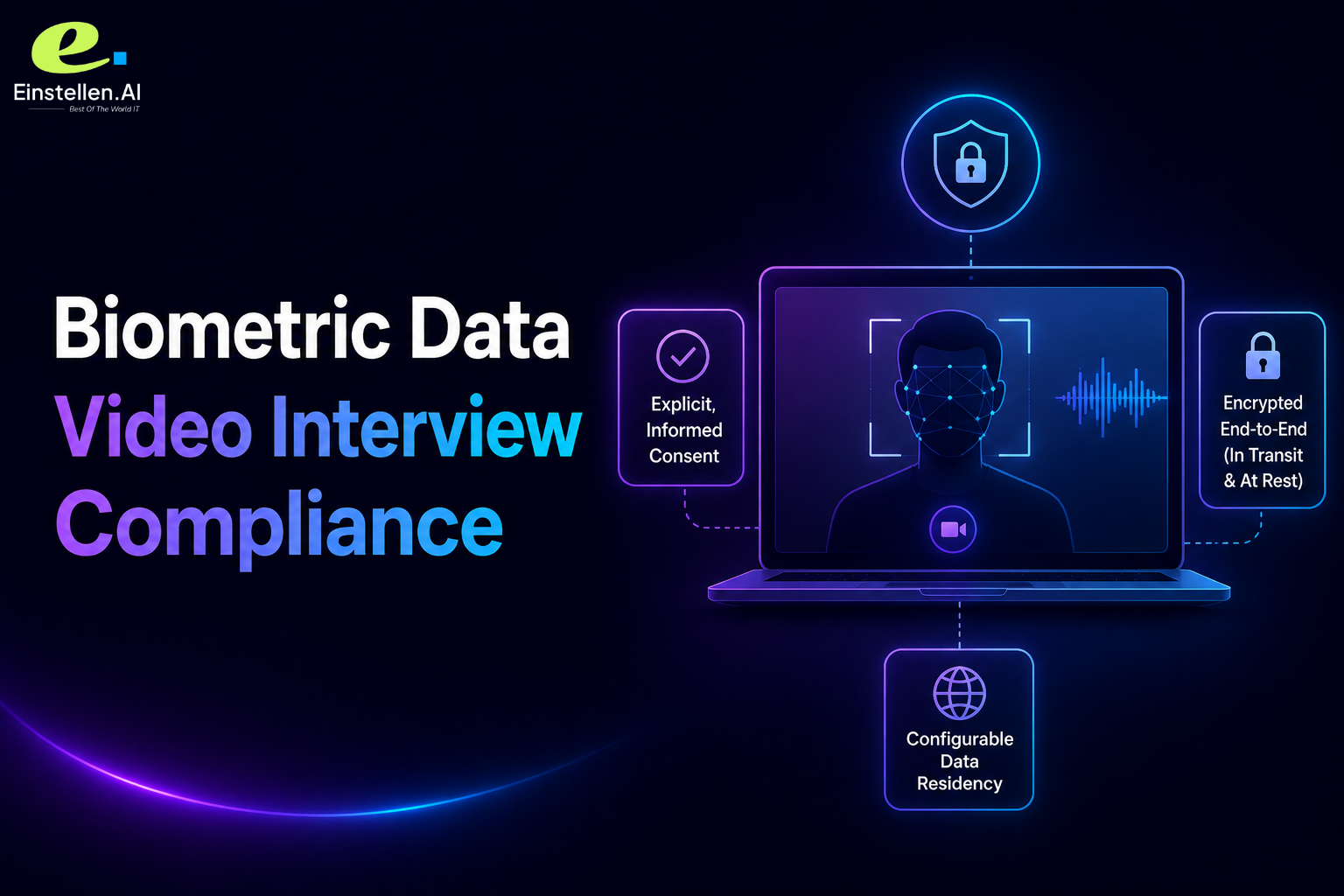
biometric-data-video-interview-compliance Video and voice interviews are biometric data collection events, full stop. Biometric data video interview compliance deserves its own line item, separate from general data security, because several jurisdictions regulate biometric identifiers more strictly than standard personal data. Verify three things specifically: do candidates give explicit, informed consent before recording begins; is the recording encrypted end-to-end in transit and at rest; and are fraud or proxy detection mechanisms disclosed at a policy level, even if the exact detection method stays confidential for integrity reasons (and it usually should).
Configurable data residency is worth checking directly, not assuming. A vendor that lets an enterprise choose where interview data physically lives is solving a real compliance need for multinational hiring, particularly EU candidate data that can't leave the region under some client policies. Ask what the default region is if you don't specify one, and get that answer in writing before go-live. Not after.
AI Hiring Platform Vendor Risk Assessment: The Checklist Nobody Finishes
Most AI hiring platform vendor risk assessment processes stall out because security and procurement ask different questions than the hiring team does, and nobody ever merges the two lists. A complete assessment needs to cover: certifications with viewable certificates (not just claimed on a slide), encryption standards for recordings specifically, access control granularity, retention policy split by data type, DPIA completion, incident history, and explainability of scoring.
That last one is the item most checklists still miss entirely. The EU AI Act's documentation requirements for high-risk AI systems (Annex III includes recruitment and employment decisions) include training data bias documentation and complete decision audit logs under Articles 11-12 of the Regulation itself. An AI hiring score that can't be explained isn't just a fairness problem. It's a documentation gap you cannot close in an audit. If your vendor can't produce a structured justification for an individual score on request, you've got a governance risk sitting quietly inside your hiring pipeline.
Why Explainability Is a Security Control, Not Just a Feature
Most vendor evaluations file "explainable AI" under a nice-to-have fairness feature, separate from the security checklist. That framing misses the point entirely. An opaque score is unverifiable by definition, and unverifiable outputs are exactly what auditors, regulators, and internal legal teams flag first when they review an AI hiring decision after the fact.
Einstellen.AI's platform runs on Magic OS, with the MAGIC model producing a structured, justified score for every interview rather than an unexplained ranking. Each interview generates a per-answer scored report with a full transcript, so a hiring manager or a compliance reviewer can see exactly which answer drove which part of the result. That report is the audit trail a black-box competitor simply cannot produce on request.

This matters most in disputed cases. If a rejected candidate challenges a hiring decision, or an internal audit asks why a specific score got assigned, "the algorithm decided" isn't a defensible answer under emerging AI governance expectations. A structured justification report is.
What to Verify: Quick Comparison
| Verification Area | What "Good" Looks Like | Why It Matters |
|---|---|---|
| Certifications | ISO/IEC 27001:2022, GDPR, SOC 2 Type II, viewable certificates | Confirms independent audit, not self-declared compliance |
| Data encryption | End-to-end encryption for recordings and transcripts, in transit and at rest | Protects biometric interview data specifically, not just account data |
| Access control | Role-based access limited to designated hiring team members, full audit logs | Limits exposure surface for a candidate data breach scenario |
| Data retention | Distinct Personal Data vs Usage Data retention policy tied to legal purpose | Satisfies GDPR AI hiring data retention expectations, avoids blanket claims |
| Scoring explainability | Per-answer structured justification report with full transcript | Provides the audit trail EU AI Act-style documentation requirements expect |
| Pricing transparency | Open, published per-interview pricing, no demo-gated negotiation | Lowers the barrier to switching vendors securely, without lock-in |
Proof point: Einstellen.AI's Trust Center and Enterprise page publicly display ISO/IEC 27001:2022, GDPR, and SOC 2 Type II certifications with viewable certificates, and interview recordings are end-to-end encrypted in transit and at rest, with role-based access restricted to designated hiring team members and full audit logs.
FAQ
Is it safe to use AI for hiring and candidate data?
It can be, provided the vendor has independently audited certifications (SOC 2, ISO 27001, GDPR), encrypts recordings end-to-end, and restricts access by role with audit logging. Safety here is something you verify, not something you assume. Ask for viewable certificates and a documented incident history before you treat any vendor claim as sufficient.
What should enterprises ask AI hiring vendors about data security?
Ask for certification certificates, encryption details specific to video and audio interview data, the retention policy split between Personal Data and Usage Data, whether a DPIA has been completed, the security incident history for the past 24 months, and whether individual AI scores come with a structured justification report.
Do AI hiring platforms comply with GDPR?
Compliance varies by vendor, and you should never take it on a footer statement alone. A genuinely GDPR-ready platform supports data subject access and deletion requests, distinguishes Personal Data from Usage Data in its retention policy, and can show DPIA documentation for AI-driven processing under Article 35.
How is candidate interview data (video/audio) stored and deleted?
Interview recordings and transcripts should be encrypted end-to-end, in transit and at rest, with access limited to designated hiring team members. Personal Data is retained only as long as necessary for legal compliance, dispute resolution, and enforcement of agreements, while Platform Usage Data follows a separate, generally shorter retention track.
Post Your Role With Verified Security Standards
If your hiring team is evaluating AI interview vendors, don't sign before your security and compliance stakeholders sit down and review certifications, retention policy, and scoring explainability side by side. Einstellen.AI publishes its ISO/IEC 27001:2022, GDPR, and SOC 2 Type II certifications on its Trust Center, integrates with your existing ATS at no additional cost, and pairs every score with a structured justification report your compliance team can actually review, line by line.
Post your role on Einstellen.AI and see the MAGIC Report format for yourself before you commit to a long-term contract.





Leave a Comment
Share your perspective. Comments are moderated before publishing.