
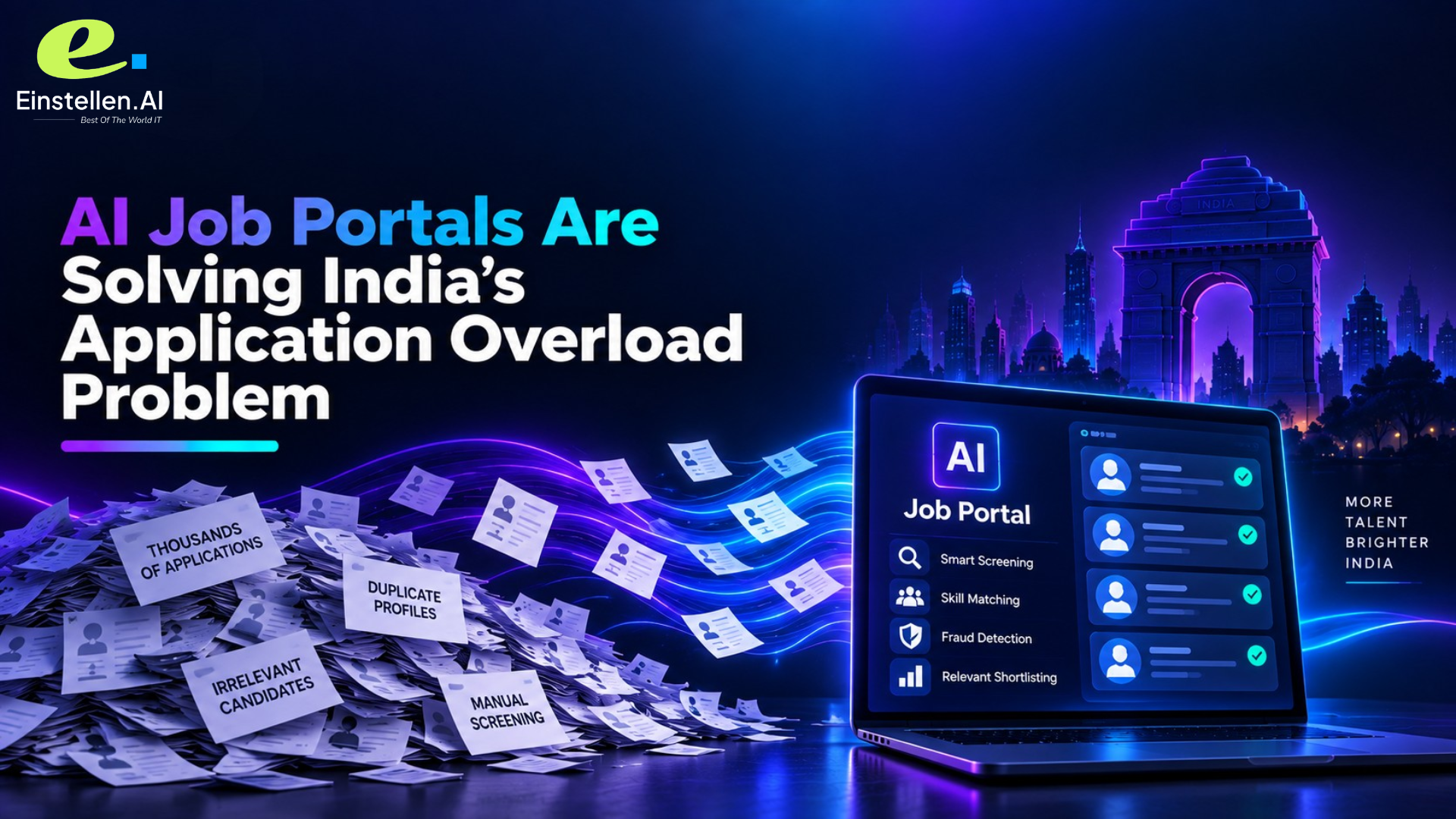
Quick Answer: AI job portal application overload is best solved not by matching resumes faster, but by giving employers a shortlist they can trust without re-reviewing every application. Einstellen.AI's structured justification reports and adaptive AI interviews let hiring managers see why each candidate scored as they did, cutting review time without a black-box guess.
Picture this: a hiring manager in Bangalore posts a mid-level backend role on a Friday. By Monday morning, 400 applications are sitting in the inbox. Most of these candidates don't meet the core requirements at all. So the manager is stuck with two bad options: spend an hour skimming resumes for keywords, or trust an AI tool's "match score" that gives zero explanation for how it ranked anyone. Neither one actually solves the overload. Faster filtering was never the real fix. What employers actually need is a shortlist they can act on without redoing the work themselves.
Why Application Overload in India Jobs Keeps Getting Worse
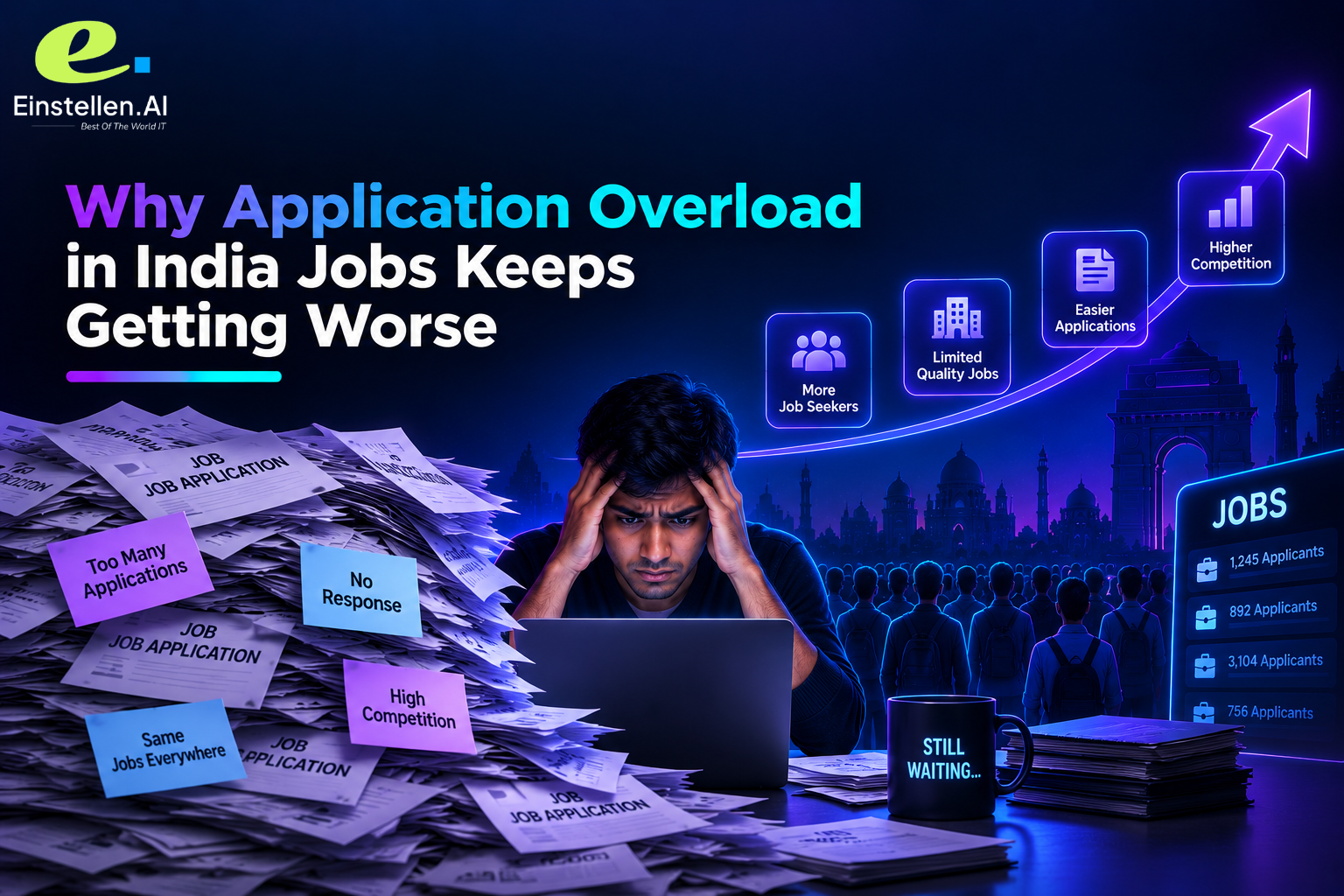
The volume problem in Indian tech hiring isn't new. But AI-enabled applying has made it worse, not better. Candidates can now apply to dozens of roles in the time it used to take to apply to one. A single product-company posting on a general job board can pull in hundreds of applications within days, and most of them have nothing to do with the actual role.
Most AI job portals responded to this the obvious way: build a matching algorithm, score resumes against the job description, and spit out a ranked list. That cuts the volume a recruiter sees. It doesn't cut their actual workload, though, because nobody trusts a ranking they can't interrogate. So the hiring manager still opens the top 20 resumes manually just to sanity-check what the algorithm decided. The overload doesn't disappear. It just moves one step downstream.
Einstellen.AI starts from a different premise. The goal was never a shorter list; it's a shortlist a hiring manager will actually rely on. And that only happens once the reasoning behind each score is visible, not just the score itself.
AI Resume Screening India ATS Rejection: The Trust Gap
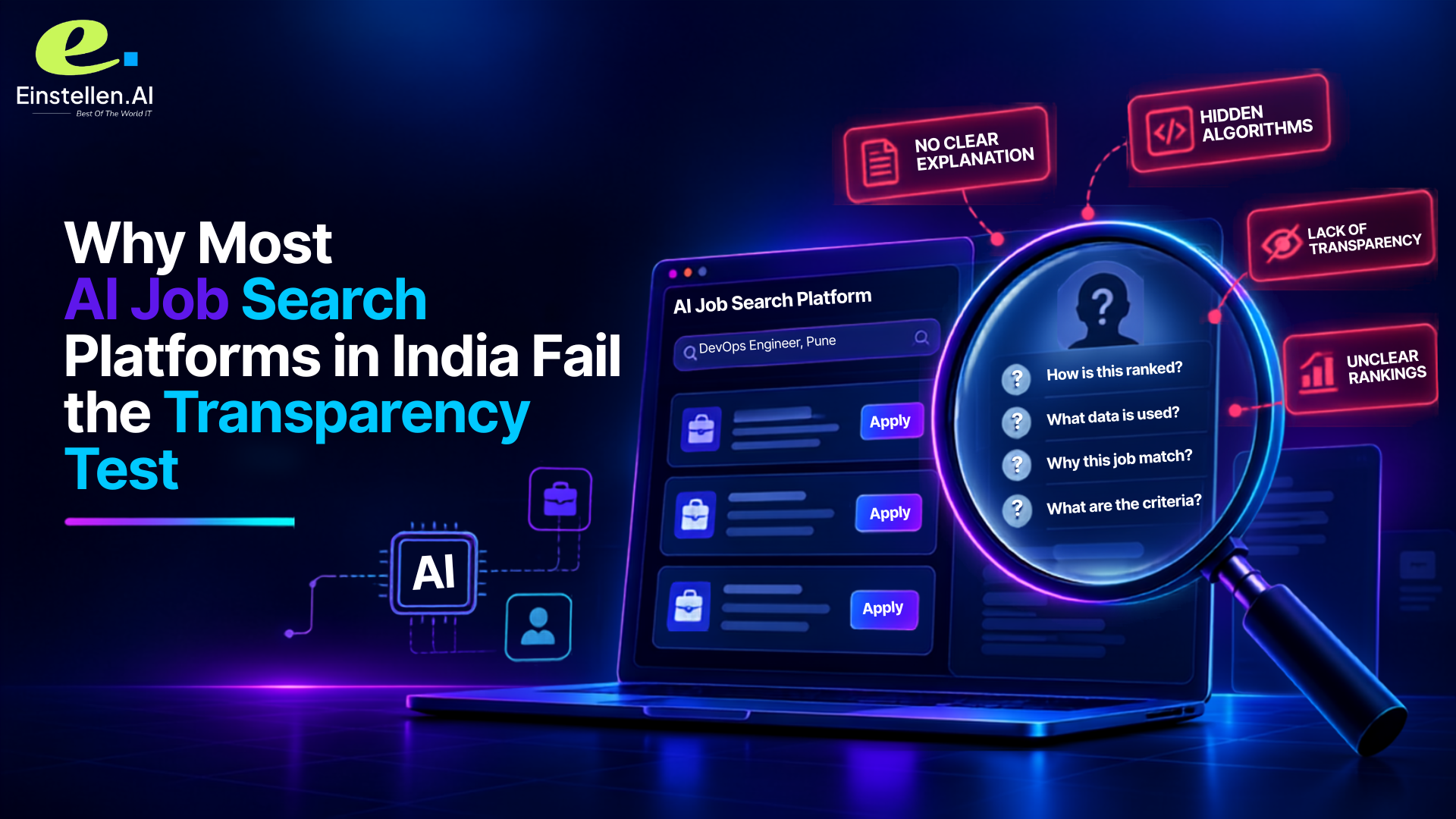
Most candidates filtered out by AI resume screening never find out why. Most hiring managers reviewing an AI-ranked shortlist can't see the "why" either, honestly. That's the structural weakness in black-box screening: a score with no accessible reasoning behind it isn't something you can defend to a panel, a compliance reviewer, or a candidate who pushes back on the decision.
Einstellen.AI's MAGIC OS model was built specifically to close that gap. Every score the platform produces comes paired with a structured justification, showing which part of a candidate's answer drove which part of the result. So when a hiring manager is looking at a borderline candidate, they see the actual reasoning behind the score, not just a number attached to a confidence interval nobody can explain.
This matters even more now that ATS-driven rejection has become routine at scale. A resume filter that silently drops a qualified candidate over a formatting quirk or one missed keyword creates real hiring risk. A platform that shows its work lets you catch that mistake before it costs you a strong hire.
Passive Candidate Sourcing Senior Roles India
At the junior and mid-level, application overload is a volume problem, plain and simple. At the senior level, it flips entirely. There aren't enough applications because the strongest senior candidates for product-company roles usually aren't applying anywhere. They're passive. Employed. Hard to reach through a static posting sitting on a job board.
This is exactly where a curated, active candidate pool beats a bigger applicant funnel. Einstellen.AI positions itself as a marketplace of currently active candidates rather than a static CV database, and that distinction is built for precisely this gap. A senior engineer weighing a move from a services background at Cognizant or Wipro toward a product company like Razorpay or CRED behaves nothing like a fresher blasting out 50 applications a week. Sourcing that candidate takes depth and relevance. More inbound volume won't get you there.
Adaptive AI interviewing helps on this front too. Instead of running the same five fixed questions no matter what the candidate says, humAIn listens to what a senior candidate actually tells it and probes deeper exactly where the conversation reveals something worth exploring. Closer to how a skilled human interviewer works a conversation than to a checklist.
Job Search Mental Health India AI Hiring
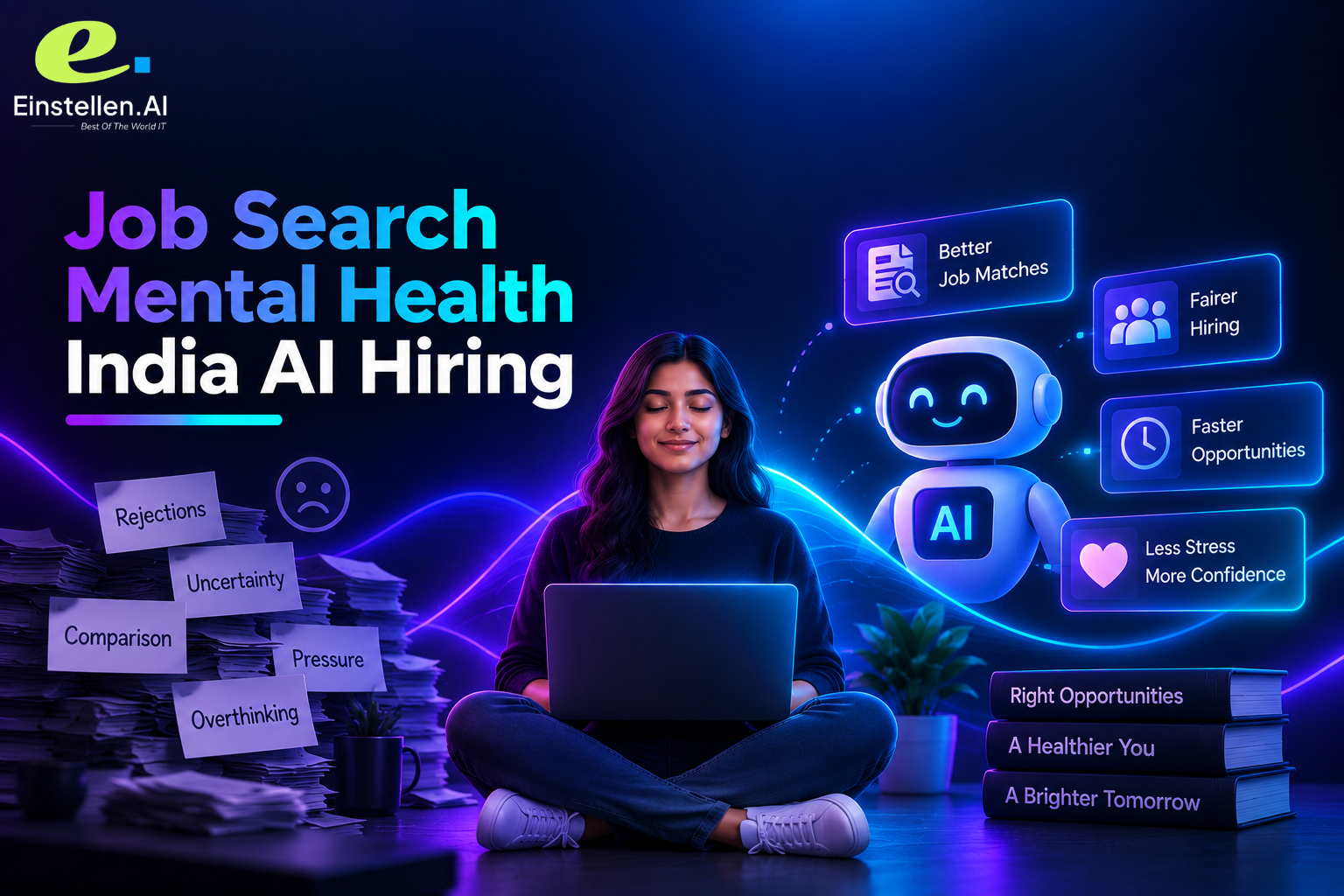
The overload problem isn't just an employer cost. On the seeker side, the sheer scale of manual searching has become its own burden. The sheer volume of manual searching across multiple portals, with little feedback on each application, has become its own burden. Applying to a process that cannot explain its reasoning makes that worse, not better.

That kind of volume compounds anxiety. You're applying to what feels like a black hole, with zero visibility into whether your application was even fairly reviewed. An opaque AI screening process makes that worse, not better, because a rejected candidate has no way of understanding what actually happened.
Einstellen.AI's answer on the seeker side is the same explainability principle, just pointed the other way. A candidate going through an AI-powered interview gets evaluated against a visible, structured basis instead of a mystery number. That's a fairer experience no matter how the interview turns out.
ATS Integration Without the Overload Tax
Here's a pain point that's gone unaddressed for years: companies have historically paid extra just to get their AI screening tool talking to the ATS they already use. Magic OS integrates with any ATS a company already runs, at no additional cost. Greenhouse, Lever, and Workday are named specifically as native, bi-directionally synced integrations on Einstellen.AI's Enterprise page. Scores, transcripts, and reports flow directly into the existing candidate record, and there's no retraining needed for recruiter workflows already in place.
That closes a gap most "best AI job portal" listicles skip over entirely. They'll compare matching accuracy and feature checklists all day but rarely mention what it actually costs to make the tool work inside a recruiter's existing stack.
| Approach to Application Overload | What Employer Gets | Trust Gap |
|---|---|---|
| Manual resume review | Full visibility, very slow | None, but doesn't scale |
| Black-box AI ranking | Faster shortlist, no reasoning shown | High — score can't be defended |
| Einstellen.AI adaptive interview + MAGIC Report | Faster shortlist with structured justification per score | Low — reasoning is visible per answer |
| Einstellen.AI at ₹249/interview, pay-per-use | Same flat rate at 1 or 10,000 interviews, no contract | None — pricing itself is public |
Proof Point: Einstellen.AI has conducted 150,000+ AI interviews across 1,200+ institutions, backed by IIM Lucknow and NASSCOM. MediAssist's enterprise deployment on the platform produced 92.5% fewer screening interviews required, 15-day average fulfillment, 100% position closure rate, and 60% interview-to-deployment conversion-every score delivered with a structured justification report so hiring managers could defend every shortlisting decision with documented evidence, not an unexplained ranking.
FAQ
How does AI reduce the number of job applications recruiters have to review?
An adaptive AI interview engine screens candidates against role-specific answers rather than just resume keywords, and it produces a structured, justified score for each one. That gives a hiring manager a smaller, pre-qualified shortlist with visible reasoning attached, instead of hours spent skimming resumes to double-check an opaque ranking.
Is AI resume screening biased or unfair to candidates?
It can be. Resume screening that leans purely on keyword matching will sometimes filter out qualified candidates over nothing more than formatting or phrasing. Einstellen.AI's MAGIC model addresses this by pairing every score with a structured justification report showing exactly which answer drove which part of the result, so a hiring manager can catch and correct a questionable filter before it costs them a strong hire.
What is explainable AI in hiring/recruitment?
It means every candidate's score comes with a visible, structured reason attached, not an opaque number. Einstellen.AI's structured justification reports show what was asked, what was answered, and why a particular score was assigned. That's the direct counter to black-box AI interview tools that hand you a ranking with no accessible reasoning behind it.
How much does an AI recruitment/job portal cost in India?
Einstellen.AI's public list price is a flat ₹249 per AI interview, pay-per-use, no subscriptions, no contracts, no volume pricing tiers, whether you run 1 interview or 10,000. The full MAGIC Report, including video, transcript, skill scoring, and fraud detection, is included in every credit. No premium add-on tacked on.
Hire Without the Overload
If application overload is costing your team hours every week reviewing resumes you can't fully trust, a bigger funnel isn't the fix. What you actually need is a shortlist backed by a structured justification report your hiring managers can rely on without second-guessing it. Einstellen.AI's adaptive AI interviews and no-cost ATS integration with Greenhouse, Lever, and Workday mean you can plug explainable scoring straight into the workflow you already run.
Post your next role on Einstellen.AI and see the shortlist with the reasoning attached, not just a ranking.








Leave a Comment
Share your perspective. Comments are moderated before publishing.