
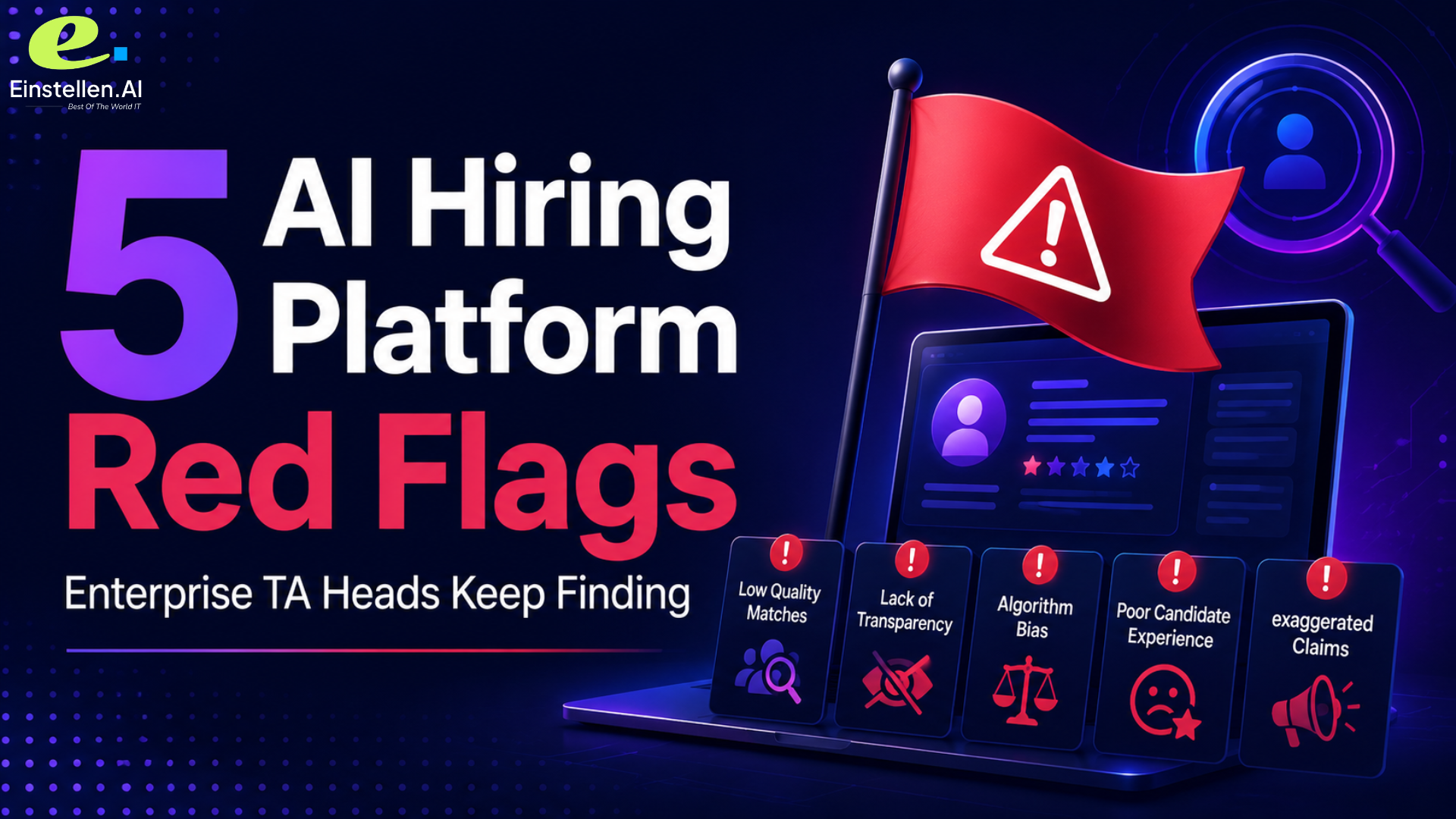
Quick Answer: The five AI hiring platform red flags TA heads repeatedly find during vendor evaluation are black-box scoring with no justification, static scripted interviews sold as "adaptive AI," no measurable ROI framework, integration surcharges or rigid ATS fit, and thin, non-auditable reports. Each one surfaces in the first pilot round, not the sales deck.
Picture this. A TA Head at a 400-person product company kicks off a pilot with a well-funded AI interview vendor. Three weeks in, two shortlisted candidates score lower than a third candidate who visibly struggled through the recorded interview. Nobody on the panel can explain why. We're not making this up. It's the single most common complaint we hear directly from enterprise hiring leads evaluating AI hiring platforms, and it's exactly why these red flags need to be checked in a live pilot, not read off a features page.
Black-Box Scoring: Candidate Trust and AI Hiring Bias
The first red flag appears the moment a hiring manager asks, "Why did this candidate score 72 and not 85?" and the vendor can't provide a specific answer tied to a specific response. A number with no reasoning behind it isn't a hiring decision aid. It's a ranking you're asked to trust rather than evaluate.
This connects directly to candidate trust and AI hiring bias concerns that are no longer theoretical. Stanford HAI's research on AI hiring tools found substantial evidence of racial disparities in automated candidate screening, noting that roughly 90% of U.S. employers use AI screening tools to sort and rank job seekers, most relying on the same handful of third-party vendors. The same research found that 26% of Black applicants and 15% of Asian applicants applied to positions where the AI system discriminated against their racial group.
Einstellen.AI's MAGIC model is built to answer the "why" question by design. Every score comes paired with a structured justification report, showing which specific answer drove which part of the result, so a hiring manager reviewing a borderline candidate sees the actual reasoning behind the number, not just the number itself.
Static Interviews Sold as Adaptive AI
The second red flag is harder to catch in a demo, mostly because it sounds identical to the real thing on a sales call. A genuinely adaptive interview listens to what a candidate just said and generates the next question based on that answer. A static, scripted interview asks the same five questions in the same order, no matter how the candidate responds, and then gets called "AI-powered" because a model scores the transcript afterward.
TA heads find this out the hard way. A candidate gives a vague, underdeveloped answer about a specific project, and the "adaptive" tool moves straight on to the next scripted question instead of probing the gap. That's a missed opportunity to get a real signal, not some unavoidable technology limitation.
humAIn, Einstellen.AI's interview engine, runs autonomous adaptive questioning. The system generates the next question from the candidate's actual answer, going deeper exactly where the conversation reveals something worth exploring, rather than marching through a fixed script no matter what was said. This is the concrete mechanism behind "agentic" interviewing. It's not a marketing label glued onto a checklist tool.
AI Recruiting Platform ROI Measurement Nobody Can Show
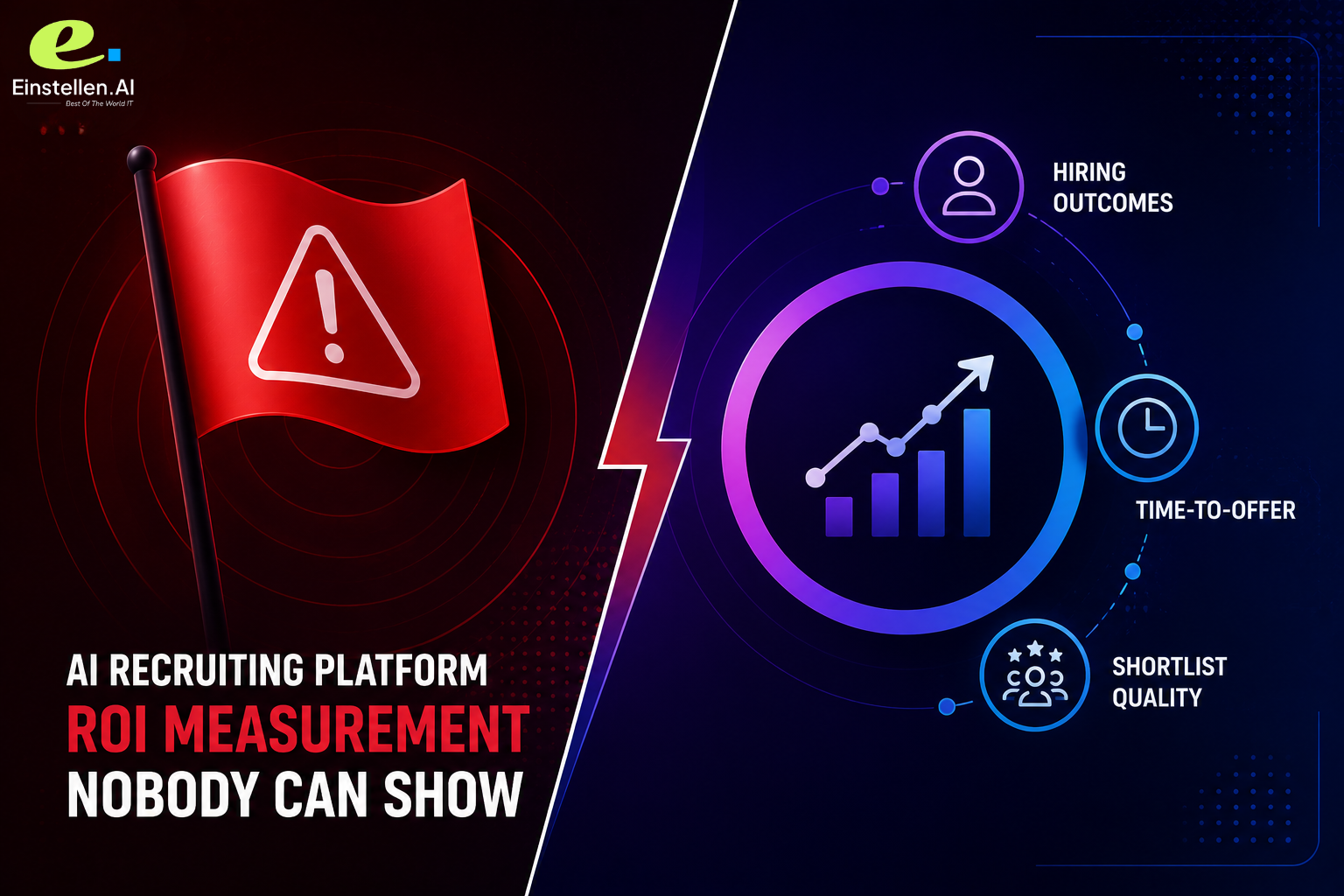
ai-recruiting-platform The third red flag: a vendor that can't show how ROI is measured beyond "time saved per requisition." TA heads increasingly ask for AI recruiting platform ROI measurement tied to actual hiring outcomes. Did scored candidates perform on the job? Did time-to-offer actually shrink? Did the shortlist quality hold up against a control group screened manually?
Pricing structure is part of this red flag, and it's the one that most vendor comparison content skips entirely. Long, negotiated contracts with volume tiers make ROI hard to isolate because the cost base itself is opaque. Einstellen.AI runs flat, open pricing: ₹249 per interview, pay-per-use, the same rate whether a client runs one interview or ten thousand, with no subscription, no contract, and no volume negotiation. That openness is deliberate. A platform that won't publish its price is asking a TA Head to trust the ROI math without seeing one side of the equation.
AI Hiring Platform Integration Issues and Point Solution Sprawl
The fourth red flag is an AI hiring platform that doesn't fit into the ATS a company already runs, or worse, charges extra to make it fit. This one's well documented: companies have historically been billed as if ATS integration were a premium add-on rather than baseline functionality, and the reaction when told otherwise is usually genuine disbelief, not mild interest.
This compounds into the point solution sprawl HR tech teams already struggle with. A screening tool here, an assessment tool there, an interview tool that doesn't talk to either, each with its own login and its own partial slice of data. Magic OS integrates with any ATS an enterprise is already using, with Greenhouse, Lever, and Workday as native, bi-directionally synced examples, where scores, transcripts, and reports flow directly into the existing candidate record. No retraining of recruiter workflows is required, and no separate charge for the connection.
Thin Reporting That Doesn't Survive an Audit
The fifth red flag only shows itself weeks into a pilot, right when a TA Head needs to defend a hiring decision internally, or to a candidate who asks for feedback. A shallow report with a final score and nothing else can't support that conversation. Legal and compliance publishers have started treating this as more than a UX complaint: a lawsuit against AI recruiting platform Eightfold, covered by Bloomberg Law, argues that when software scores or ranks candidates using consumer-report-type information, the Fair Credit Reporting Act may already apply.
A per-answer scored report with a full transcript is the difference between a defensible hiring record and a liability. Every Einstellen.AI interview produces exactly that: what was asked, what was answered, and why a given score was assigned, available to the hiring manager reviewing the file. Fraud and proxy detection are built into the same interview flow, which matters more at volume, especially for bulk enterprise rounds and campus placement drives where impersonation risk climbs as scale goes up.
Comparing What Enterprise TA Heads Actually Get
| Red Flag | What Vendors Show in a Demo | What a Real Pilot Reveals |
|---|---|---|
| Black-box Scoring | A match/fit score | Whether any answer maps to the score |
| Adaptive Interviewing | A conversational-sounding script | Whether follow-up questions actually change based on the candidate answers |
| ROI Framework | Time-saved metrics | Whether hiring outcomes were ever tracked post-hire |
| ATS Integration | API available | Whether synchronization is bi-directional at no extra cost |
| Reporting Depth | A final score | Whether the report can withstand internal review or legal scrutiny |
Based on Einstellen.AI's platform mechanics (30,000+ interviews, 1,200+ institutions) and publicly available competitor positioning; not a claim about any single named competitor's current feature set.
Proof point: Magic OS has powered 30,000+ AI interviews across 1,200+ institutions, with every score generated through the MAGIC model's structured justification rather than an unexplained ranking.
FAQ
What are the risks of using AI in hiring?
The main risks are unexplained scoring that can't withstand a legal or internal challenge, disparate impact on protected groups if the model isn't monitored, over-reliance on automated rankings with no human override, and unclear data retention or model-training practices. Enterprise TA teams should push vendors to document each of these directly, rather than accept a general "we take this seriously" answer.
How do you know if an AI hiring tool is biased?
Ask the vendor to show you a structured justification for a specific score, not just the number. If they can't point to which answer drove which part of the result, there's no way to audit the tool for disparate impact after the fact. Explainable scoring is the precondition for bias auditing, not a separate feature bolted on later.
What's the difference between AI screening and AI interviewing?
AI screening typically filters resumes or applications against criteria before a human ever sees them. AI interviewing conducts an actual conversation with a candidate, adaptively or on a fixed script, and produces a scored transcript. HumAIn does the latter: adaptive, conversational interviews with per-answer scoring, not resume filtering.
What should I ask an AI recruiting vendor before signing a contract?
Ask for the exact list price with no negotiation required, whether ATS integration carries a surcharge, whether the interview engine adapts to answers or runs a fixed script, and whether every score comes with a report showing the reasoning behind it. If any answer comes back vague, treat it as a red flag, not a detail to revisit later.
Ready to Pilot an Explainable AI Interview Process?
If your team has run into any of these five red flags while evaluating an AI hiring platform, the fix isn't another black-box tool with better marketing. It's an interview engine that adapts to what candidates actually say, and a report that shows hiring managers the reasoning behind every score, at a price you can see before you sign anything.
Explore Einstellen.AI for Employers to see how Magic OS handles adaptive interviewing, structured justification reports, and no-cost ATS integration, or head to Post a Job to run your own pilot at ₹249 per interview, no contract required.






Leave a Comment
Share your perspective. Comments are moderated before publishing.