
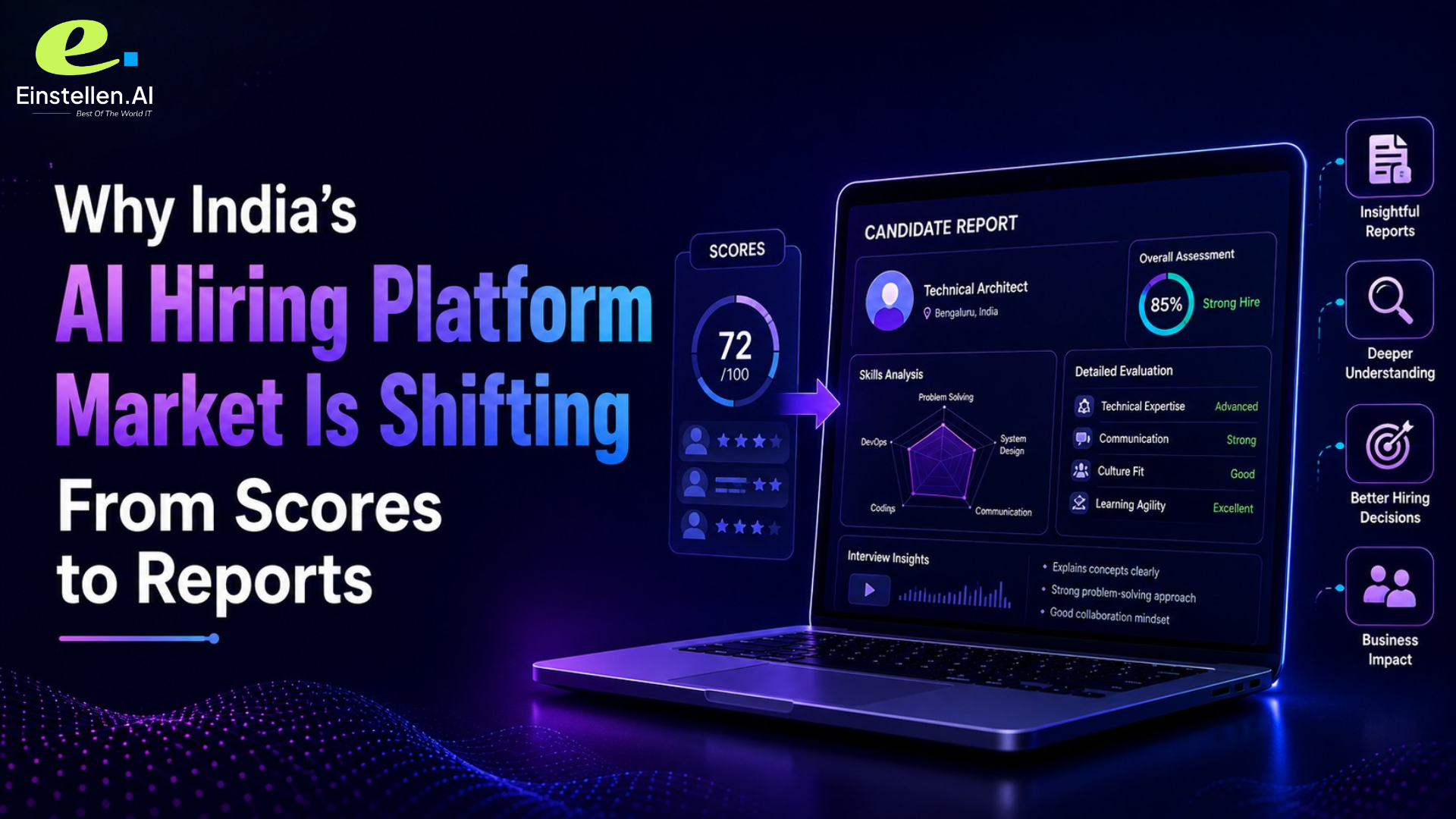
Quick Answer: India's AI hiring platform market is shifting because a bare score cannot be defended to a candidate, a regulator, or a hiring committee. A transcript-backed report shows exactly which answer drove which part of the result. Platforms built on structured justification, like Einstellen.AI's Magic OS model, are replacing black-box scoring as the enterprise standard for 2026.
Here's a scenario that plays out more often than most TA teams want to admit. A hiring manager in Bangalore rejects a candidate at 78/100 and moves an 82/100 forward. Three weeks later, the 82 quits before onboarding. Turns out the 78 was the stronger technical fit the whole time. Nobody on the team can explain why the score said otherwise, because the platform never showed its reasoning in the first place.
That's the exact failure pattern pushing India's AI hiring platform market away from raw scores. TA heads keep saying the same thing, over and over: scores from other tools just don't correlate with who actually performs on the job. AI interviewing itself isn't the problem. Evaluation with no visible reasoning behind it. And that gap has become the central buying criterion for any AI hiring platform that Indian employers are evaluating in 2026.
The Problem With a Bare Score From Any AI Hiring Platform
A number alone tells a hiring manager nothing about why a candidate scored that way. Was it communication? Technical depth? One vague answer that tanked the whole result? Without that detail, you've got a black box with a confidence interval attached, and every borderline decision turns into a guess dressed up as data.
This matters more in India than the headline recruitment numbers suggest. The Indian staffing and recruitment market was valued at $18.06 billion in 2022 and is projected to reach $48.53 billion by 2030, growing at a 13.2% CAGR, according to Qureos' hiring guide. Qureos also reports that over 92% of Indian companies now use some form of AI-driven recruitment. At that volume, an unexplained score isn't some minor inconvenience. It's a systemic risk multiplied across thousands of hiring decisions a month.
The scrutiny is catching up, too. In the US, the EEOC has stated that employers remain liable under Title VII for discriminatory outcomes produced by AI hiring tools, even when a vendor's algorithm made the call. That's US law, not Indian law, but the direction is the same everywhere you look: a score you can't explain is a liability you can't defend, whether that's in a courtroom or just your own Monday hiring committee meeting.
Explainable AI Hiring Scores India Employers Can Actually Defend
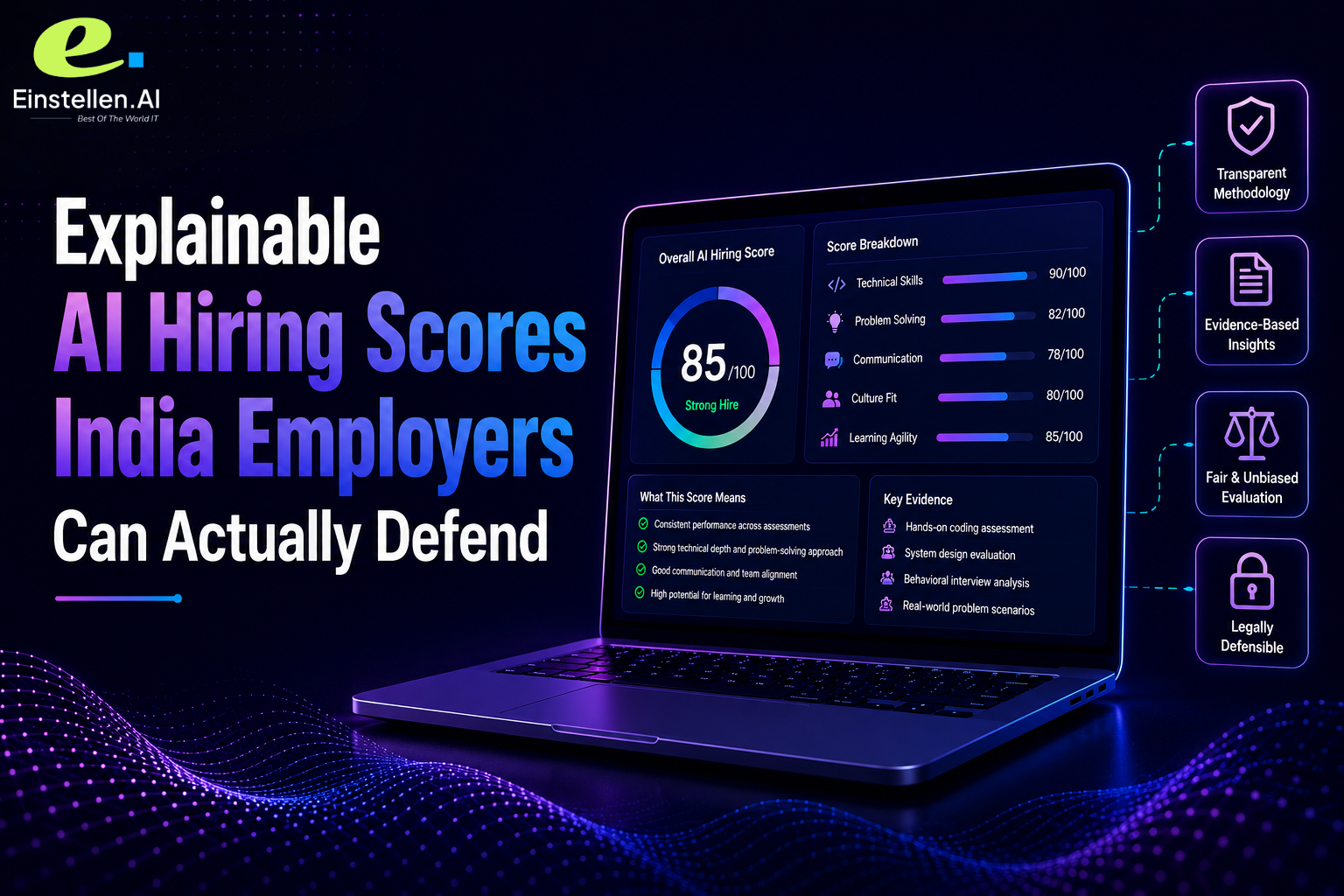
Explainable AI hiring scores in India teams can defend to a candidate that they all share one property: every number comes with a reason attached. Einstellen.AI's Magic OS model is built around exactly this. Instead of spitting out a standalone number, the platform generates a structured, justified score, and the report shows exactly which answer drove which part of the result.
That distinction can sound subtle until you're the one staring at a borderline candidate. A report that just says "68/100" is a guess dressed up in a number. A report that says "scored lower on system design specifically because the candidate's answer on database indexing was vague when probed further" is something a hiring manager can actually stand behind, in a debrief or in front of leadership.
This is also where the job fit score vs joining probability score distinction comes in, something most India-focused roundups skip entirely. A job fit score describes skill match. A joining probability signal, inferred from how a candidate engages during the interview itself, describes something else: intent and how likely they are to follow through. Reports that keep these two signals separate, instead of blending them into one opaque figure, give hiring managers a genuinely better basis for deciding who to prioritize, not just who's qualified but who's actually likely to say yes.
Read More: AI Hiring Platform Implementation Without ATS Disruption
Agentic AI Recruiting India 2026: What "Adaptive" Actually Means
Most India-market AI interview tools still run fixed-script video interviews with sentiment analysis bolted on top. The candidate answers five preset questions no matter what they say, and the system scores tone and word choice instead of substance. That's the standard most 2026 roundups quietly assume is "AI hiring." It isn't, really.
Agentic AI recruiting in India 2026 looks structurally different. Einstellen.AI's humAIn engine listens to what a candidate actually says and generates the next question based on that answer, instead of marching through a checklist regardless of how the conversation is going. Give a vague answer about a specific project, and the system probes deeper into that project rather than skipping to an unrelated scripted question.
What you get is closer to what a skilled human interviewer would pull out of someone than any static test could manage. Picture two candidates who both claim five years of Kubernetes experience. An adaptive interview is what actually separates the one who ran production incidents at 2am from the one who watched a tutorial once.
Fraud Detection and Integration: The Parts of the Report Nobody Talks About
A transcript-backed candidate report only means something if the interview behind it is real. Einstellen.AI's platform builds fraud and proxy detection into the interview process itself, and this matters most at volume: campus placement drives and bulk enterprise screening rounds are exactly where proxy interviewing risk shows up hardest.
The other quiet differentiator is what integration actually costs. Companies have historically been charged extra just to connect an AI hiring tool to the ATS they're already paying for. Tell a TA leader that Magic OS integrates with any ATS a company is already using, including native, bi-directionally synced connections to Greenhouse, Lever, and Workday, at no additional cost, and the reaction is usually disbelief, not mild interest. That reaction tells you everything about how normalized the surcharge has become in this category, and honestly, how low the bar still is.
Read More: 5 AI Hiring Platform Red Flags Enterprise TA Heads Keep Finding
Comparing the Two Models
| Dimension | Score-Only AI Interview Tools | Transcript-Backed Report (Einstellen.ai) |
|---|---|---|
| Output | Single number, no reasoning shown | Per-answer scored report with full transcript |
| Interview style | Fixed script regardless of answers | Adaptive questioning based on what was said |
| Fraud/proxy detection | Varies, often undocumented | Built into the interview process |
| ATS integration cost | Frequently a paid add-on | Included at no additional cost, any ATS |
| Pricing model | Contact-for-pricing tiers common in India roundups | Flat pay-per-use, no subscriptions or contracts |
Proof point: Einstellen.AI's Magic OS has powered 30,000+ AI interviews across 1,200+ institutions, with every interview producing a per-answer scored report and full transcript instead of a standalone number.
FAQ
What is an AI hiring platform, and how does it work in India?
An AI hiring platform automates candidate screening and interviewing using algorithms instead of relying on manual review alone. In India, platforms increasingly pair an AI interview engine with structured scoring. Einstellen.AI's version runs adaptive, autonomous questioning through humAIn, then evaluates responses using the MAGIC model, which produces a justified report rather than an unexplained rank.
Are AI hiring scores accurate or biased?
It really comes down to whether a platform can show its reasoning. A score with no visible justification can't be audited for bias, and that's exactly the complaint TA heads keep raising about black-box tools. Platforms that pair every score with a structured justification report, showing which answer drove which result, let a hiring manager actually inspect the reasoning instead of just trusting it blindly.
What is the difference between an AI score and an AI interview report?
A score is a single number with no reasoning attached to it. A report is a full transcript paired with a per-answer breakdown showing exactly what was asked, what was answered, and why a given score came out the way it did. Einstellen.AI's platform always produces the latter, because a score is only actually useful, in content and in practice, when it comes with its justification.
How much does an AI hiring platform cost in India?
Public pricing varies a lot across vendors, and many India-market platforms just list "contact for pricing" tiers. Einstellen.AI publishes a flat rate of ₹249 per interview, pay-as-you-go, no subscriptions, no contracts, no volume pricing tiers. Credits never expire. And the full report, video, transcript, and scoring come included with no premium add-on tacked on.
Hire With a Report, Not Just a Score
If your hiring team is still arguing over a candidate based on a number nobody can explain, the AI hiring platform is the problem, not the candidate. Einstellen.AI's AI interview engine pairs every score with a structured justification report and a full transcript, integrates with your existing ATS, including Greenhouse, Lever, and Workday,y at no extra cost, and runs on flat, pay-as-you-go pricing with no contracts.
Post your next role on Einstellen.AI and see the difference a defensible report makes to your next hiring decision.








Leave a Comment
Share your perspective. Comments are moderated before publishing.