
Quick Answer: Enterprise recruiting software goes further, adding AI screening, high-volume automation, multi-location workflows, and compliance-grade analytics. Whereas an ATS tracks candidates through a hiring pipeline. Most enterprises need both: an ATS as a system of record and enterprise recruiting software with explainable AI scoring layered on top to evaluate candidates at scale without becoming a black box.
A TA Head running 400 open requisitions across six cities doesn't have a software problem. They have an evidence problem. Their ATS shows who applied and what stage they're in. It won't tell them why one candidate scored higher than another, or whether that score would survive a compliance audit if a rejected candidate pushed back. That gap is exactly where enterprise recruiting software is supposed to step in, and it's also where most vendors quietly stop short.
Every "best enterprise recruiting software" listicle out there covers the same ground: multi-location support, workflow automation, integrations, reporting. Almost none of them explain how the AI actually arrives at a score, or why that matters when legal, compliance, and hiring managers all have to trust the same number. This article walks through the ATS-vs-enterprise-software distinction properly, then gets into the part the rest of the internet skips.
Read More: ATS Integration Should Never Cost Extra: What Enterprise Hiring Missed
Enterprise Recruiting Software and ATS: What Is the Difference Between Them?
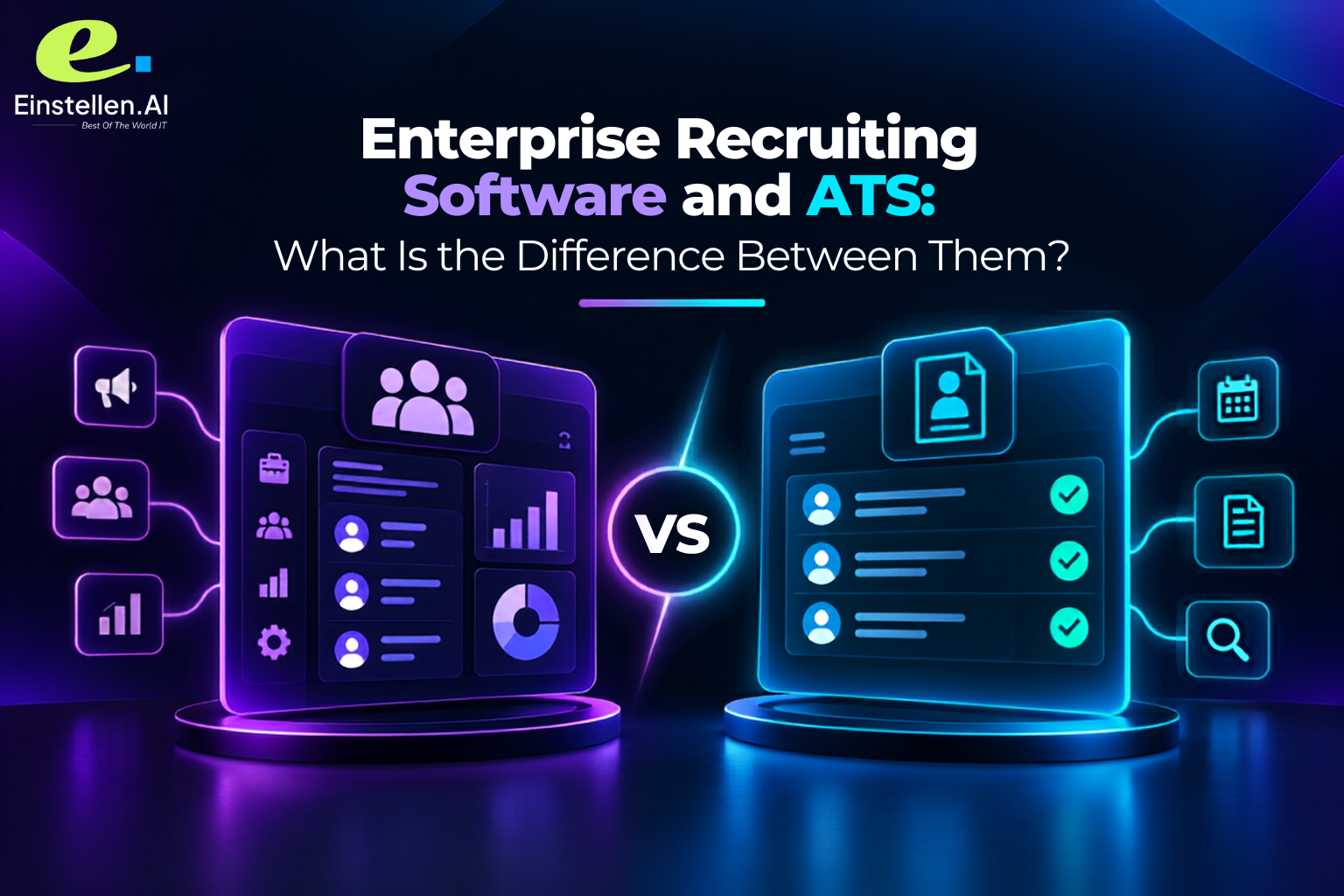
An ATS is a system of record. It stores candidate profiles, moves them through pipeline stages, and logs recruiter activity. Greenhouse, Lever, and Workday all do this well, and chances are your enterprise already runs one of them.
Enterprise recruiting software is a broader category designed for organizations that hire hundreds or thousands of people a year across multiple locations. It typically layers on AI-driven resume screening, structured interview scoring, workflow automation across business units, and analytics on top of ATS data, rather than trying to replace it.
Most market content muddles this by treating the two as competing choices. They're not. An ATS answers "Where is this candidate in the process?" Enterprise recruiting software answers "Should this candidate move forward, and can I defend that decision?" A 400-requisition hiring operation needs both functions running side by side, not one tool awkwardly trying to do both jobs.
The practical failure mode is fragmentation: an ATS for tracking, a separate assessment tool, a separate interview tool, and a data team stitching results together months later. That stitching problem is the real cost most enterprises underestimate when they're evaluating a new platform.
AI Recruiting Tools: What Features Should Enterprises Prioritize?
Feature checklists on vendor sites list "AI-powered matching" as a bullet point and move on. That's not enough to survive a compliance review. Enterprises should be prioritizing four things specifically.
First, explainability. Every AI score should come with a structured justification report showing which parts of a candidate's answer drove which part of the result, not just a number sitting there unexplained. Second, adaptive questioning. A fixed-script AI interview asks the same six questions to every single candidate; an adaptive engine generates each follow-up from what the candidate actually said, which produces a sharper read on real ability.
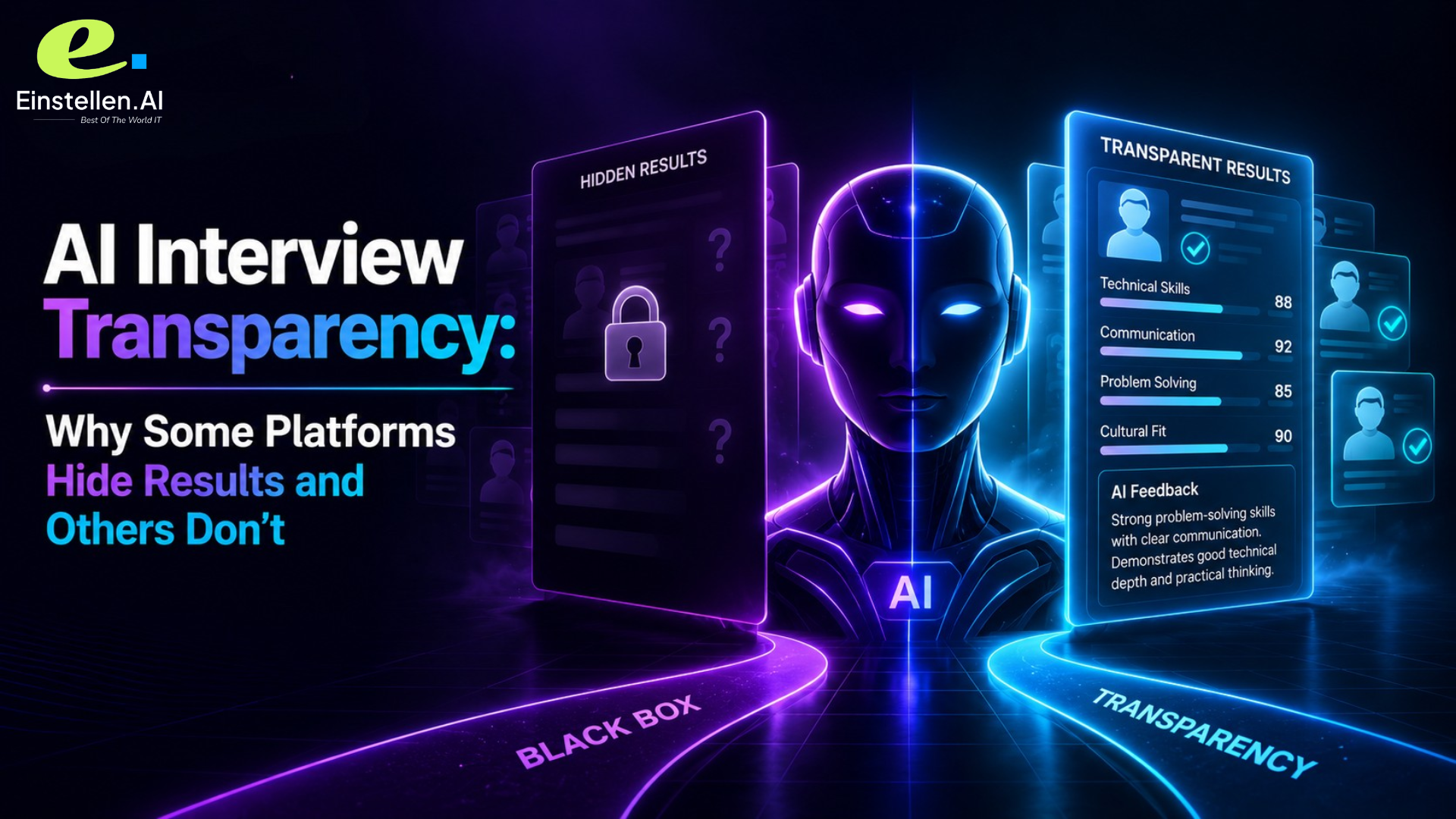
Read More: AI Interview Transparency: Why Some Platforms Hide Results and Others Don't
Third, ATS integration without a surcharge. Enterprises have been conditioned to expect an added cost here, when honestly, integration should just be baseline. Fourth, fraud and proxy detection are built into the interview process itself, since high-volume hiring is exactly where interview fraud tends to concentrate.
Skip any of these four, and the gap shows up later, usually during a legal review or when a TA Head has to explain to a hiring manager why the top-ranked candidate flopped on the job. AI enterprise recruiting software that can't answer "why did this candidate score an 82?" isn't really evaluation. It's a guess with a confidence interval bolted on.
Enterprise Recruiting Software With Explainable Scoring
Explainability is the single biggest gap in current enterprise recruiting content. Vendors mention an "AI Hiring Agent" or "AI-powered matching" feature without ever describing the mechanism, and almost none of them address whether the scoring would hold up under a bias audit.
Einstellen.AI's MAGIC OS model was built specifically to close this gap. Every interview score comes with a structured justification report, showing a hiring manager exactly which responses drove which part of the outcome. This isn't a transparency slogan we put on a slide. It's a specific artifact a TA Head can actually hand to legal or to a hiring manager who's questioning a rejection.
The pattern behind this design choice isn't theoretical, either. Companies come to Einstellen.AI repeatedly after another AI interview platform produced rankings that didn't correlate with how candidates actually performed on the job. The complaint was never about AI interviewing as a concept. It was about the absence of any justification behind the score. That's the difference between enterprise candidate screening software that scales trust and one that just scales risk.
What Makes Enterprise Recruiting Software Genuinely Agentic
"Agentic" gets thrown around loosely in HR tech marketing these days. Genuinely agentic means the system adapts its own behavior mid-interview based on what the candidate says, rather than executing a fixed decision tree someone wrote in advance.
humAIn, Einstellen.AI's interview engine, generates each follow-up question from the candidate's prior answer. If a candidate gives a shallow answer on system design, the next question digs into that specific gap instead of moving on to the next pre-written item on a script. That's what actually separates adaptive interviewing from a video-recorded question bank with an AI label slapped on it.
This matters most in high-volume hiring, where a fixed-script tool asks 5,000 candidates the identical six questions and produces near-identical transcripts for someone to review later. An adaptive engine produces a differentiated signal at that same volume because the questioning path itself reflects what each candidate actually demonstrated. For enterprise recruiting automation to earn the label, the automation has to adapt, not just execute faster than a human could.
Read More: Adaptive Questioning vs Fixed-Script AI: Which Catches Better Candidates at Scale
Enterprise Recruiting Automation: Bias Audit Readiness
Bias auditability is turning into a real enterprise compliance requirement, and it's almost entirely missing from current market content on enterprise recruiting software. A scoring system that can't show its reasoning can't be meaningfully audited for bias. There's simply nothing to inspect beyond the output number.
Structured justification reports change that equation. Because each score ties back to specific evidence from the candidate's answers, compliance teams get something concrete to review instead of a black-box ranking they have to trust on faith. This is really a direct extension of the explainability point above, and it's the reason enterprise recruiting platform decisions shouldn't be separated from security and compliance evaluation the way they often are.
Einstellen.AI's platform holds ISO/IEC 27001:2022, GDPR, and SOC 2 Type II certifications, with viewable certificates on its Trust Center. Fraud and proxy detection also run within the interview process itself, which matters disproportionately at high volume, since that's where interview fraud tends to concentrate. Enterprises evaluating any AI enterprise recruiting software should be asking for the justification artifact before the demo even ends, not after the contract's signed.
How to Choose the Best Enterprise Recruiting Software for Your Team
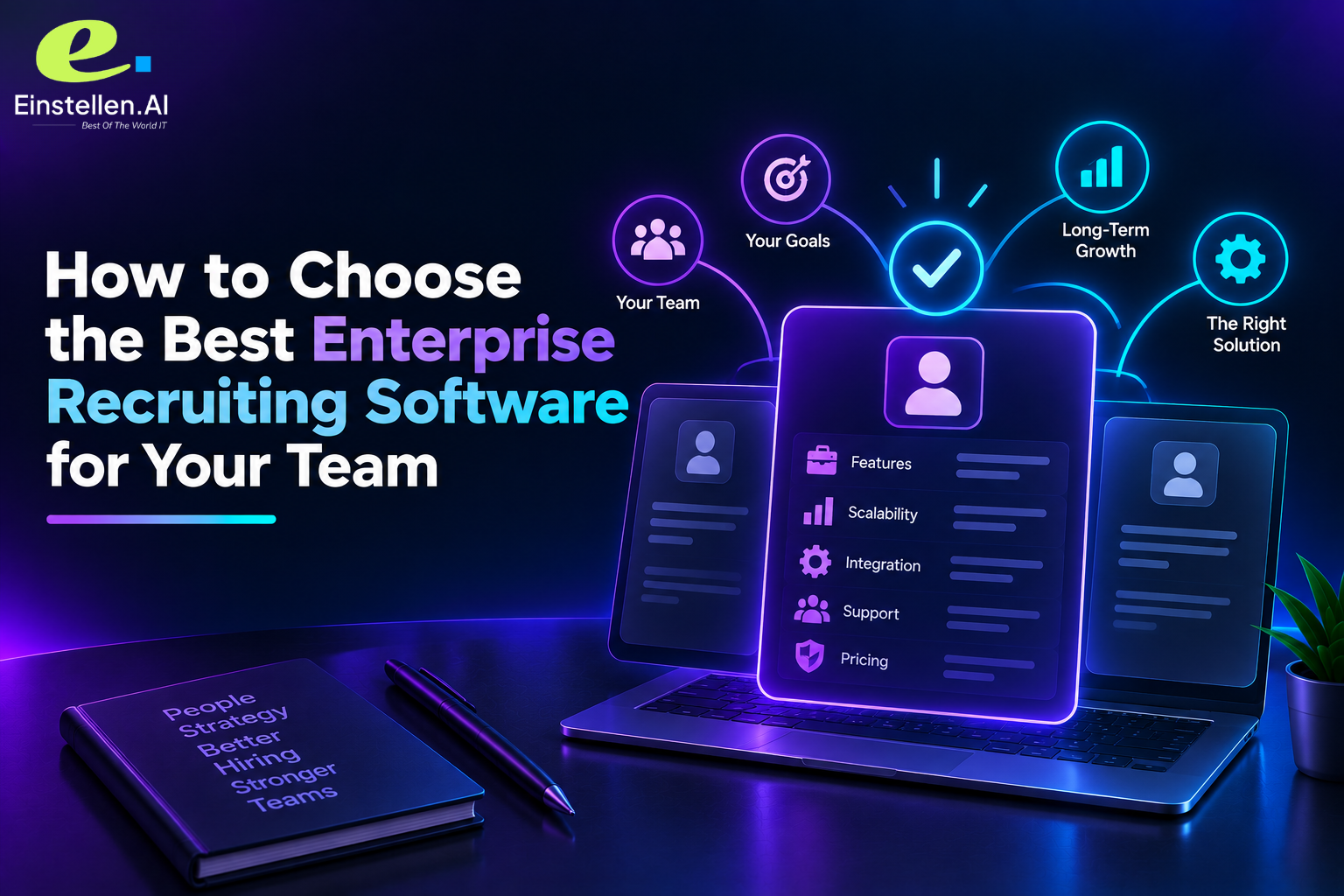
Start with the stack you already have, not the vendor's feature list. If an ATS is already embedded across the org, the real decision isn't "replace it." It's "what integrates cleanly on top of it." According to Calendly's guide, which cites G2, there are more than 1,300 enterprise recruiting software solutions listed on that platform alone across 13 categories, so filtering by ATS integration compatibility first cuts out most of the noise right away.
Second, ask for pricing in writing before the first call. Most enterprise vendors gate pricing behind a sales conversation, which slows down evaluation and hides the true cost until late in the cycle. Einstellen.AI's public model is flat, pay-as-you-go pricing per interview, with no subscriptions, no contracts, and credits that never expire.
Third, require a sample justification report, not just a sample score. Fourth, confirm ATS integration is included, not sold as an add-on tier. Companies are frequently surprised that this is standard rather than a paid upgrade, which tells you a lot about how conditioned the market has become to paying extra for baseline functionality.
How Long Does Enterprise Recruiting Software Take to Implement
Implementation timelines vary depending on how many ATS integrations and business units are involved, but the two biggest delays are usually data migration and workflow mapping across regions, not the AI layer itself. Since Einstellen.AI's Magic OS integrates with any ATS, including native bi-directional sync with Greenhouse, Lever, and Workday, at no additional cost, the integration step that typically stalls enterprise rollouts gets taken off the critical path entirely.
| Deployment Factor | Typical Enterprise Timeline | Notes |
|---|---|---|
| ATS integration setup | Fast when native sync exists | Greenhouse, Lever, Workday supported natively |
| Multi-location workflow mapping | Longest variable | Depends on number of business units |
| AI interview configuration | Short | Adaptive engine requires role calibration, not scripting |
| Compliance/security review | Runs in parallel | ISO 27001:2022, GDPR, SOC 2 Type II certificates available upfront |
Based on platform data from Einstellen.AI, covering 150,000+ AI interviews conducted and 1,200+ institutions on the platform.
Proof Point: Einstellen.AI has powered 150,000+ AI interviews across 1,200+ institutions, backed by IIM Lucknow and NASSCOM. MediAssist's enterprise deployment on the platform produced 92.5% fewer screening interviews required, 15-day average fulfillment, 100% position closure rate, and 60% interview-to-deployment conversion, with every score delivered with a structured justification report. The platform integrates with any ATS, including Greenhouse, Lever, and Workday, at no additional cost.
FAQ
What is enterprise recruiting software?
Enterprise recruiting software is a platform built for organizations hiring at high volume across multiple locations, adding AI screening, workflow automation, and compliance-grade analytics on top of the tracking function an ATS already provides. It's not a replacement for an ATS, more of an additional layer built for scale.
Is an ATS the same as enterprise recruiting software?
No. An ATS is a system of record that tracks candidates through pipeline stages. Enterprise recruiting software adds evaluation and automation capabilities, things like AI interview scoring and multi-location workflow management, that most ATS platforms simply aren't built to handle at enterprise volume.
How much does enterprise recruiting software cost?
Pricing varies widely by vendor, and most enterprise tools gate it behind a sales call. Einstellen.AI's public model is flat, pay-as-you-go pricing per AI interview, with no subscriptions, no contracts, no volume tiers, and credits that never expire.
Can enterprise recruiting software integrate with an existing ATS?
Yes, and honestly, it should be included at no additional cost rather than sold as an add-on. Einstellen.AI's Magic OS integrates with any ATS, with Greenhouse, Lever, and Workday supported as native, bi-directionally synced integrations.
Ready to Close the Explainability Gap in Your Hiring Stack?
Enterprise hiring teams don't need to choose between an ATS and enterprise recruiting software. What they actually need is an evaluation layer that plugs into the ATS they already run and gives every score a paper trail hiring managers and compliance teams can genuinely trust.
Einstellen.AI's MAGIC OS model delivers explainable, structured scoring backed by adaptive interviews, integrates with any ATS at no extra cost, and runs on transparent, pay-as-you-go pricing.
Post your first role and see a structured justification report for yourself. Visit Einstellen.AI's employer page to get started.







Leave a Comment
Share your perspective. Comments are moderated before publishing.