
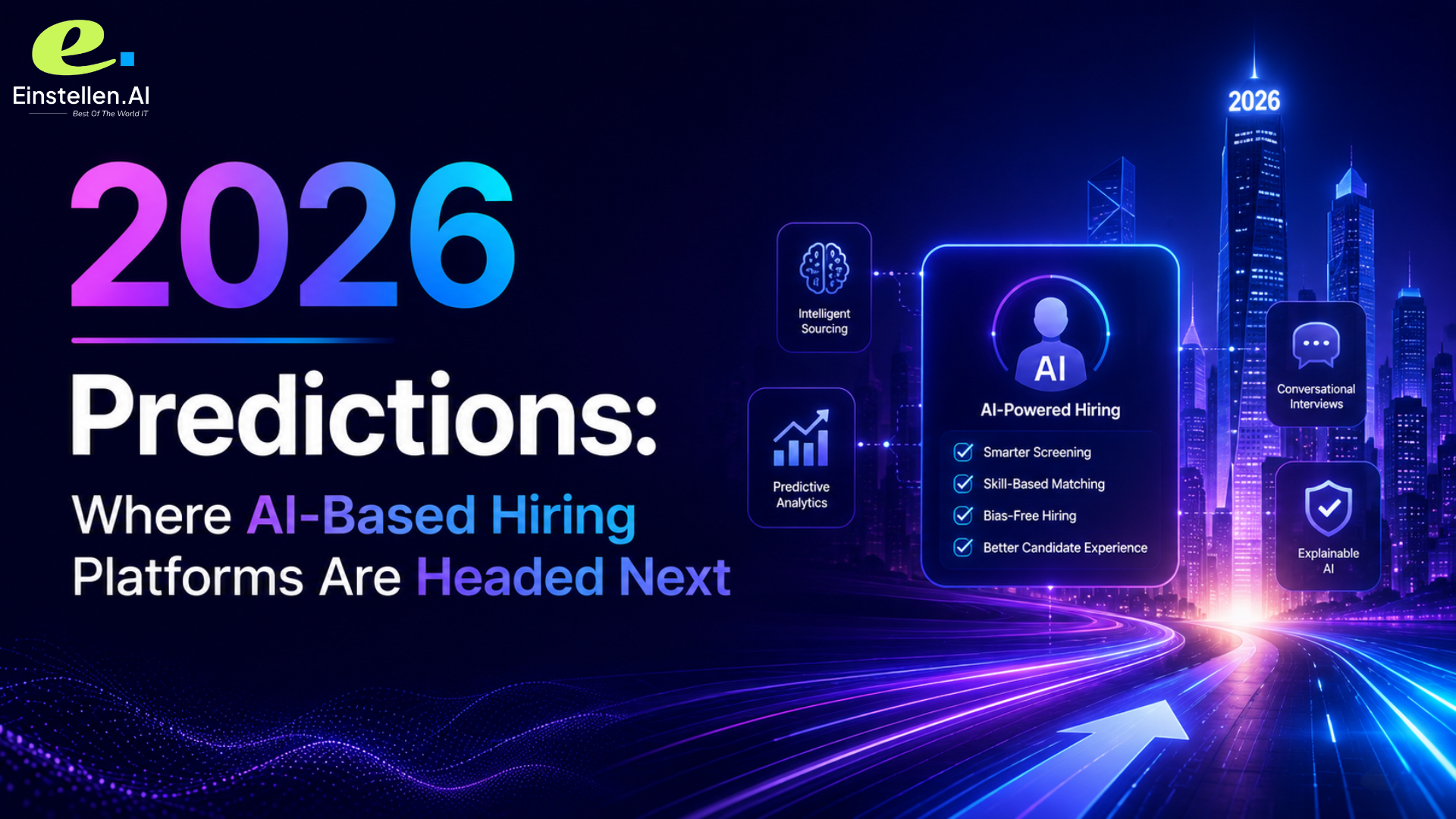
Quick Answer: In 2026, AI-based hiring platforms will compete less on automation speed and more on explainability. Expect adaptive interviews that adjust in real time, structured scoring reports candidates can actually read, stronger fraud detection for high-volume rounds, and pricing that's public rather than quote-gated. Trust, not just automation, becomes the deciding factor for both candidates and employers.
You finish an AI video interview, hit submit, and wait. No idea what was scored. No idea why. No idea if the system even understood your answer about that migration project you spent twenty minutes explaining. That silence is the actual candidate experience on most AI-based hiring platforms today, and it's exactly what 2026 is going to start correcting.
Most "2026 trends" pieces on AI hiring platforms talk to recruiters: sourcing automation, agentic pipelines, ATS integrations. Almost none of them ask what changes for the person sitting on the other side of the webcam. That gap is the real story here. The platforms that win the next stretch will be judged on whether they can show their work, not just on how fast they can screen a stack of resumes.
Agentic AI Recruiting 2027: What Actually Changes for Candidates
"Agentic AI recruiting" is the phrase showing up across HR-tech blogs for 2027 roadmaps, and it usually means AI agents that source candidates, schedule interviews, and route approvals without a recruiter touching each step. For candidates, though, the version of "agentic" that actually matters isn't the sourcing side. It's whether the interview itself behaves like an agent responding to you, or like a script that runs regardless of what you say.
A fixed-script AI interview asks the same five questions no matter how you answer the first one. An adaptive, agentic interview listens to what you actually said and decides the next question based on it. Give a vague answer about a specific project, and the system probes deeper on that project instead of jumping to some unrelated scripted item. Einstellen.AI's humAIn engine works this way: autonomous adaptive questioning that goes deeper exactly where your answer reveals something worth exploring, instead of just checking boxes on a fixed list.
Here's the practical effect for you as a candidate: a stronger, more specific answer actually gets explored further instead of getting cut off by the next scripted prompt. That's a meaningfully fairer test of what you know. It's closer to how a skilled human interviewer would probe, and it's the direction serious platforms are heading through 2027.
Read More: AI Hiring Platform Interview Etiquette: What to Do and Never Do
Quality of Hire vs Time to Fill in 2027: Why This Matters to You
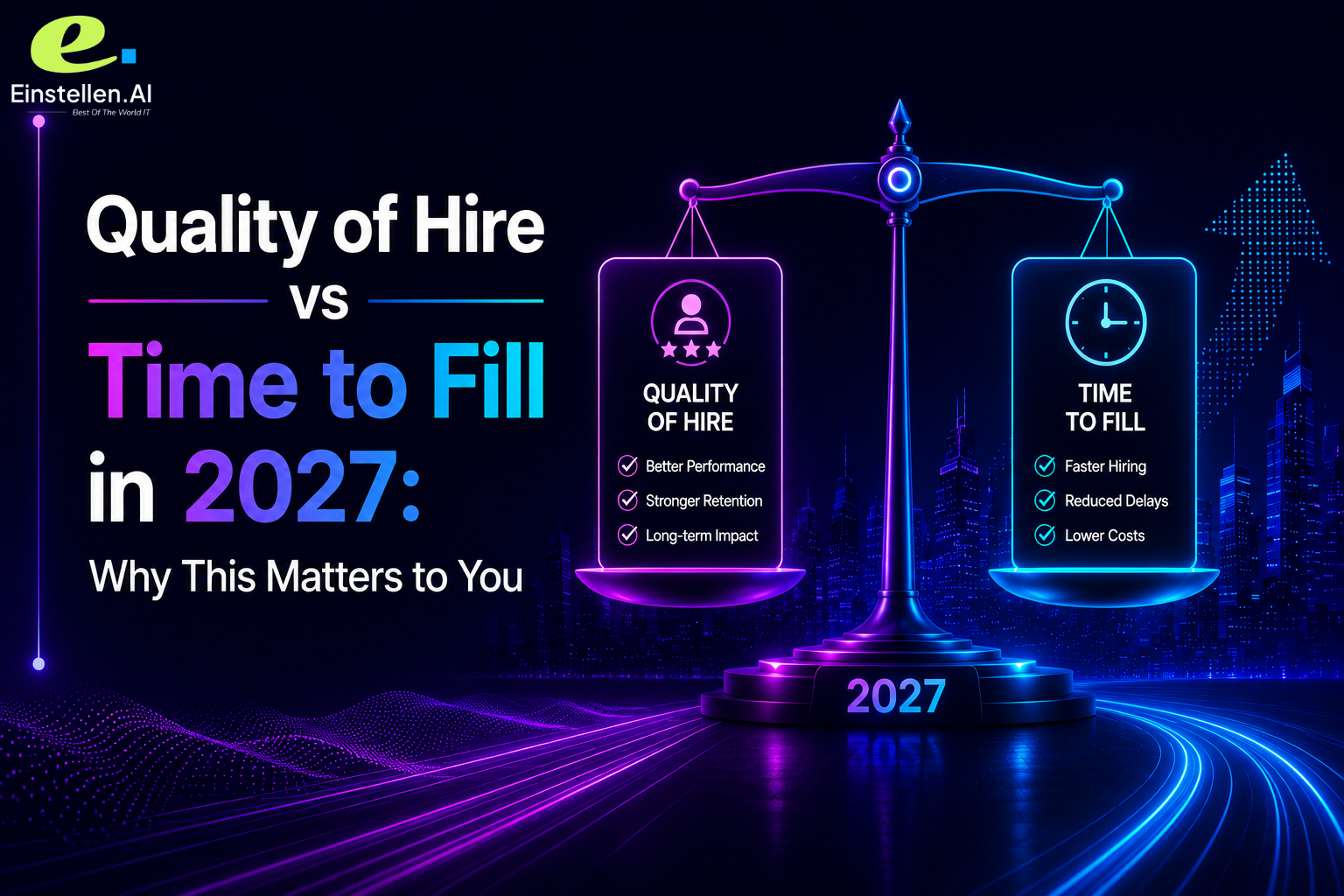
Employers have spent years optimizing "time to fill," basically how fast a role gets closed. The 2027 conversation is shifting toward "quality of hire" instead, meaning whether the person hired actually performs once they're in the seat. This shift matters to candidates directly, because platforms optimized purely for speed tend to produce shallow, generic screening that rewards keyword-matching over actual substance.
Why the shift? It's blunt, honestly: scores from black-box AI tools haven't reliably correlated with on-the-job performance. Hiring managers evaluating AI vendors are now asking the tools to justify a score, not just spit one out. On Einstellen.AI, every interview generates a per-answer scored report with a full transcript, so a hiring manager reviewing a borderline candidate can see exactly which answer drove which part of the score. Not just a final number sitting there with no explanation.
For you, this is good news if you interview well but don't always look great on paper. A platform optimizing for quality of hire has more incentive to surface a genuinely strong answer buried in an unconventional resume, because the report shows the reasoning behind it. And a recruiter dismissing a well-justified score without cause becomes a lot harder to defend internally.
AI Candidate Fraud Detection: What It Protects You From
Fraud detection sounds like something built purely to catch cheaters. It is that, but it also protects honest candidates. In high-volume rounds, think campus placements or bulk enterprise hiring, proxy interviewing (someone else answering on a candidate's behalf) and AI-generated answer scripts distort the whole pool. If a platform can't catch this, honest candidates end up compared unfairly against inflated scores from people gaming the system.
Einstellen.AI builds fraud and proxy detection directly into the interview process, which matters most at scale. Campus placement drives and large enterprise screening rounds are exactly where impersonation attempts concentrate. The mechanism stays general by design; publishing exact detection logic would just help bad actors work around it, but the presence of this layer is a meaningful thing to check for when you're deciding which AI interview process gets your actual shot at a role.
EU AI Act Compliance and What It Signals About a Vendor
The EU AI Act classifies AI systems used in recruitment and candidate evaluation as high-risk. That means vendors selling into that framework face requirements around transparency, human oversight, and documentation of how a system reaches a decision. India doesn't have equivalent binding legislation yet, but the underlying expectation that an AI hiring decision should be explainable and reviewable is becoming the global default for how these tools get judged by serious buyers, regardless of jurisdiction.
For a candidate, this is a useful filter even outside any legal context. If a platform can't tell you what its score means or how it got there, that's the same failure mode regulators are targeting: a decision with real consequences and no accessible reasoning behind it. "Can I see why I scored this way?" is a fair question to bring into any AI interview process in 2026, whether or not the vendor even operates under EU jurisdiction.
The Trust Gap Every AI-Based Hiring Platform Must Close
The candidate sentiment data explains why this shift is happening now rather than later. According to enhancv.com, 47.7% of candidates agree AI hiring tools are biased against their age, race, gender, or background. Separately, employerbranding.news reports that 87% of companies now use AI in hiring, while only 26% of candidates trust it to evaluate them fairly, and 67% of job seekers feel outright uneasy about AI-led hiring systems.
That gap, 87% adoption against 26% trust, isn't something employers can smooth over with better messaging. It's structural. Candidates don't distrust AI interviewing as an idea; they distrust not knowing why they were scored a certain way. A platform that closes that gap with a visible, structured report instead of a bare number is solving the actual problem, not just the perception of it.
Where the Money Is Going
Market sizing backs up why vendors are racing to fix this. GlobeNewswire reports the AI in talent acquisition industry stood at $1.35 billion in 2025 and is projected to keep climbing through predictive analytics adoption. That capital is chasing platforms that can prove their scores hold up, not just platforms that screen faster.
| Trend Shaping 2026-2027 | What Changes for Candidates | What to Ask a Platform |
|---|---|---|
| Agentic, adaptive interviewing | Deeper follow-up on strong answers, not a fixed script | Does the interview adjust questions based on my actual answers? |
| Quality of hire over time to fill | Scores start correlating with real job performance | Is there a report showing why I scored this way? |
| Fraud/proxy detection at scale | Fairer comparison in high-volume rounds | Does the platform screen for impersonation and scripted answers? |
| EU AI Act-style transparency norms | Explainability becomes a baseline expectation, not a bonus | Can I see the reasoning behind my evaluation? |
Proof point: Einstellen.AI has conducted 30,000+ AI interviews across 1,200+ institutions, with every interview producing a per-answer scored report and full transcript rather than an unexplained ranking.
FAQ
What is an AI-based hiring platform and how does it work?
An AI-based hiring platform uses machine learning to screen, interview, and evaluate candidates, usually combining resume parsing, chatbot or video interviews, and predictive scoring. The more advanced versions, like Einstellen.AI's humAIn engine, use adaptive questioning that responds to what a candidate actually says instead of running through a fixed set of questions regardless of the conversation.
Are AI hiring platforms biased against candidates?
Some documented research raises real concerns here. Stanford HAI's research on AI hiring tools found that 26% of Black applicants and 15% of Asian applicants applied to positions where the AI system discriminated against their racial group, documenting racial disparities that are exactly what explainable scoring is designed to surface and address. This is exactly why explainable scoring, where you can actually see the reasoning behind an evaluation, matters more than ever when you're deciding which process to trust.
Will AI replace recruiters in 2026?
No. AI-based hiring platforms are handling more of the screening and interview volume, sure, but hiring managers still review reports, make the final call, and manage the relationship. What's changing is what recruiters review: a structured, justified score with a transcript attached, rather than raw applications or an opaque ranking with no reasoning behind it.
How can I tell if an AI interview is evaluating me fairly?
Look for whether the platform shows you, or your future employer, a structured justification for the score rather than just a number. Ask whether the interview adapts to your specific answers or runs a fixed script regardless, and check if the platform mentions fraud/proxy detection. That's a sign the scoring pool itself is being kept honest.
Find Your Next Role With a Process You Can Trust
If you're tired of applying into a black hole, an AI-based hiring platform built on structured justification, not an unexplained score, is worth the switch. Einstellen.AI gives you access to active, current listings and an interview process that shows its work. Every interview you take produces a report you can actually understand.
Registration and applying are completely free for candidates. Create your profile on Einstellen.AI, browse active listings across Bangalore, Hyderabad, Mumbai, Pune, Delhi NCR, and Chennai, and take an interview that adapts to what you actually say. Register today and see the difference explainable scoring makes to your job search.






Leave a Comment
Share your perspective. Comments are moderated before publishing.