
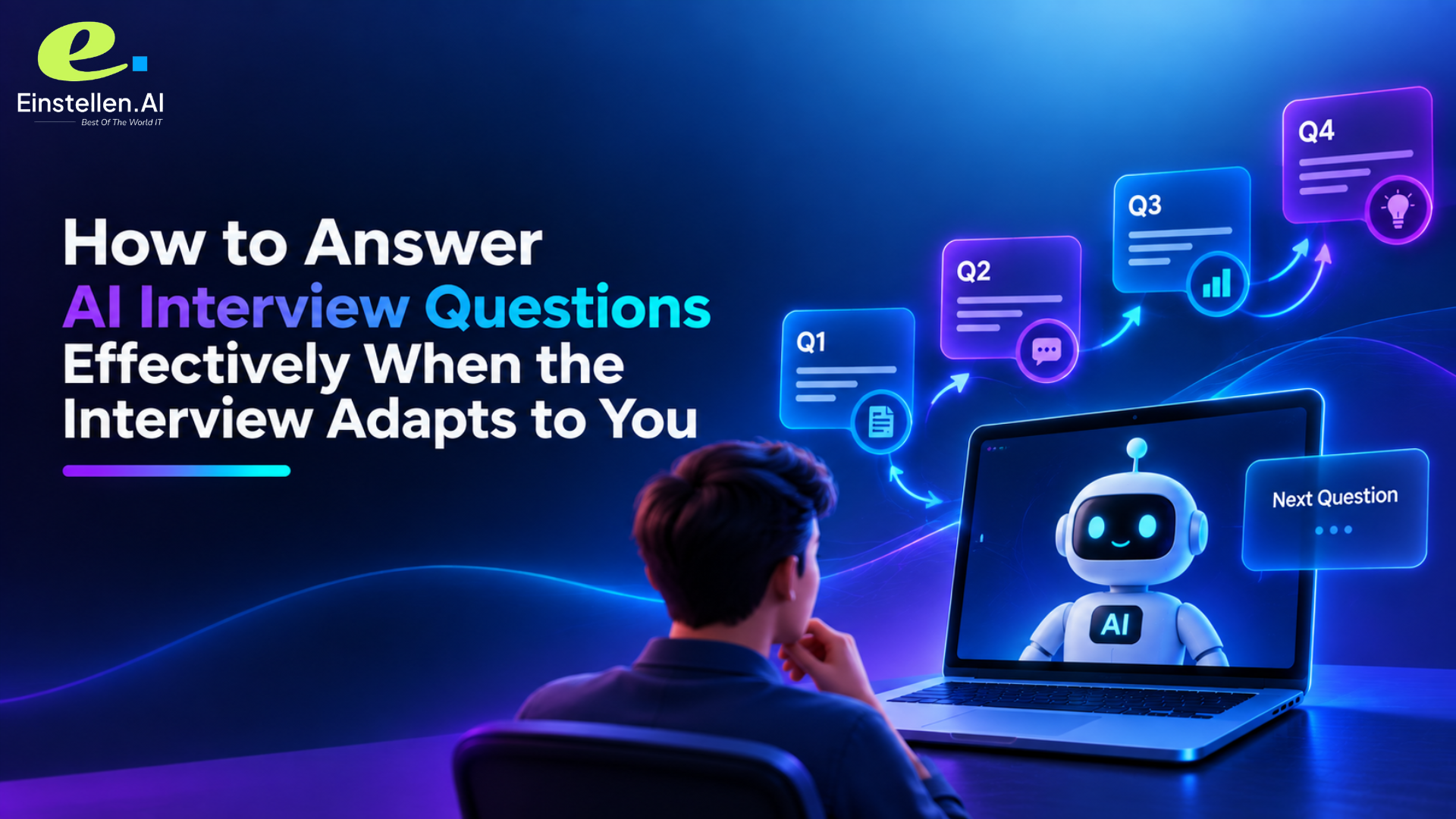
Quick Answer: To answer AI interview questions effectively, treat every response as the setup for the next question, not a box you tick and move past. Adaptive engines like humAIn dig deeper into vague or interesting answers, so front-load specific, structured examples. A vague answer doesn't get skipped. It gets a follow-up that exposes the gap.
Say you finish answering a question about a project you led. Instead of a generic next item, the interview asks you to walk through exactly how you handled one decision you just mentioned in passing. If you'd only prepped for a fixed list of expected questions, that would catch you flat-footed. That's really the whole ballgame when it comes to answering AI interview questions well: the system in front of you is adaptive, not scripted, and your prep has to account for that.
A lot of career advice floating around still assumes AI interviews run a static list, the same five questions to every candidate, no matter what they say. That assumption doesn't hold up anymore. Adaptive AI interview engines change the game, and getting ready for one takes a different mindset than polishing rehearsed answers to rehearsed prompts.
How Adaptive AI Interviews Work
An adaptive AI interview doesn't run a fixed script. It listens to your actual answer and builds the next question from what you just said, instead of marching through a checklist regardless of how the conversation is going. Einstellen.AI's humAIn engine works exactly this way: give a vague answer about a specific project, and it presses further on that project specifically, rather than jumping to some unrelated scripted line.
That changes what "good preparation" actually looks like. A single polished answer to "tell me about a challenge you faced" won't carry you, because whatever comes next depends entirely on the details you drop in that first answer. Mention a metric, a tool, or a decision point; the system will likely ask you to unpack it.
Here's the upside, if you understand this going in: an adaptive interview behaves a lot more like a skilled human interviewer than a form to fill out. It rewards real depth of experience over a memorized script, simply because there's no follow-up path you can memorize in advance when it depends on your own words. For someone who's actually done the work they're describing, that's a fairer test, structurally.
AI Interview Preparation Tips That Actually Match How Adaptive Systems Work
Standard interview advice says: prepare STAR-format stories and call it done. For an adaptive interview, that's step one. Not the whole plan.
Build every example with at least two layers underneath it. State the outcome, sure, but also know the specific numbers, tools, and decisions that got you there, because the follow-up question is probably going to ask for exactly that layer. Say you "improved deployment speed"? Be ready to explain what the old process looked like, what you actually changed, and what the measured improvement was.
Skip vague claims you can't defend under a follow-up. "I'm good at problem solving" is basically an invitation for the system to ask you for a concrete instance. Give the instance the first time around, and you cut off that risk before it starts.
Practice speaking in complete, specific units instead of fragments. Adaptive systems, humAIn included, build the next question out of what you actually said, so a rambling or half-finished answer just gives you a weaker follow-up path to show depth on. Think of each answer as its own self-contained, specific statement.
How to Prepare for an AI Interview Without Overthinking the AI Part
Candidates spend a surprising amount of energy trying to "game" the AI instead of just preparing substance. Mostly wasted effort, honestly, since there's no fixed script to reverse-engineer here.
Prepare the way you would for a tough human interviewer: know your own resume cold, including projects from two or three years back, because adaptive questioning can circle back to anything you've mentioned. Read the job description and line up two or three real experiences against its requirements before you even log in.
Handle the practical stuff too. Test your mic and your connection beforehand. Fraud and proxy detection, which is part of Einstellen.AI's platform as an interview integrity measure, is built to flag irregular conditions, not to punish a normal setup. A quiet, stable environment just takes friction out of the conversation.
And don't try to guess "what the AI wants to hear." Adaptive systems weigh what you actually said against a structured framework, not a keyword match. Talking naturally and specifically beats performing what you think an ideal candidate sounds like, every time.
Why Explainable Scoring Changes How You Should Think About the Result
A lot of candidates are afraid of being judged by some unexplained score with zero visibility into the reasoning. Fair fear, honestly, some platforms in this category really do hand you a ranking with no accessible justification attached.
Einstellen.AI's MAGIC OS model works differently. Every score comes with a structured justification attached to it. The report shows exactly which answer drove which part of the score, so if you're reviewed for a borderline call, the reasoning is right there, not buried behind one number.
That should shift how you prepare. Rather than guessing at some opaque formula, focus on giving answers a hiring manager could read the justification for and nod along to. If your answer to a technical question is thin, the report reflects that specifically, tied to that specific answer, not as some vague overall deduction.
 And because the evaluation is explainable, you can request or review your own report content where the process allows it, not just your outcome, but the actual reasoning trail behind it.
Common Mistakes Candidates Make With Adaptive AI Interviews
Reusing the same story for every question is the single most common mistake. Adaptive interviews notice when depth is missing, and recycling one strong anecdote across several different questions just gives you thinner material to work with each time it comes back around.
Rushing the first answer to "get to the real questions" is another one. In an adaptive system, that first answer often shapes everything downstream, so a rushed or shallow opener sets up a shallower interview overall, not a faster one.
Treating fraud detection like it's out to get you also causes a lot of unnecessary stress. It exists for interview integrity at scale, especially in high-volume situations like campus placement drives, not to penalize a normal candidate doing normal candidate things.
Salary Context for Roles Commonly Screened With AI Interviews
Software engineering, data, and QA roles get screened through adaptive AI interviews most often at scale, particularly in high-volume hiring rounds. Knowing where you sit in the market helps you walk in with the right expectations.
| Role | City | Fresher (0-2yr) | Mid (3-6yr) | Senior (7+yr) |
|---|---|---|---|---|
| Software Engineer | Bangalore | ₹4-8L | ₹18-35L | ₹35-65L |
| Data Engineer | Bangalore | ₹5-9L | ₹20-36L | ₹36-62L |
| QA Automation Engineer | Bangalore | ₹3-6L | ₹12-24L | ₹24-42L |
| Data Scientist | Bangalore | ₹5-9L | ₹20-40L | ₹40-70L |
| Software Engineer | Hyderabad | ₹4-7L | ₹17-32L | ₹32-58L |
Proof point: Einstellen.AI's humAIn engine has conducted 30,000+ AI interviews across 1,200+ institutions, each producing a per-answer scored report with a full transcript, giving hiring managers visibility into exactly what was asked, what was answered, and why a given score was assigned.
According to the World Economic Forum's Future of Jobs report, employers increasingly prioritize demonstrated analytical and problem-solving skills over credentials alone, which lines up with why adaptive interviews probe for real depth instead of rehearsed answers.
FAQ
Can candidates cheat an adaptive AI interview?
The platform includes fraud and proxy detection as part of the interview process. The exact detection mechanisms stay generally public on purpose, since spelling them out would just help bad actors route around them, but the system is built for interview integrity at scale, especially for high-volume hiring rounds and campus placement drives.
How is an adaptive AI interview different from a black-box AI interview tool?
An adaptive interview builds its next question from your actual previous answer instead of running a fixed script. It's also paired with structured, justified scoring rather than an unexplained ranking, so a hiring manager reviewing your report sees the reasoning behind it, not just a number sitting there unexplained.
How accurate is AI interview scoring?
Einstellen.AI doesn't publish a single accuracy percentage, and that's a deliberate position. An accuracy number without a published criterion-validity study behind it is a marketing claim, not a verified finding. Instead of a number you'd have to take on faith, every score on this platform comes with a full interview transcript and a per-answer justification report, so a hiring manager can evaluate the reasoning directly rather than trusting a figure that can't be audited.
What should I do differently to prepare for an adaptive interview versus a normal one?
Build layered examples with specific numbers, tools, and decisions behind each outcome, since follow-ups dig into exactly those details. Skip vague claims, speak in complete, specific statements, and treat your first answer as setting the tone for everything that follows.
Ready to Practice on Real Active Listings?
Understanding how adaptive AI interviews work only matters once you're applying to real, current roles instead of stale listings sitting around from months ago. Einstellen.AI gives you access to active candidate opportunities and transparent salary benchmarking, so you know exactly what to expect before you walk into any interview, AI-driven or otherwise.
Browse software engineer jobs and other active listings on Einstellen.AI, create your profile, and see what an interview process built to be explainable, rather than opaque, actually feels like. Create your profile today and start applying to roles where the evaluation process respects your time and your actual answers.








Leave a Comment
Share your perspective. Comments are moderated before publishing.