
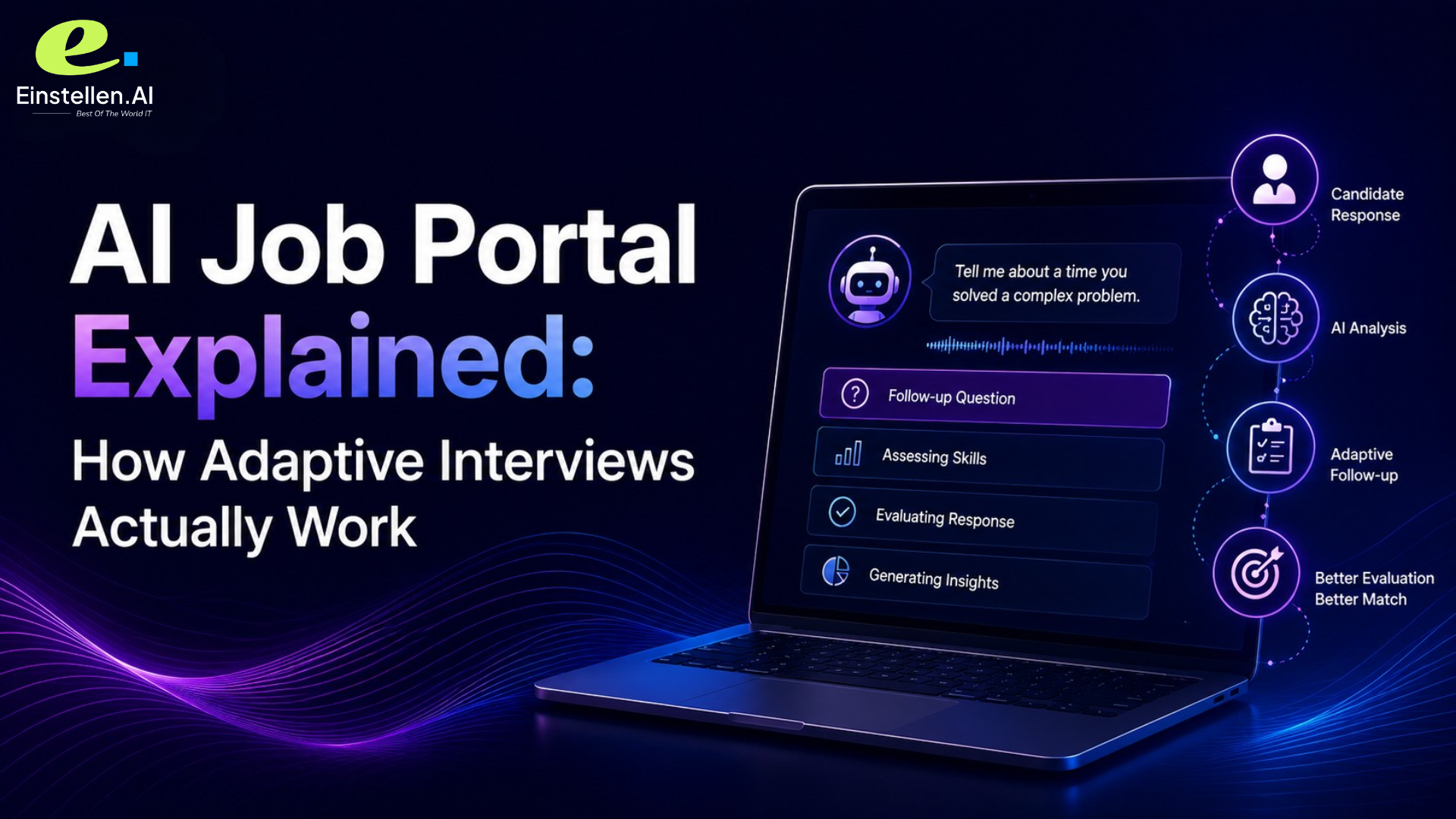
Quick Answer: An AI job portal combines active job listings with an AI-driven interview and feedback loop in one flow. Adaptive interviews, like Einstellen.AI's humAIn engine, listen to your actual answer and generate the next question based on it, then produce a structured, justified score with a full transcript, not just a pass/fail number.
You finish an AI interview, submit it, and wait. Two days later: rejected, no explanation, no way to know if your answer to the second question tanked your score or if something else happened entirely. Most job seekers describe exactly this when they talk about AI interviews. It's the gap that makes "AI job portal" such a confusing term to search for. Results mix up AI-industry job boards, resume-autofill tools, and enterprise interview software sold to recruiters. Almost nothing out there is written for the person actually sitting in front of the webcam.
An AI job portal, done properly, isn't just a listings page with a chatbot bolted on. LinkedIn's January 2026 India job search report found that 90% of Indian professionals plan to use AI tools in their job search in 2026, yet 84% still feel unprepared to find a new role, suggesting the tools exist, but the experience of actually using them well doesn't. It's one flow that takes you from finding an active role, through an adaptive interview, to seeing a real, structured reason for your score. That last part is where most platforms go quiet. This article breaks down how adaptive AI interviews actually work under the hood, how that's different from the fixed-script interviews a lot of candidates have already sat through, and what you should reasonably expect to see about your own evaluation.
Dynamic Branching vs Adaptive AI Interview: What's Actually Different
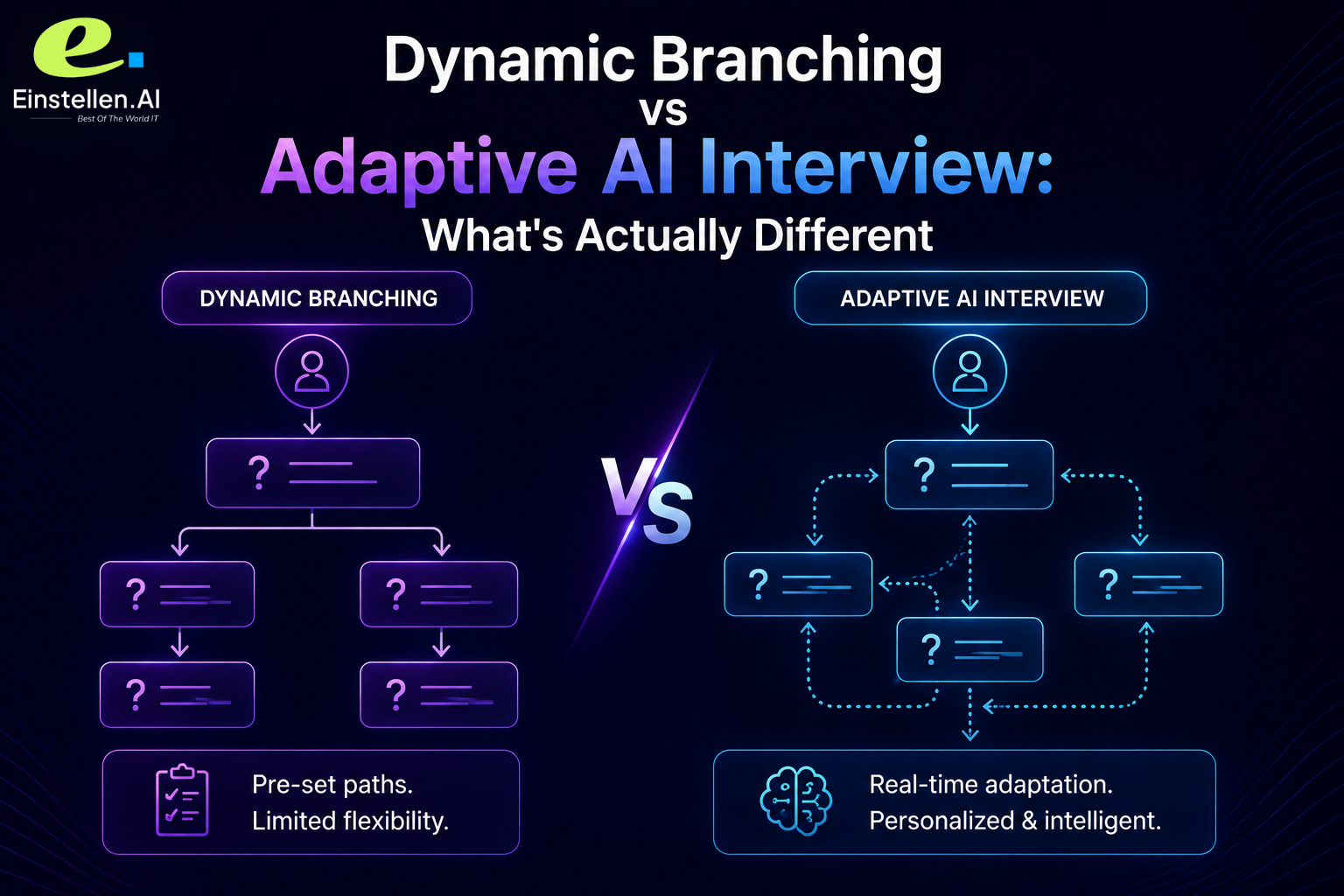
Most AI interview tools run on dynamic branching. Think of it as a decision tree: your answer routes you down one of several pre-written paths. It looks responsive on the surface, but every possible question was scripted well in advance. The system just picks a branch. It doesn't generate anything new.
An adaptive interview works differently. Einstellen.AI's humAIn engine listens to what you actually said and builds the next question out of that specific content, instead of selecting from a pre-built tree. A 2026 peer-reviewed study in Scientific Reports examining adaptive AI interviewers found the same mechanism: for each response, the system decides whether a follow-up is warranted and generates a tailored question from the specific content of the answer, rather than selecting from a pre-built library. Mention a specific project in a vague way, and the next question gets built around that project. It's not pulled off a menu of generic follow-ups.
The practical difference shows up in signal quality. A branching system can only ever ask what someone anticipated when they built the tree. An adaptive system can ask about something you brought up that nobody predicted because it's reasoning from your actual sentence, not matching it to the nearest scripted category. The mechanism is straightforward: the system evaluates whether an answer is specific enough to move on from, or incomplete enough to probe further. Give a clear answer with a real example and outcome, and the system typically moves forward. Leave a gap, and the next question goes directly into that gap.
Read More: AI Hiring Platform Interview Etiquette: What to Do and Never Do
AI Question Sequencing: What Actually Triggers a Deeper Follow-Up
Here's the trigger point candidates should actually understand: vagueness or incompleteness in an answer is what typically prompts a deeper probe. It's not a fixed number of questions per topic.
Give a full, specific answer with a clear example, metric, and outcome, and an adaptive system will often just move on. Give a partial or generic answer, something like "I worked on optimizing the database" with no detail, and the system is far more likely to dig in. What specifically did you change? What was the measured result? What did you try that didn't work?
So prep for an adaptive interview looks different than prepping for a scripted one. Rehearsing five expected answers doesn't help much if the system is going to probe wherever your first answer left a gap. The better move is being ready to go two or three layers deep on your own real projects, because that's exactly where the system is built to go.
AI Interview Follow-Up Probing Methodology in Practice
There's an industry-wide pattern here: most AI interview tools score candidates against a role-specific rubric and hand the recruiter a ranked shortlist. What's missing from almost all of that coverage is what the candidate gets to see about that same rubric. Usually, nothing. 
On Einstellen.AI, the MAGIC OS model is the evaluation framework behind every score, and it doesn't output a bare number. Every score comes paired with a structured justification showing which parts of your answers drove which part of the result. The report shows exactly which answer contributed to which portion of the score. If you're a borderline candidate, you get to see the actual reasoning instead of a rejection with no basis given.
That flips the explainability conversation most vendor content is having. Most of it explains why a recruiter should trust an AI-generated shortlist. Very little explains why a candidate should trust the process that just evaluated them. A transcript and a justified score are what actually close that gap.
AI Interview Transcript Real-Time Scoring: What Happens While You Talk
Scoring on an adaptive platform isn't one verdict handed down at the end. Each answer gets scored as it's given, and the full transcript, question by question, answer by answer, is kept alongside those per-answer scores.
That matters for two reasons. First, fraud and proxy detection runs inside the interview itself, which counts for a lot at scale, think campus placement drives or high-volume enterprise hiring rounds, where nobody can manually police interview integrity across thousands of candidates. Second, if you're reviewing your own report afterward, you can trace a specific low score back to a specific answer instead of just being told the overall result missed the bar.
That's a meaningfully different experience than a black-box ranking with no accessible reasoning behind it, which happens to be the most common complaint TA heads and hiring managers raise about competitor AI interview tools: scores that don't correlate with how a candidate actually performs on the job, because there was never a visible basis for the score in the first place.
Read More: What Happens After You Finish an AI Interview? A Walkthrough
What an AI Job Portal Should Give You Beyond the Interview
A genuine AI job portal isn't just the interview step. It's active, current listings (not a static resume database sitting untouched for months), a salary benchmark you can actually check against real market data, and an interview process where you can see the basis for your evaluation instead of guessing at it.
Access shouldn't require an enterprise sales call either. Einstellen.AI's public pricing model is pay-per-use, no subscriptions, no contracts, built specifically so individual access to a fair, explainable interview process isn't locked behind enterprise-only pricing. That's a different posture than most AI interview vendors, who quote enterprise clients privately and rarely publish a rate a job seeker could actually look at.
AI Job Portal vs Traditional AI Interview Tools: Quick Comparison
| Factor | Fixed-script / dynamic branching tools | Adaptive AI job portal (Einstellen.ai) |
|---|---|---|
| Question generation | Pre-written tree, selects a branch | Generates next question from your actual answer |
| Score output | Single ranked number to recruiter | Score paired with structured justification and full transcript |
| Candidate visibility | Typically none | Per-answer report showing what drove the score |
| Fraud/proxy detection | Varies by vendor | Built into the interview process |
| Access model | Enterprise quote, often contract-based | Pay-per-use, no subscription, no contract |
Proof point: Einstellen.AI has conducted 30,000+ AI interviews across 1,200+ institutions, each producing a per-answer scored report with a full transcript rather than an unexplained rank.
FAQ
What is an AI job portal, and how is it different from a normal job site?
A normal job site is a static listings database you search and apply through manually. An AI job portal adds an active-candidate layer plus an AI-driven interview step, where the platform screens you with adaptive questioning and hands back a scored, explained result. No waiting around indefinitely with zero visibility into what happened.
How does an AI adaptive interview decide what question to ask next?
It listens to your actual answer and builds the next question from what you specifically said, rather than choosing from a pre-built branching tree. Vague or incomplete answers are the most common trigger for a deeper follow-up on that exact topic, not a scripted march to the next unrelated question.
Can I see why I passed or failed an AI interview?
On Einstellen.AI, yes. Every interview produces a per-answer scored report with a full transcript, using the MAGIC model's structured justification instead of an unexplained number. You can see which specific answer contributed to which part of your score, instead of getting a single black-box result with no reasoning behind it.
Do I need to install anything or sign a contract to use an AI interview portal?
No. Einstellen.AI's public model is pay-per-use, no subscriptions, no contracts, no volume commitments, and credits don't expire. There's no separate app to install to complete an interview through the platform.
Ready to Experience an Explainable AI Interview?
If you're tired of AI interview rejections with no reasoning attached, the right AI job portal is built around the opposite approach: explainable scoring from the first question to the last. Einstellen.AI's adaptive interview engine asks questions based on what you actually say, and every score comes with a structured report you can actually read and understand.
Registration and application are completely free for candidates. Browse active listings and create your profile to get matched with roles where the evaluation process is visible from the first question to the last.







Leave a Comment
Share your perspective. Comments are moderated before publishing.