
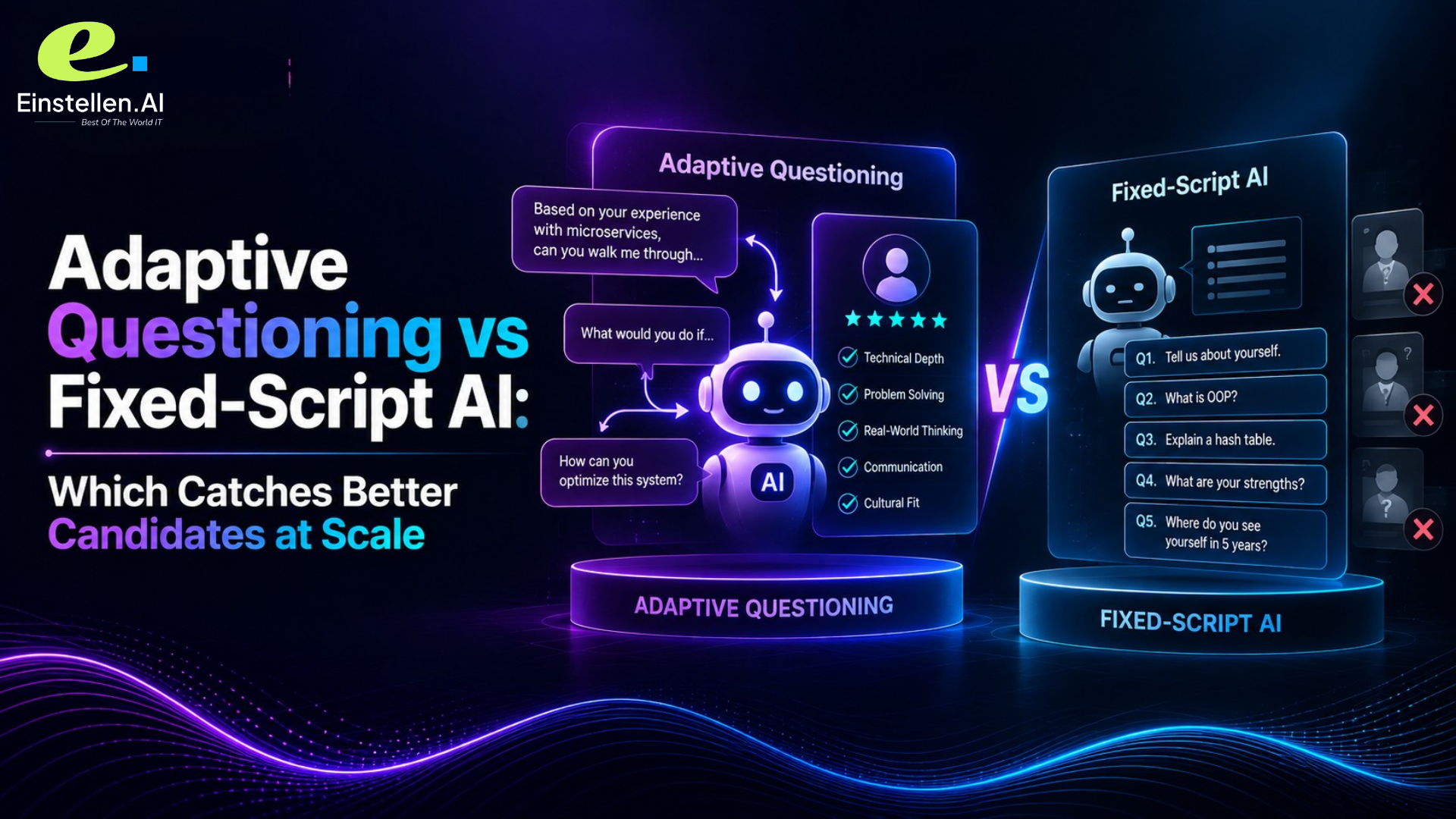
Quick Answer: An adaptive AI interview hiring platform generates each question based on the candidate's previous answer, probing deeper where responses are vague. A fixed-script AI interview asks the same questions regardless of what was said. Adaptive questioning produces richer, more human-like signal at volume, which is why it matters most in high-volume rounds like campus placements and bulk enterprise hiring.
Picture a TA head running 4,000 first-round interviews for a bulk engineering hiring drive. A fixed-script tool fires the same five questions at every candidate, whether they gave a sharp answer or a rehearsed one. By the time reports land on the recruiter's desk, half the "top-ranked" candidates can't repeat what the transcript says they said in a follow-up call. It happens more often than you'd think. This is the exact failure mode that pushes hiring teams to search for an adaptive AI interview hiring platform instead of another static test.
The difference isn't cosmetic. A fixed script can't tell the difference between a candidate who gave a vague answer because they don't know the material and one who gave a vague answer because the question was oddly worded. Adaptive questioning can, because it asks a follow-up in the moment, do the same as a sharp human interviewer would.
How Adaptive AI Interviews Improve Candidate Evaluation
Adaptive AI Interviews means the system listens to what a candidate just said and generates the next question from that answer, instead of working through a checklist regardless of the conversation. This is how Einstellen.AI's humAIn interview engine operates within Magic OS.
Say a candidate gives a vague answer about a specific project. The system probes further on that project specifically, rather than jumping to an unrelated scripted item. Over the course of an interview, this compounds. A fixed-script tool asks five preset questions no matter what. An adaptive engine can ask five questions or fifteen, depending on where the conversation reveals something worth exploring and where it doesn't.
The output isn't just a longer transcript. It's a transcript that looks a lot closer to what a skilled human interviewer would pull out of a real conversation, because the system is reacting to substance instead of executing a script. For a hiring manager reviewing a borderline candidate later, that difference shows up directly in the report: more specific probing on the areas that actually mattered, less time wasted on scripted questions the candidate had clearly already prepared for.
Fixed-Script AI Interview Tools: The Structural Limit
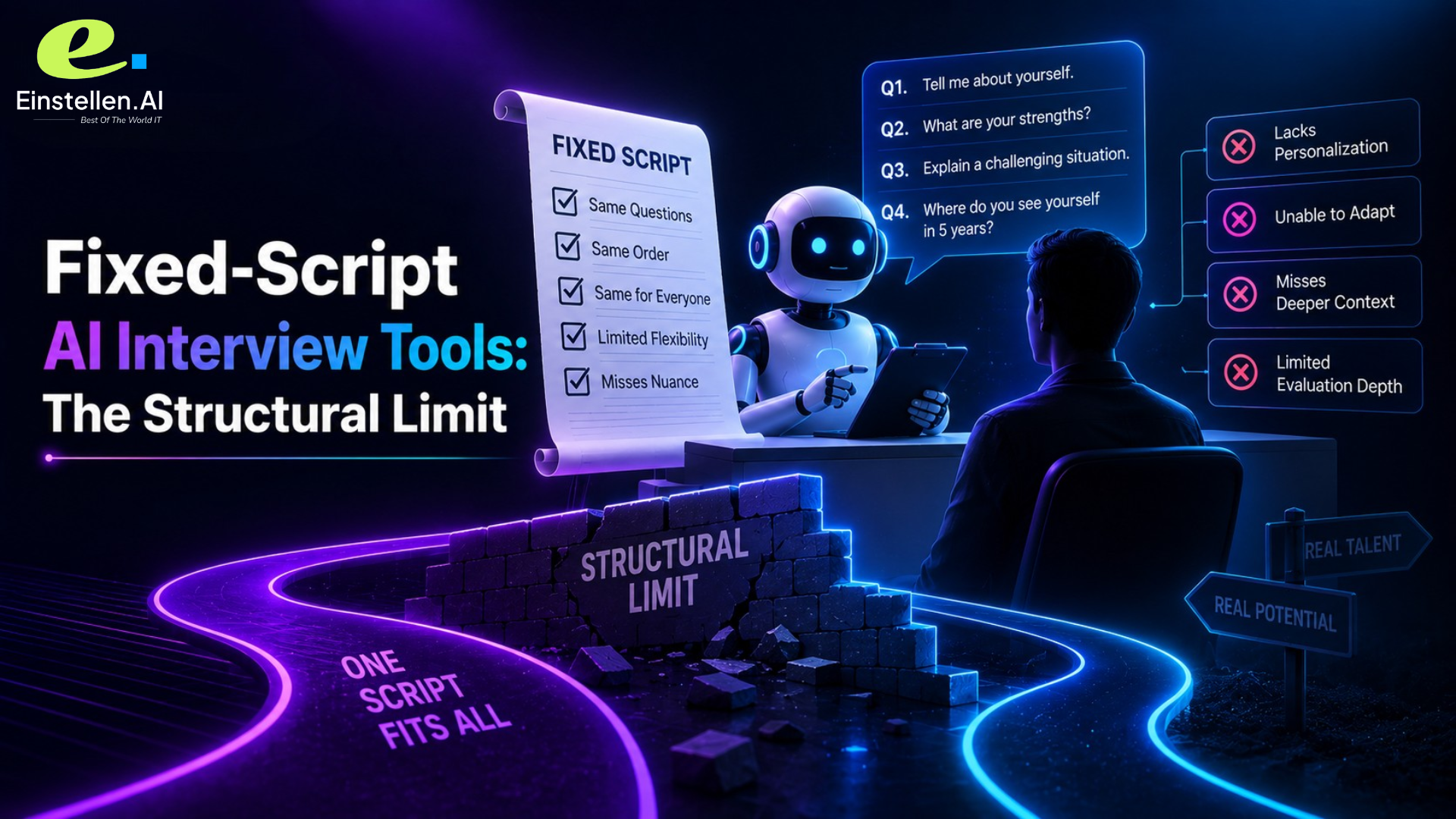
A fixed-script AI interview isn't a bad idea badly executed. It's a structurally different design choice, and it has a real ceiling. Because the question sequence is predetermined, candidates who've seen similar question banks before, and this happens constantly at campus scale, where question sets circulate among students within days, can prepare targeted answers without ever demonstrating real depth.
The tool still produces a ranking. That's the trap. A ranking looks like a result, but if the questions never adapt to probe deeper into a weak answer, the ranking is measuring how well someone prepared for a predictable format, not how they'd perform on the job. Most competitor platforms in the AI interview category are built around this fixed-progression model paired with a score that offers no reviewable justification for how it was reached.
This is the pattern Einstellen.AI hears repeatedly from TA heads: AI interview scores from other platforms don't correlate with actual on-the-job performance, and the complaint is never about AI interviewing as a concept. It's specifically about scores with no explainable basis behind them.
Signal Quality at Volume: Why Scale Changes Everything
At low volume, a recruiter can compensate for a weak automated tool by manually reviewing every transcript. At high volume, that safety net just isn't there. A campus placement drive covering thousands of students, or a bulk enterprise hiring round, has no manual-review capacity to catch what a fixed script missed.
This is exactly where adaptive questioning earns its value. Because the system is generating targeted follow-ups in real time rather than running a static sequence, the signal quality per interview stays consistent whether you're running 50 interviews or 30,000. Volume doesn't dilute the depth of any single conversation because each conversation is still reacting to what that specific candidate said.
Fraud and proxy detection matter more at this scale, not less. Einstellen.AI's platform includes fraud and proxy detection within the interview process itself, which is particularly relevant for high-volume use cases like campus placements and bulk enterprise rounds where a single impersonated interview can go unnoticed in a stack of thousands if nothing is checking for it structurally.
Explainable Scoring: The Difference That Shows Up After the Interview
Adaptive questioning solves the input problem: better conversations produce better raw material. Explainable scoring solves the output problem: what happens to that material once it becomes a number a hiring manager has to act on.
Einstellen.AI's MAGIC OS model produces a structured, justified score for every interview, never a standalone number. The report shows exactly which answer drove which part of the score, so a hiring manager reviewing a borderline candidate can see the actual reasoning, not just a ranking. That combination, adaptive input plus explainable output, is what separates a platform built for defensible hiring decisions from one built to produce a fast leaderboard.

According to SHRM's research on AI in hiring, transparency in how automated hiring decisions are reached has become a growing compliance and fairness concern for HR leaders, not just a nice-to-have. A justified score is the practical answer to that concern. It's also why "black box" AI interview tools are getting a harder time from skeptical hiring managers these days.
Comparison at a Glance
| Dimension | Adaptive AI Interview | Fixed-Script AI Interview |
|---|---|---|
| Question generation | Based on candidate's actual last answer | Predetermined sequence regardless of answers |
| Signal depth at scale | Consistent per-interview depth at any volume | Degrades as candidates learn the question bank |
| Scoring output | Structured score with per-answer justification | Ranking with limited or no reviewable reasoning |
| Fraud/proxy detection | Built into the interview process | Varies by vendor, often not built into flow |
| Best fit | Campus placement drives, bulk enterprise rounds | Low-stakes, low-volume screening only |
Proof point: Einstellen.AI's Magic OS has powered 150,000+ AI interviews across 1,200+ institutions, with fraud/proxy detection and per-answer structured justification built into every interview, not added as a premium layer.
FAQ
How is scoring calculated in an adaptive AI interview?
Scoring runs on Einstellen.AI's MAGIC OS model, which produces a structured, justified score rather than an unexplained number. Every score comes with a report showing which parts of the candidate's answers drove which part of the result, so a hiring manager can see the reasoning behind a borderline decision instead of just a ranking.
Can candidates cheat an adaptive AI interview?
Einstellen.AI's platform includes fraud and proxy detection within the interview process itself. This matters more, not less, at high volume, since a single impersonated interview can otherwise pass unnoticed in a stack of thousands during a bulk hiring round or campus placement drive.
How is this different from a black-box AI interview tool?
A black-box tool produces a ranking with no accessible reasoning. Einstellen.AI's structured justification report shows exactly what was asked, what was answered, and why a given score resulted, and the interview itself adapts to each candidate's answers instead of running a fixed script regardless of the conversation.
Does adaptive AI interviewing cost more to integrate with our ATS?
No. Magic OS integrates with any ATS a company is already using, including Greenhouse, Lever, and Workday as publicly named native, bi-directionally synced examples, at no additional cost. ATS integration should never carry a surcharge.
Ready to Replace Fixed-Script Screening?
If your hiring team is running bulk rounds and still relying on a fixed-script AI interview tool that produces an unexplained ranking, the volume problem is only going to get harder to manage manually. Einstellen.AI's adaptive interview engine and structured justification reports are built specifically for hiring at scale, without losing the depth of a real conversation.
See how Einstellen.AI's employer platform works and post your job to start running adaptive, explainable interviews in your next hiring round. Visit employers to review the full platform capability before your next high-volume drive.








Leave a Comment
Share your perspective. Comments are moderated before publishing.