
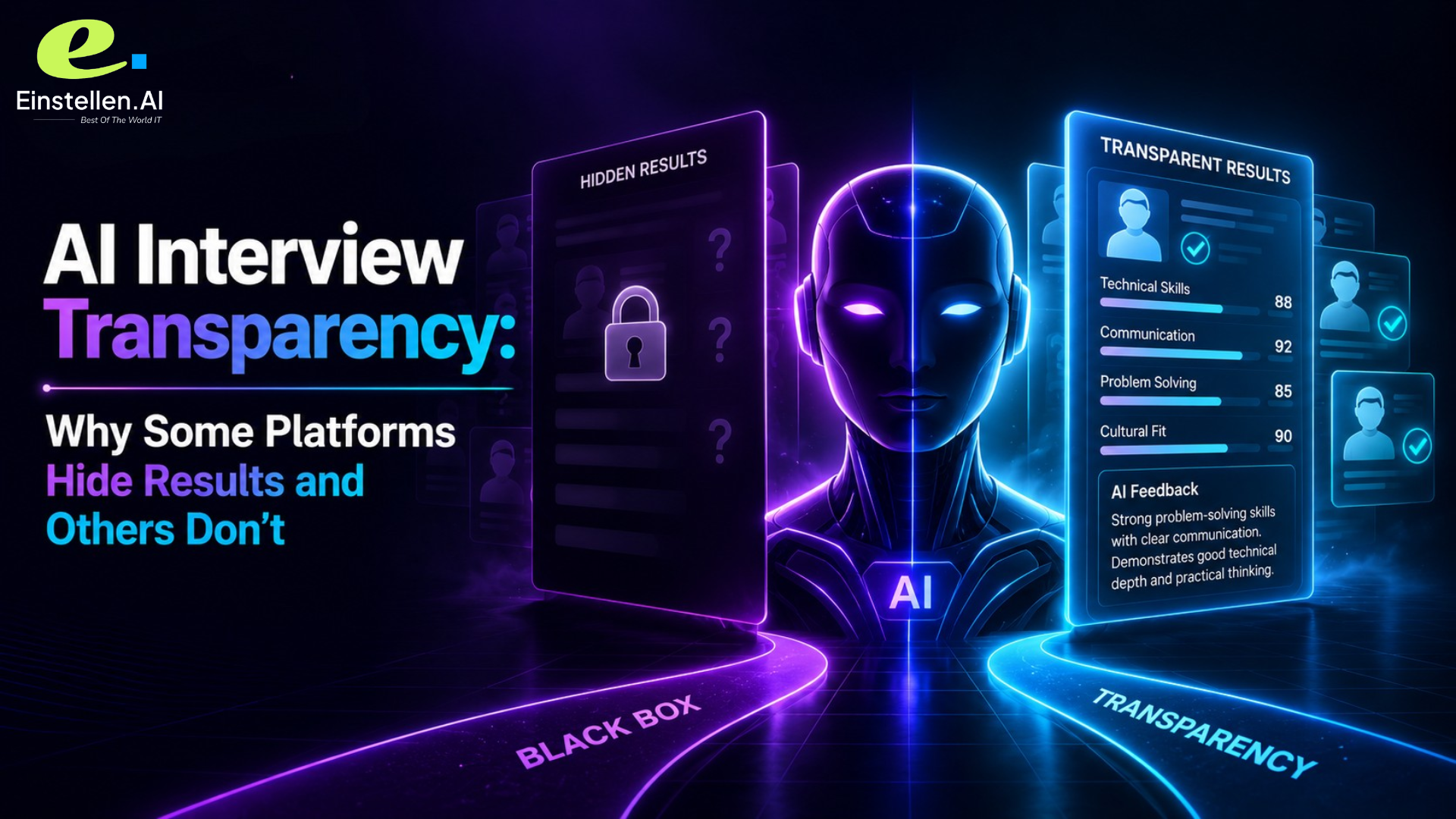
Quick Answer: AI Interview Transparency results mean you can see exactly which answers drove your score, not just a final number. Some platforms show only a rank or pass/fail. Others, like Einstellen.AI, generate a structured justification report with a full transcript, so you know precisely why you scored the way you did.
You finish an AI interview, wait three days, and get a rejection email with no explanation. No score breakdown, no indication of what went wrong, nothing you could actually use next time. It happens to thousands of candidates every hiring season, and honestly, it's the single biggest reason people don't trust AI interviews.
The problem isn't that AI is doing the evaluating. It's that most platforms hand you a verdict without showing their work. So if you're wondering whether transparent AI interview results actually exist, or whether every platform just says that and moves on, the honest answer is: it depends entirely on which platform a company chooses to use.
AI Interview Transparency: What It Actually Means
AI interview transparency isn't a marketing slogan. It's a specific, checkable thing about the report you get after an interview. Does it show which answer influenced which part of your score? Or does it just show you a number and leave you guessing?
A transparent report lets you trace a low "problem-solving" score back to the exact moment in the transcript where you gave a vague answer about a specific project. An opaque report gives you a 62/100, and that's it. You can't appeal it, you can't learn from it, you can't even check whether it was fair, because there's nothing there to point to.
This matters more in India's hiring market than almost anywhere else, given the sheer volume of applications flowing through generic listings. When hundreds of people apply for one role and an AI interview is the first filter, an unexplained rejection leaves you with zero information to adjust before you send out the next fifty applications. A transparent report, at minimum, tells you where to focus.
Why Some Platforms Hide Their Scoring Logic
Most AI interview tools on the market run a fixed script. Same set of questions no matter how you answer the first one, then a score with barely any visible reasoning behind it. That's a structural choice, not an accident.
Building a system that explains its own reasoning, answer by answer, is genuinely harder than building one that just spits out a rank. It means the evaluation model has to tag each response against specific criteria and carry that mapping all the way through to what the candidate actually sees. A lot of platforms skip this because a bare score ships faster and costs less to build.
Hiring managers have started pushing back on exactly this. Talent acquisition heads have said it plainly to platforms: AI interview scores from certain tools don't correlate with how a candidate actually performs once hired. The complaint is never really about AI interviewing as a method. It's about the missing reason behind the number.
AI Interview Transparency: What Explainable AI Interviews Look Like in Practice
AI Interview Transparency becomes practical when an explainable AI interview does two things differently from a fixed-script tool. First, the interview itself adapts. It listens to what you actually say and asks its next question based on that, instead of marching through a checklist no matter how you respond. Give a thin answer about a specific project, and a genuinely adaptive system will push deeper on that exact project rather than jump to some unrelated scripted question.
Second, the score comes with a structured justification attached. Einstellen.AI's AI interview engine, humAIn, works this way: autonomous adaptive questioning that generates each next question from your last answer, combined with the MAGIC model evaluation framework, which produces a scored report tied to a full transcript. A hiring manager looking at your file can see exactly what was asked, what you said, and which part of that answer moved which part of your score.
That's the practical difference between "the AI said no" and "here's the specific answer that pulled your score down, and here's the one that pulled it up." One of those is actually useful to a candidate. The other is a black box with a number stapled to it.

Unbiased AI Hiring: Can You Actually Verify It?
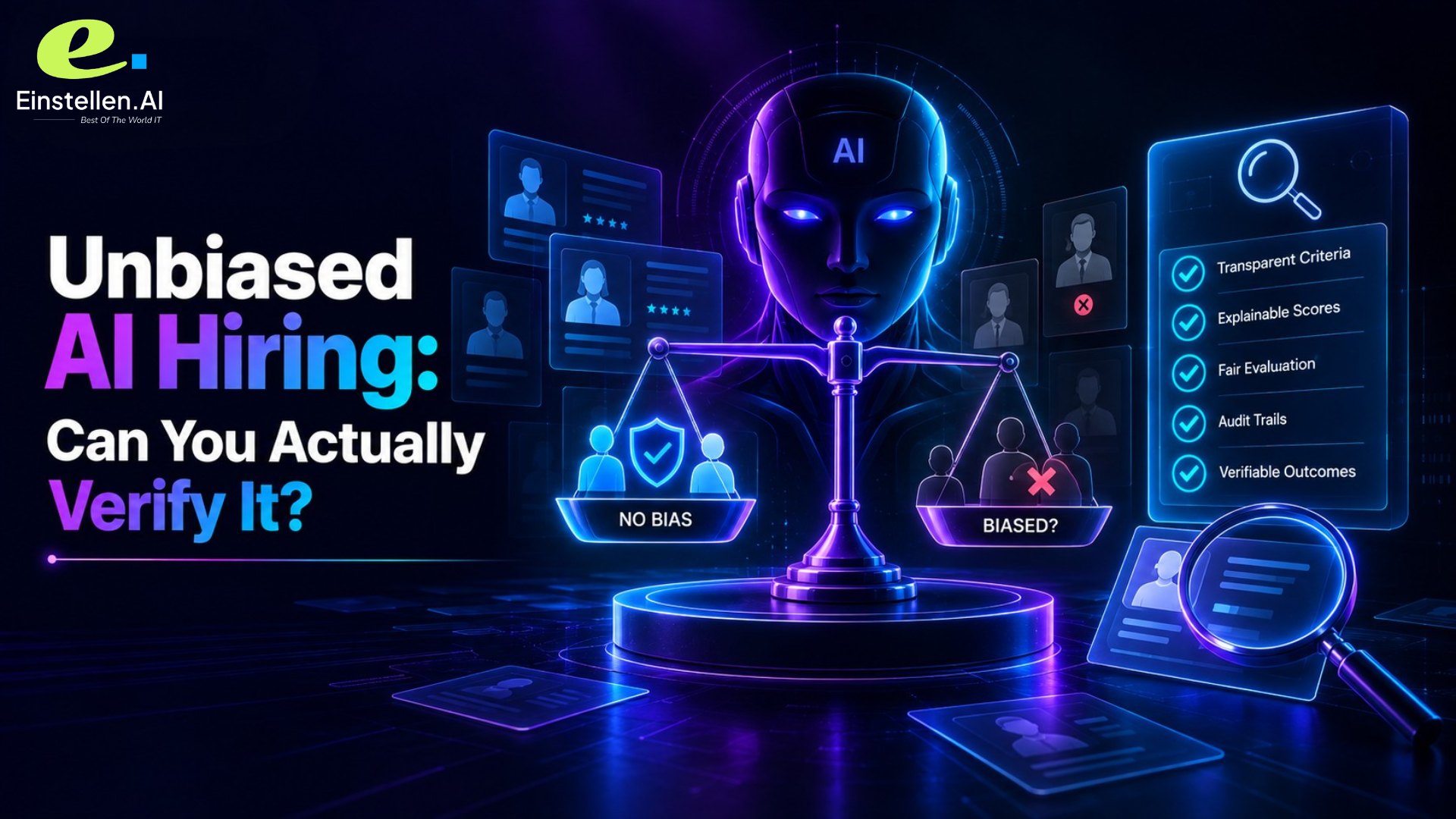
Bias in AI hiring is hard to catch from the outside, mostly because most platforms never show their reasoning in the first place. If a scoring system quietly weights certain answer patterns more than others, you'd have no way of knowing unless the report shows its logic.
A structured justification report changes that equation. Because the score ties back to specific transcript moments instead of some unexplained aggregate, both the candidate and the hiring manager reviewing a borderline case can check whether the reasoning actually holds up. That doesn't eliminate the need for good evaluation design, but it does make flawed evaluation visible instead of invisible, and visible is the only starting point for fixing anything.
Fraud and proxy detection sit right alongside this same idea. Einstellen.AI's platform builds fraud and proxy detection into the interview process itself, which matters for candidates too. It protects the integrity of the process you're competing in, especially in high-volume screening rounds like campus placement drives, where thousands of candidates are sitting through interviews in the same window.
How to Check If Your AI Interview Results Are Actually Transparent
Before you sit for any AI interview, there are a few concrete things worth checking. Ask whether you'll get a transcript, not just a score. Ask whether the interview adapts to your answers or just runs the same fixed set of questions for everyone regardless of how they respond.
If a platform can only tell you "you scored 71%" and nothing else, that's a black box, no matter how sophisticated the underlying model claims to be. If it can show you which specific answer affected which specific part of the evaluation, that's a structured justification, and it's a meaningfully fairer process to be judged by.
| AI Interview Trait | Opaque / Fixed-Script Platforms | Transparent / Adaptive Platforms (e.g. Einstellen.AI) |
|---|---|---|
| Question flow | Same script regardless of answers | Adapts next question to your last answer |
| Score output | Single number or rank | Score paired with structured justification |
| Transcript access | Often limited or unavailable | Full transcript provided |
| Fraud/proxy detection | Varies, often undisclosed | Built into the interview process |
| Candidate recourse | Little to no basis to appeal | Specific answers to point to |
Proof point: Einstellen.AI has conducted 150,000+ AI interviews across 1,200+ institutions, and every single one produces a per-answer scored report with a full transcript, not a standalone number.
FAQ
How is AI interview scoring calculated?
On a genuinely explainable platform, scoring runs on a structured evaluation framework, not one opaque metric. Einstellen.AI's MAGIC OS model produces a score paired with a report showing which parts of your answers drove which parts of the result, so the score always traces back to something you actually said.
How accurate is AI interview scoring?
Einstellen.AI doesn't publish a single accuracy percentage, and that's a deliberate position. An accuracy number without a published criterion-validity study behind it is a marketing claim, not a verified finding. Instead of a number you'd have to take on faith, every score on this platform comes with a full interview transcript and a per-answer justification report, so a hiring manager can evaluate the reasoning directly rather than trusting a figure that can't be audited.
Can candidates cheat an AI interview?
Some candidates try to use proxies or other workarounds during high-stakes AI interviews, particularly in bulk screening rounds. Platforms with fraud and proxy detection built into the interview process, like Einstellen.AI is built to catch this, which protects the integrity of the process for the candidates competing fairly.
How is this different from a black-box AI interview tool?
A black-box tool hands you a score or rank with no reasoning you can actually get to. A transparent platform pairs every score with a structured justification report and runs an adaptive interview that responds to what you actually say, instead of a fixed script that ignores your answers entirely.
Find Roles That Evaluate You Fairly
If you're prepping for your next interview, look for employers on platforms that show their reasoning, not just a rank. Einstellen.AI's active listings connect you with companies running adaptive, explainable AI interviews, so you know exactly how you're being evaluated at every stage.
Browse active jobs on Einstellen.AI, check real salary benchmarks for your role and city, and create your profile to get matched with employers who use a transparent, structured interview process instead of handing you an unexplained score.
Create your profile on Einstellen.AI today and start applying to roles where your evaluation is something you can actually see and understand.








Leave a Comment
Share your perspective. Comments are moderated before publishing.