
Quick Answer: Automated candidate screening uses AI interviews to evaluate every applicant consistently instead of forcing recruiters to filter thousands of resumes manually. Einstellen.AI's adaptive AI interview engine screens large volumes of applicants with structured, justified scoring and built-in fraud detection, so hiring teams review ranked, explainable shortlists instead of raw application volume.
A Bangalore-based Talent Acquisition head told us recently that a single job posting pulled in 4,000 applications in four days. Two recruiters spent a full week just filtering resumes before anyone got scheduled for an interview. If you've hired in India's product and services market, you already know this problem: the "200 irrelevant applications" headache that every hiring manager complains about, except now multiply it across every open role during a bulk hiring drive or campus placement season.
SHRM's 2025 benchmarking data shows the average time from job posting to offer acceptance in the US runs 42 days; in India's high-volume product hiring market, that window compresses while application volumes are often an order of magnitude larger.
Automated candidate screening exists to solve exactly this bottleneck. Most candidate screening software speeds up the triage step but leaves the defensibility problem untouched. But done properly, it doesn't just filter faster; it filters with a reason attached to every decision, so the shortlist can actually survive the moment a hiring manager asks, "Why did we reject this person?" That gap between fast filtering and defensible filtering is where most bulk hiring AI platforms quietly fall short. It's also where the rest of this article is focused.
Why Application Overload Breaks Manual Screening
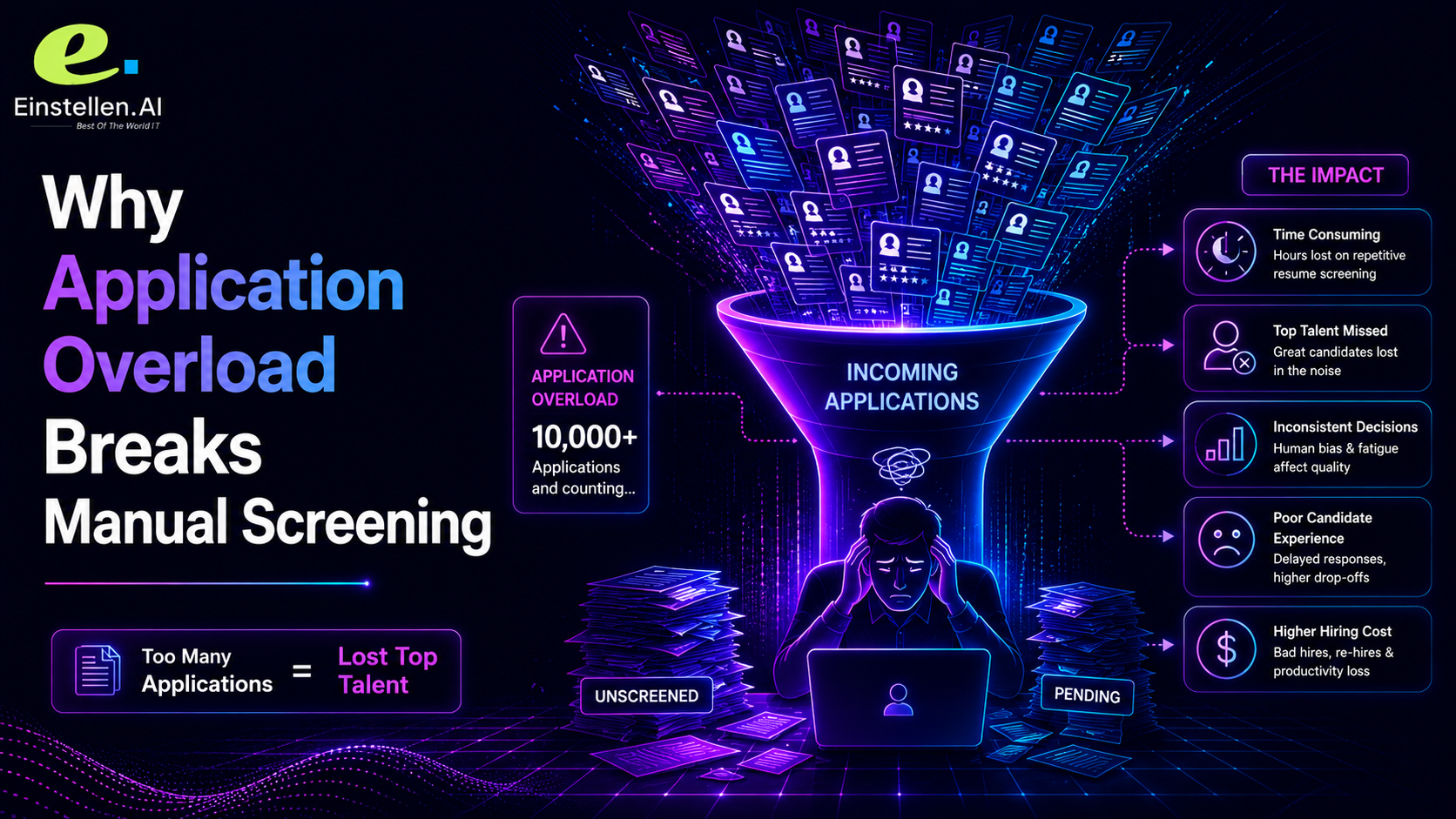
Why Application Overload Breaks Manual Screening Why Application Overload Breaks Manual Screening Why Application Overload Breaks Manual Screening Manual resume screening doesn't scale linearly. Add another 1,000 applications, and you add roughly proportional recruiter hours, but hiring deadlines never move to match. The result is a pattern every enterprise recruiter in India has seen: qualified candidates sitting unreviewed in an ATS queue for days, while a fixed number of recruiters grind through volume they were never staffed to handle.
Speed pressure creates a second, quieter problem: shortcuts. Keyword-matching filters reject candidates who describe the same skill in different words than the job description used. Recruiters skimming under deadline pressure make inconsistent calls between two similar resumes reviewed hours apart, sometimes without even realizing it. Neither failure shows up in a dashboard. It surfaces later, when a hiring manager asks why a genuinely qualified candidate never got a callback.
Mass hiring automation fixes the volume problem structurally, not by throwing more reviewers at it. Instead of a human reading every resume, an adaptive AI interview evaluates every applicant against the same framework, at the same depth, whether they're applicant number 1 or applicant number 4,000. That consistency, not raw speed, is the actual value here.
How AI Screening Bulk Applicants Actually Works
The mechanism matters more than the marketing line. AI resume screening parses what a candidate claims on paper. Adaptive AI interviewing tests whether those claims hold up under questioning, and that distinction is the entire value difference. Einstellen.AI's humAIn interview engine listens to what a candidate actually says and builds its next question around that specific answer, instead of marching through a fixed script no matter what the candidate said. If someone gives a vague answer about a project they claim to have led, the system pushes further on that exact project rather than jumping to the next scripted question anyway.
This adaptive approach produces interview data close to what a sharp human interviewer would dig up, but at a volume no interviewing team could physically match. Every interview then runs through the MAGIC OS model, Einstellen.AI's evaluation framework, which outputs a structured, justified score, not an unexplained ranking number pulled from a black box.
That justification piece is where most AI screening tools quietly stop. A hiring manager looking at a borderline candidate from a 4,000-person pool can open the report and see exactly which answer drove which part of the score. Not just a number with no reasoning behind it. For bulk screening in particular, that means recruiters aren't blindly trusting a black-box filter to make thousands of silent rejection calls on their behalf.
Fraud and Proxy Detection at Volume
High-volume recruitment brings an integrity risk that smaller hiring rounds rarely face. Campus placement drives and bulk enterprise hiring rounds are exactly where proxy candidates and interview fraud slip through, simply because no recruiter can watch 4,000 interviews closely enough to catch every irregularity. Nobody has that kind of attention span, and pretending otherwise doesn't help anyone.
Einstellen.AI builds fraud and proxy detection directly into the interview process, not as a compliance step bolted on after the fact. That distinction matters a lot for institutions running placement drives across large student cohorts, where the same integrity check has to apply just as strictly to interview number 10 of the day as to interview number 3,000.
For enterprises running bulk hiring rounds, this closes a real gap. A shortlist generated at scale is only worth anything if the hiring manager can trust that every candidate on it actually gave the answers being scored.
Shortlisting at Scale Without Losing Signal Quality
The concern hiring managers raise most is signal loss. Does screening 4,000 candidates in days instead of weeks mean worse hires than a slower, more careful manual process would produce? Honestly, it depends entirely on whether the screening method degrades under volume or holds steady.
A fixed-script AI interview asks the same five questions to every single candidate, regardless of what they said in answer one. That caps signal quality at whatever the script writer happened to anticipate months earlier. Adaptive questioning doesn't have that ceiling, because it follows the actual conversation instead of a predetermined path, whether it's running one interview or ten thousand.
 Explainable AI hiring is the standard that makes this possible. This is also why ATS integration matters more, not less, at high volume. Magic OS integrates with any ATS an enterprise already uses, including native, bi-directionally synced integrations with Greenhouse, Lever, and Workday, at no additional cost. Scores, transcripts, and reports land directly in the existing candidate record, so a recruiter running a bulk round isn't stuck reconciling two separate systems on top of an already brutal workload.
Bulk Hiring AI Platform Economics
Cost per screen behaves differently at scale than it does for a single senior hire. Einstellen.AI's public pricing model is pay-per-use: a flat ₹249 per interview, the same rate whether a client runs 1 interview or 10,000, with no subscriptions, no contracts, and no volume-based negotiation. The full report- video, transcript, skill scoring, and fraud detection is included in every credit, with no premium add-on tier hiding behind it.
For a team running a bulk campus placement round or a large enterprise screening campaign, that predictability is worth something real. Costs don't spike unpredictably right when application volume spikes, which is exactly the moment hiring teams are least equipped to absorb a pricing surprise.
Screening Volume vs. Signal Quality: What the Data Shows
| Screening Approach | Consistency Across Volume | Explainability of Decision |
|---|---|---|
| Manual resume review | Degrades as volume increases | Recruiter judgment, not documented |
| Keyword-filter ATS screening | Consistent but rigid | No reasoning shown |
| Fixed-script AI interview | Consistent | Score with no structured justification |
| Adaptive AI interview (Einstellen.AI) | Consistent at any volume | Per-answer structured justification report |
Proof Point: Einstellen.AI has conducted 150,000+ AI interviews across 1,200+ institutions, backed by IIM Lucknow and NASSCOM. MediAssist's enterprise deployment on the platform produced 92.5% fewer screening interviews required, 15-day average fulfillment, 100% position closure rate, and 60% interview-to-deployment conversion, evidence that adaptive, explainable screening holds up at genuine bulk-hiring volume, not just in small pilot runs.
FAQ
How is automated candidate screening different from a black-box AI screening tool?
The core difference is explainability. A black-box tool spits out a candidate ranking with no accessible reasoning behind it. Einstellen.AI's screening runs on the MAGIC model, which pairs every score with a structured justification report showing exactly which answer drove which part of the result. A hiring manager gets to review the reasoning, not just a number.
Can candidates cheat or use a proxy during bulk AI screening?
Einstellen.AI's platform builds fraud and proxy detection into the interview process itself, which matters most for high-volume cases like campus placements and bulk enterprise rounds where nobody can manually watch every interview. We keep the exact detection mechanics general in public content, on purpose, so we're not handing bad actors a workaround.
Does automated screening integrate with the ATS we already use?
Yes. Magic OS integrates with any ATS a company already uses, at no additional cost. Greenhouse, Lever, and Workday are natively, bi-directionally synced, with scores, transcripts, and reports flowing straight into the existing candidate record. No need to retrain recruiters on a new workflow.
What does automated screening cost at high volume?
Einstellen.AI's public pricing is a flat ₹249 per interview, whether you run 1 interview or 10,000. No subscriptions, no contracts, no volume-based pricing tiers. The complete report, video, transcript, skill scoring, and fraud detection are included in every credit.
Post Your Bulk Hiring Role on Einstellen.AI
If your team is staring down thousands of applications for one role, or gearing up for a full campus placement drive, manual screening simply isn't going to close that gap fairly or fast enough. Einstellen.AI's adaptive AI interview engine screens every candidate at the same depth, attaches a structured justification report to every score, and builds fraud detection into the process itself rather than tacking it on afterward.
Post your job on Einstellen.AI and reach a curated pool of active candidates, backed by explainable scoring your hiring managers can actually stand behind.








Leave a Comment
Share your perspective. Comments are moderated before publishing.