
Quick Answer: Most AI job search platform applications get ignored due to five fixable mistakes: keyword stuffing instead of keyword matching, generic one-size-fits-all resumes, ATS-breaking file formats, ignoring stated application instructions, and mass auto-applying. The bigger hidden mistake: applying blind, with no visibility into why an AI actually scored your application the way it did.
You spent twenty minutes running your resume through an AI builder, hit "apply" on fifteen roles before lunch, and heard nothing back from any of them. Not even a rejection email. It's the most common frustration we hear from job seekers using an AI job search platform in 2026, and it's usually not bad luck. There's a specific, identifiable mistake buried in how the application was built or submitted, and in most cases, the candidate never finds out which one.
That's the real problem, actually. Resume advice sites will tell you what went wrong with your file. Almost none of them tell you why a specific AI system scored you the way it did, because most of those systems were never built to explain themselves in the first place.
Keyword Stuffing vs. Keyword Matching: The Difference That Costs You Interviews
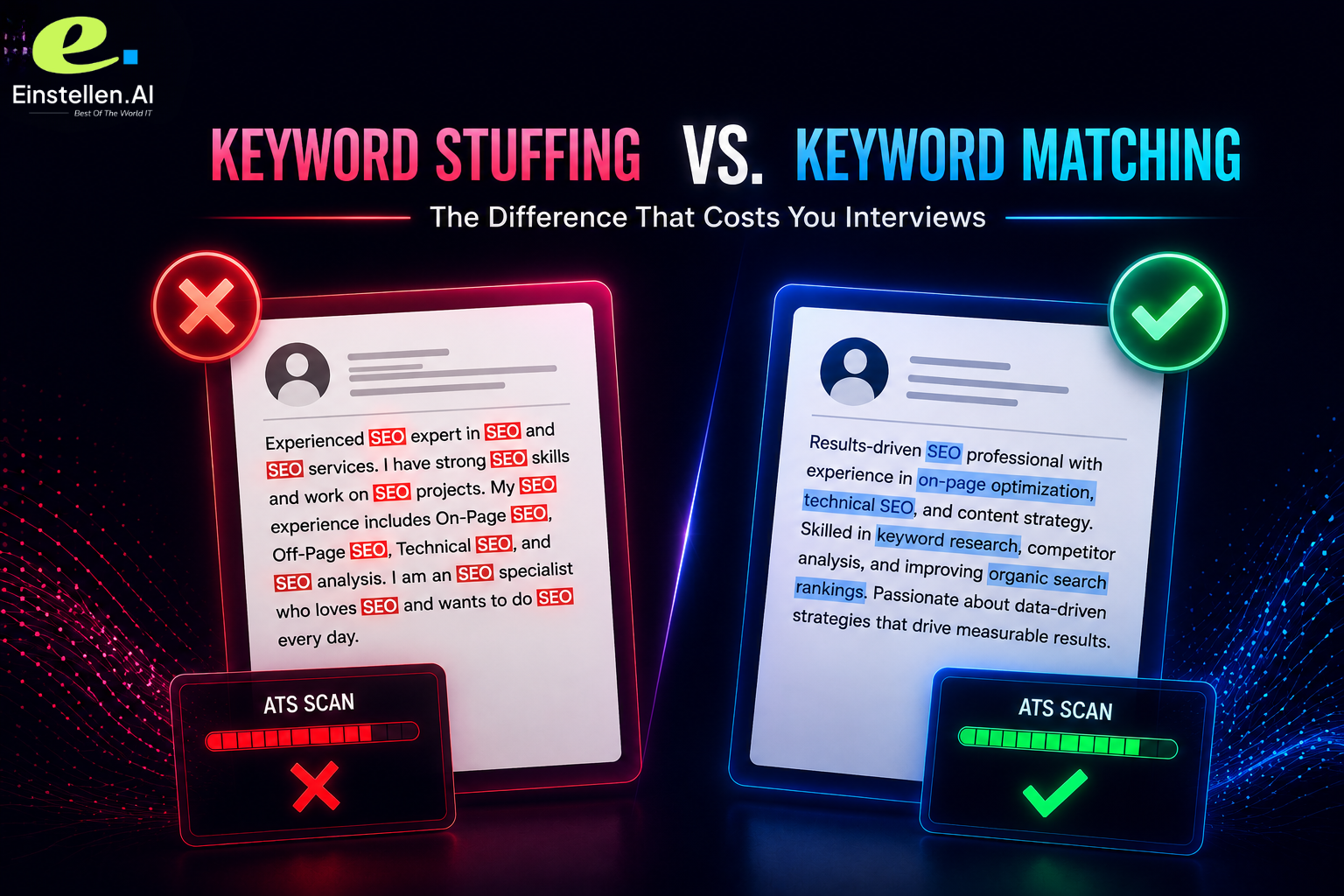
Keyword stuffing means pasting every skill mentioned in a job description into your resume, whether or not you actually have that experience. Keyword matching is different: you identify the 8-10 terms that genuinely reflect your background and mirror the employer's exact phrasing for them. This matters because most Applicant Tracking Systems parse for relevance, not density. A resume packed with 40 unrelated tags doesn't read as thorough. It reads as noise.
Scale.jobs has documented this directly: AI tools "often cram resumes with irrelevant keywords, leading to ATS rejections." And the same overcorrection creates a second, worse problem: fabrication. When an AI resume builder invents a skill or inflates a title just to hit a keyword target, that gap surfaces the moment a recruiter asks a follow-up question in an interview. Awkward, and entirely avoidable.
The fix is narrow. Pull the exact terms from the job description for the tools, certifications, and role titles you genuinely hold, and use the employer's own phrasing rather than whatever synonym your resume builder generated. A data engineer applying to a role listing "Apache Airflow" should write "Apache Airflow." Not "workflow orchestration tools."
ATS Formatting Mistakes That Cause Resume Rejection
Here's something most candidates don't realize: most ATS platforms parse resumes as plain text before any human opens the file. Multi-column layouts, text boxes, tables, headers or footers with your contact details tucked inside them — all of it frequently gets scrambled or dropped during that parsing step. A resume that looks sharp as a PDF can land in the ATS database as unreadable fragments.
Colored background graphics and embedded icons cause the same failure. So does submitting the wrong file format when a posting specifies one. If a listing asks for a .docx file and you send a designed PDF instead, some systems reject the file outright, before a recruiter is ever in the loop.
Stick to a single-column layout, standard section headers ("Experience," "Education," "Skills"), and a plain file name that includes your name and the role — something like "Priya-Sharma-Data-Engineer-Resume.pdf." Sounds trivial, but recruiters working through ATS-exported shortlists are scrolling past dozens of files named "Resume-Final-v3.pdf." Yours needs to be identifiable at a glance.
Read More: AI Job Portal Profiles: How to Get Noticed by Real Recruiters
Generic, One-Size-Fits-All Resumes Are the Fastest Way to Get Skipped
Send the same resume to a product company and a services company, and employers notice the mismatch immediately. A resume built for a Flipkart or Razorpay application should foreground ownership, measurable impact, and specific technologies. The same resume sent to a Tier 1 services company like TCS or Infosys should foreground process rigor, client delivery, and domain breadth instead. Try to blend one resume for both, and you signal to neither.
This is exactly the failure mode career-coaching research flags around over-reliance on AI tools: content that reads, as one HR researcher put it, "like it was written by a robot, because it was." Genuine customization to the specific employer and role is still the single highest-leverage fix available to a job seeker. And it takes minutes, not hours, once you've got a strong base resume to adapt from.
File Naming and Application Instructions: The Small Mistakes That Signal Carelessness
Job postings routinely include small, specific instructions: a required subject line, a request to name your file a certain way, an ask to answer a screening question in the form instead of just attaching a resume. Ignore these, and hiring teams read it as a proxy for how carefully you'll handle instructions once you're actually on the job — especially at high-volume employers filtering hundreds of submissions per role.
Mass auto-applying makes this worse. Tools that fire off dozens of near-identical applications a day, with autofill answers that never mention the specific employer, are increasingly recognized and deprioritized by hiring systems built to catch exactly this pattern. The pattern shows up consistently in recruiter conversations: candidates who mass-applied via automated tools often can't describe their own application in a first screening call, a direct consequence of submitting without actually reading the role.
The Mistake Nobody Talks About: Applying Blind to an AI You Can't See Inside
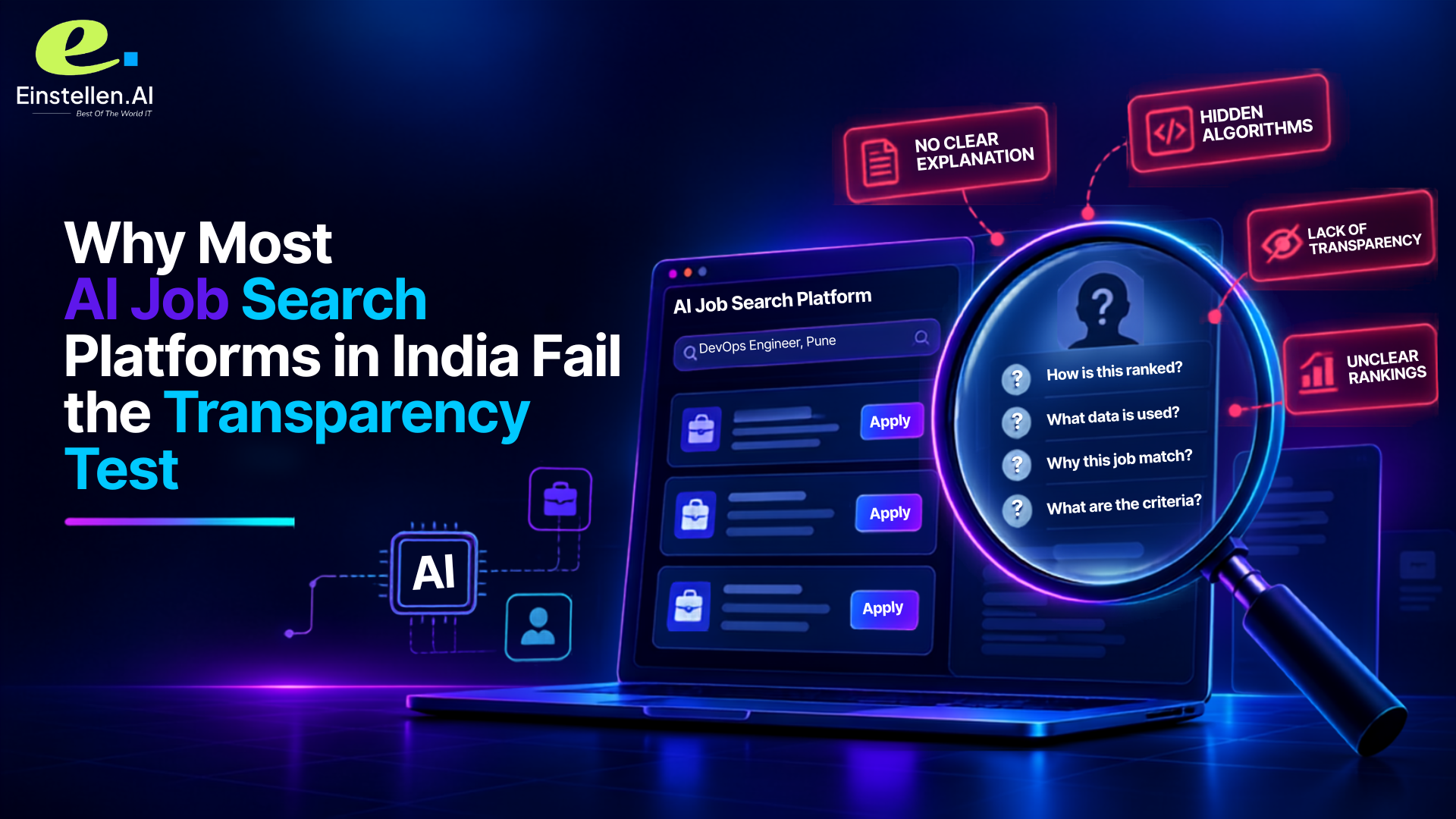
Every mistake above is fixable once you know it exists. The one most job seekers never get to fix is not knowing why an AI system rejected them in the first place. Most AI screening and interview tools spit out a ranking or a score with no accessible reasoning behind it, so a rejected candidate has no way to figure out what to improve next time.
This is where the interview stage deserves as much attention as the resume stage, and it gets almost none in current advice content. When an AI interview engine evaluates your answers with no structured justification attached, you're practicing and applying against a system you can't learn from. Einstellen.AI's platform runs on adaptive questioning through its humAIn interview engine — the system generates its next question based on what you actually said, not a fixed script — and every response is scored through the MAGIC model with a structured justification report and full transcript, rather than a bare number.
Read More: What Happens After You Finish an AI Interview? A Walkthrough
Where the Numbers Line Up
| Mistake | Reported Impact | Source |
|---|---|---|
| Keyword stuffing / irrelevant tags | Leads directly to ATS rejection | Scale.jobs |
| Visible AI-generated application text | 74% of employers say they can detect AI use in applications | Rothman Career Coach Source: Resume Genius (Jan 2025) |
| Undisclosed or unpolished AI use | 57% of employers significantly less likely to hire that applicant | Rothman Career Coach Source: Resume Genius (Jan 2025) |
Proof point: Einstellen.AI has conducted 30,000+ AI interviews across 1,200+ institutions, backed by IIM Lucknow and NASSCOM, and every single one produced a per-answer scored report with a full transcript, showing exactly which answer drove which part of the score, not an unexplained ranking.
FAQ
Why do AI job platforms reject my application?
Most rejections trace back to ATS parsing failures (bad file format, broken layout), keyword mismatch against the job description, or an application that reads as generic rather than tailored to that specific employer. Without a structured justification report, most platforms give no direct explanation. You're left guessing which of these hit you.
Can recruiters tell if I used AI to apply for a job?
Often, yes. Resume Genius's January 2025 survey of 1,000 US hiring managers found 74% say they can spot AI-generated application content, and 57% say they're significantly less likely to hire a candidate whose AI use was detectable rather than personalized and refined.
Is it bad to use AI to apply to jobs?
Not inherently. Industry data consistently shows employers respond better to AI-assisted applications that are genuinely personalized than to high-volume, generic auto-apply output. The tool itself isn't the issue. Unedited, one-size-fits-all content is submitting generic AI output at high volume is what backfires, not using AI to help draft or refine.
Are AI job search platforms worth paying for?
For candidates, registration and applying on Einstellen.AI are completely free. The ₹249 flat interview rate is charged to the employer, not you, so there's no subscription, no upfront cost, and nothing to validate before you know if the platform works for you.
Ready to Apply Somewhere That Explains Your Score?
If you're tired of applying into a black hole, an AI job search platform that explains its own scoring gives you a fairer starting point, and that's exactly what Einstellen.AI is built to do. Every interview on the platform runs on adaptive questioning that responds to what you actually say, and every score comes with a structured justification report you can actually read — not a number you're just asked to trust.
Create your profile on Einstellen.AI, browse active listings across Bangalore, Hyderabad, Mumbai, Pune, Delhi NCR, and Chennai, and find roles where you can see exactly how you're being evaluated. Registration and applying on Einstellen.AI are completely free for candidates.








Leave a Comment
Share your perspective. Comments are moderated before publishing.