
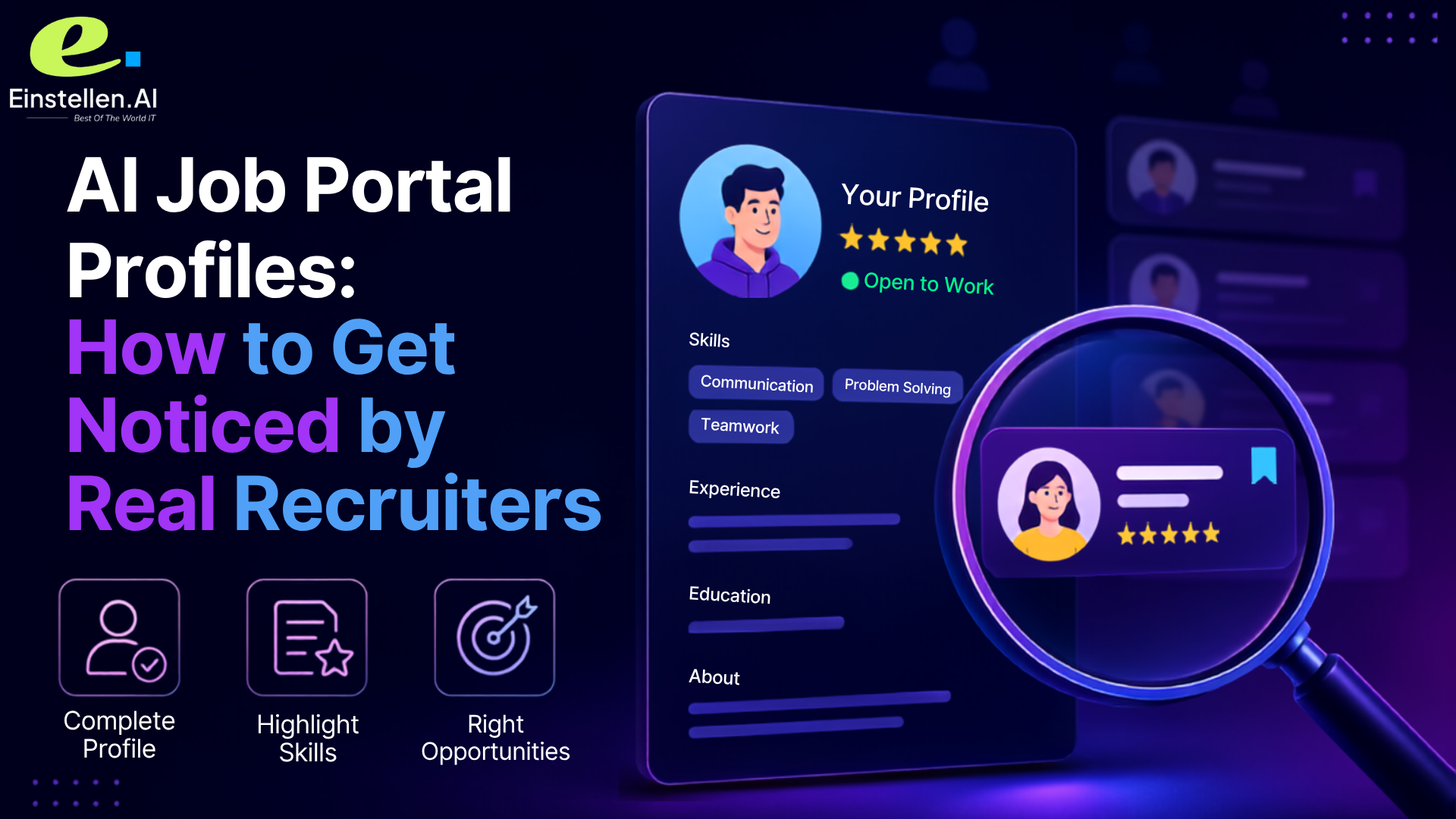
Quick Answer: An AI job portal reads your profile through parsing and structured data, not visual formatting, then ranks you by keyword weighting and skills match. To get noticed, use structured skills fields, exact and related keywords from real job descriptions, a current "open to work" signal, and a profile that explains your fit, not just claims it.
You've applied to 40 roles this month. Two replies. Both rejections. Neither came with a reason. Somewhere between your profile and the recruiter's inbox, something decided you weren't a match, and you're left guessing why.
That gap is exactly what an AI job portal is supposed to close. But it only closes if you understand how the matching works underneath the apply button. Most advice online just tells you to "optimize your resume" without explaining what the algorithm is actually doing when it reads it. That's the part worth understanding first. The section-by-section fixes only make sense once you know what's being parsed, weighted, and ranked.
How AI Job Matching Actually Reads Your Profile
Before an AI job portal shows your profile to anyone, it runs a parsing step. It extracts your work history, skills, education, and job titles into structured fields, rather than treating your profile as one long block of text. That's why a profile built from clean, separate fields (skill, employer, dates, role) gets read more accurately than a paragraph pasted into a summary box.
Once parsed, the system applies keyword weighting. A recruiter searching for "Python" and "AWS" isn't matching against your whole profile equally. Specific fields, like skills, most recent job title, and headline, typically carry more weight than a mention buried in a project description from five years back. Mercer's research found 81% of companies now use AI for candidate screening and 50% for candidate evaluation. So this parsing step isn't some niche feature. It's the default entry point for most applications today.
Read More: 6 AI Job Portal Features Freshers Should Check Before Applying
The result is a match score: a computed proximity between what a recruiter searched for and what your structured profile contains. It's a mechanical calculation, not a judgment of your worth as a candidate. Once you get that distinction, a low score stops feeling personal.
Profile Visibility to Recruiters: Are You Actually Searchable
A profile can sit in a database forever without ever surfacing in a recruiter's search results. Visibility comes down to whether your structured data matches the terms recruiters actually type in, not the terms you'd use to describe yourself over coffee.
Recruiters commonly search by role title plus 2-3 hard skills plus years of experience. Not soft-skill phrases like "team player" or "self-starter." If your headline reads "Aspiring Technology Professional" instead of "Data Engineer, SQL, Python, Airflow," you're invisible to the exact search that would have found you.
An "open to work" signal matters here too. Portals often deprioritize or exclude profiles marked inactive or not currently looking, since recruiters want candidates who'll actually respond. Keeping that status current takes five seconds and has an outsized effect on whether your profile even enters the search results.
AI Resume Screening and ATS-Friendly Profile Structure
AI resume screening tools extract text from your resume and profile the same way any parser reads a structured document: headers, dates, bullet points. Dense paragraphs, tables used for layout, creative fonts — these often parse incorrectly or drop content entirely. That's why an ATS-friendly profile favors plain structure over visual flair.
Bullet points that start with a specific action and a specific result parse more reliably than narrative paragraphs. "Reduced deployment time by 40% using CI/CD pipeline changes" extracts cleanly into a skills-plus-outcome structure. Describe the same work in flowing prose, and you'll often lose the specific skill terms during parsing.
Indeed's 2025 research found 70% of job seekers now use generative AI to draft cover letters and prepare applications. More profiles are competing on similarly polished AI language now, which makes structured, specific data an even bigger differentiator than phrasing alone.
Keyword Optimization for Your AI Job Portal Profile (Without Keyword Stuffing)
Pull the exact skill terms from 5-10 real job descriptions for the role you want. Not just one. Patterns repeat: if 8 out of 10 postings for a Bangalore data engineer role mention "Airflow" and "dbt," those terms need to sit explicitly in your skills field, not buried inside a project description.
AI matching systems generally understand related terms and synonyms to some degree, but exact keyword matches still carry more weight in most ranking algorithms than inferred connections. If a job description says "CI/CD" and your profile only says "automated deployment," add the literal term alongside your own phrasing. Don't make the system guess.
Repeating a keyword unnaturally across every field doesn't help, and in some systems it can flag as manipulation. The goal is coverage across relevant, truthful terms in the right structured fields. Not repetition for its own sake.
Skills-Based Profile vs. Job-Title-Based Profile
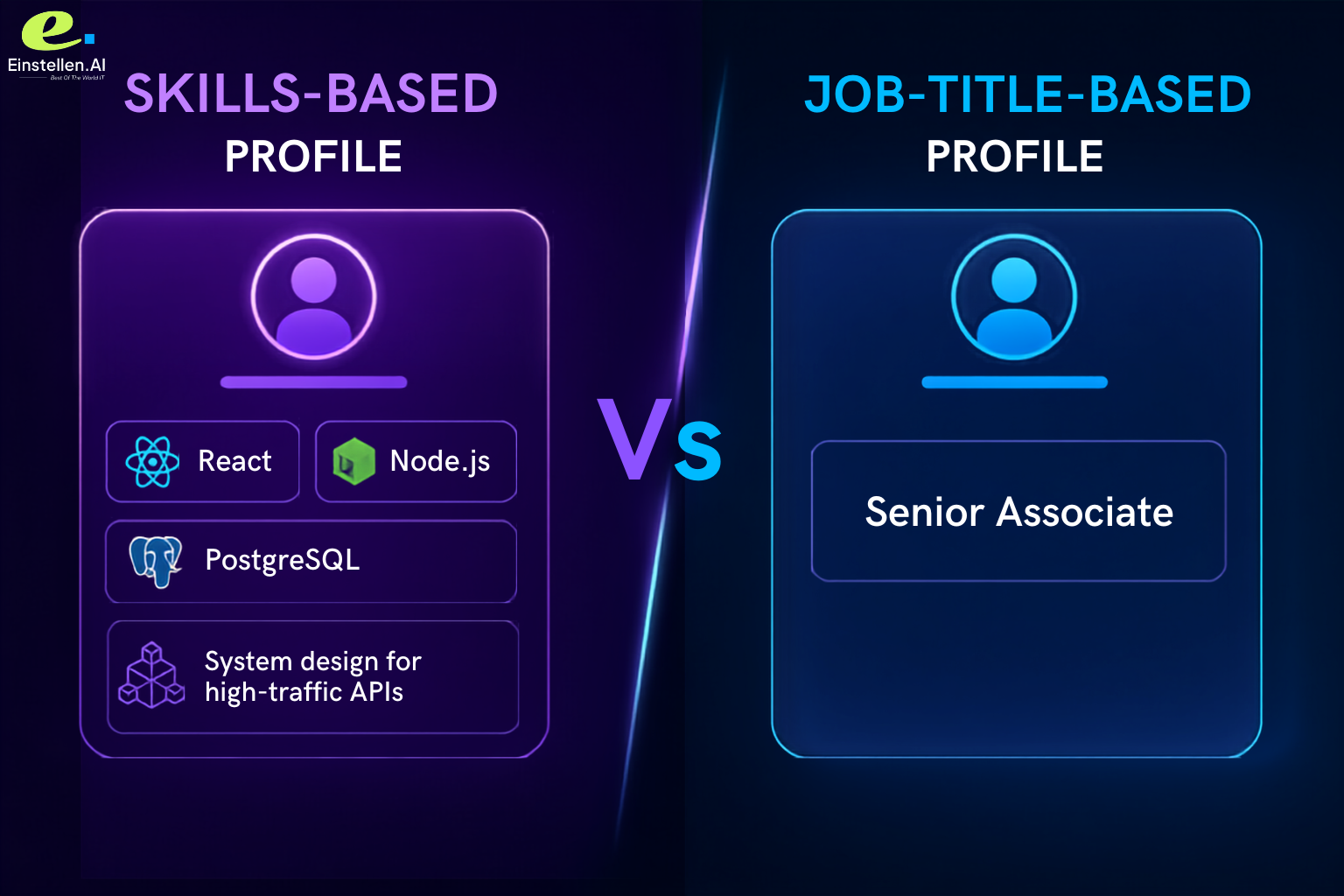
A job-title-based profile leads with "Senior Associate" or "Software Engineer II." Titles like these vary wildly between companies and tell a matching algorithm very little. A skills-based profile leads with actual capabilities: "React, Node.js, PostgreSQL, system design for high-traffic APIs."
This matters most for career changers, and for candidates moving from service companies into product companies, where the same title (Software Engineer at TCS versus Software Engineer at Razorpay) can mean completely different day-to-day work. A skills-based structure lets the matching system compare what you can actually do, instead of penalizing you for a title mismatch that has nothing to do with your ability.
Structured Profile Data: The Fields That Actually Get Searched
Recruiter keyword search tools typically query structured fields first, in roughly this order: current title, skills list, years of experience, location, education. A rich, well-written "About" paragraph helps once a human reader lands on your profile, but it's rarely what a recruiter's search filters on first.
Fill every structured field before you spend time polishing prose. An empty skills section, or a missing "years of experience" field, can quietly exclude you from searches that would have otherwise surfaced your profile — no matter how strong your written summary is.
| Profile Element | What It's Used For | Typical Recruiter Search Weight |
|---|---|---|
| Skills list (structured) | Keyword matching, ATS parsing | High |
| Current/target job title | Role-category filtering | High |
| Years of experience | Seniority filtering | Medium-High |
| Location | Geographic search filters | Medium-High |
| Open to work status | Active-candidate filtering | Medium |
| About/summary paragraph | Human review after shortlist | Low (search), High (review) |
Proof point: Einstellen.AI has powered 30,000+ AI interviews across 1,200+ institutions, and every one of those interviews produces a per-answer scored report with a full transcript. A hiring manager reviewing a borderline candidate sees the actual reasoning behind a score, not just a ranking number they're expected to trust blindly.
FAQ
How does AI job matching actually work?
The system parses your profile into structured fields (skills, titles, experience, education), then compares those fields against a recruiter's search terms or a job description using keyword weighting and proximity scoring. Fields like skills and job title typically carry more weight than free-text sections, which is why structured, specific data matters more than polished prose alone.
How do recruiters find candidates using AI?
Recruiters typically run structured searches combining a role title, 2-4 hard skills, years of experience, and location, then let the platform rank matching profiles by relevance. Many platforms also surface candidates proactively based on activity signals like an "open to work" status or recent profile updates, rather than waiting for an application.
What makes a profile show up higher in recruiter searches?
Complete structured fields, exact keyword matches to common job description terms, a current "open to work" status, and recent profile activity all typically improve ranking. A profile with gaps in structured data, even if the written summary is strong, tends to rank lower because the matching algorithm has less to compare against.
What is a good AI match score, and does a lower score mean I shouldn't apply?
A match score reflects keyword and skills proximity to a specific search or job description, not your overall qualification or potential. A moderate score with strong core skills and a clear explanation of relevant experience is often still worth applying to, especially on platforms like Einstellen.AI where scores come with structured justification a recruiter can actually review rather than a bare number used to auto-reject.
Do I need to use exact keywords, or does AI understand synonyms?
Most AI matching systems have some ability to recognize related terms and synonyms, but exact keyword matches generally carry more weight in ranking than inferred connections. The safest approach is including both the literal industry term and your own natural phrasing, rather than relying on the system to infer one from the other.
Is my profile actually visible to recruiters, or just sitting in a database?
Visibility depends on whether your structured fields match actual recruiter search patterns and whether your profile status shows as active or open to work. A complete, current profile with the right structured fields is far more likely to surface in search results than one with gaps, even on the same platform.
Can recruiters tell if I used AI to write my profile or application?
Recruiters generally can't detect AI-assisted writing with certainty, and using AI to draft or refine a profile is now common. Indeed's 2025 research found 70% of job seekers already use generative AI in their job search process, so the more relevant question is whether the content is accurate and specific, not whether AI helped write it.
Does an AI job portal profile replace a resume, or work alongside one?
It generally works alongside one. A structured profile improves how you're found and matched within the platform, while a resume remains useful for the human review stage once a recruiter shortlists you. Keeping both consistent in the skills and experience they describe avoids confusing a recruiter comparing the two.
Ready to Be Found, Not Just Filed Away
Tired of applying into a black hole with no explanation? On an AI job portal built around structured, honest data and an interview process that shows its reasoning, that changes. Einstellen.AI's adaptive AI interview goes deeper on what you actually say, and your scored report shows exactly why you matched. Not just that you did.
Create your profile on Einstellen.AI and start showing up in searches for the roles you're actually qualified for.




Leave a Comment
Share your perspective. Comments are moderated before publishing.