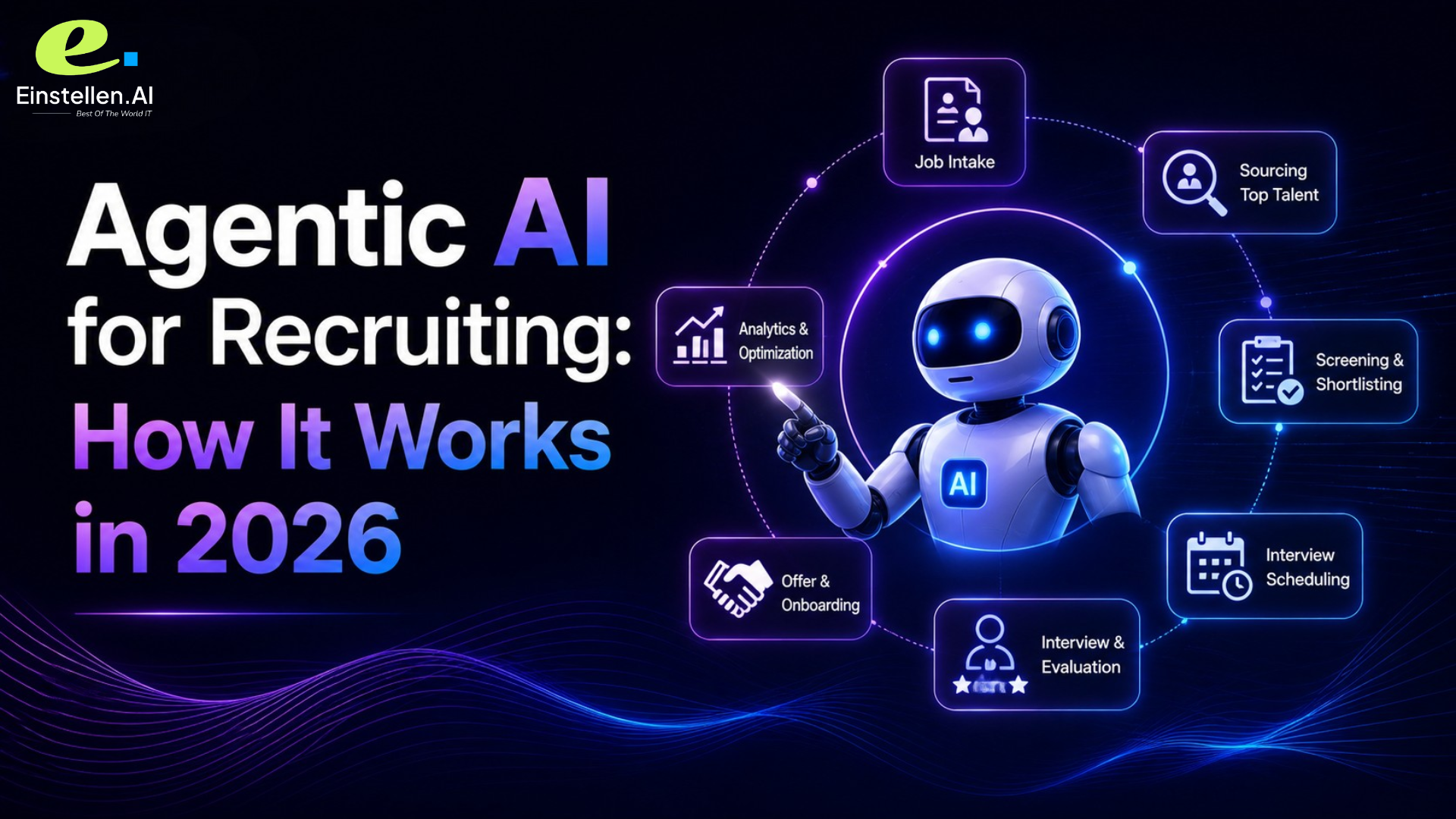
Quick Answer: Agentic AI for recruiting refers to autonomous AI systems that pursue hiring goals across multi-step workflows - sourcing candidates, running adaptive interviews, scoring responses, and updating your ATS - without a human triggering each step. Unlike a chatbot that answers questions or a GenAI tool that drafts content on demand, an agentic recruiting system decides what to do next, executes it, and self-corrects based on outcomes. It is the biggest structural shift in talent acquisition since the ATS became standard.
Most enterprise hiring teams have spent the past two years stacking AI tools on top of a process that was designed for humans. A resume parser here. A scheduling chatbot there. An AI-generated job description sitting in a tab nobody looks at. Each tool does one thing. Each tool still needs a human to move the work from one step to the next.
That is not agentic AI. That is automation with a people problem.
The shift that enterprise TA heads are actually asking about in 2026 is something structurally different: an AI system that picks up a hiring goal - "screen and shortlist 200 applications for this DevOps role by Thursday" - and executes the full sequence autonomously, adapting as it goes, without a recruiter queuing each step manually.
That is what agentic AI for recruiting actually means. And the adoption curve is moving fast enough that teams still running on fragmented automation are starting to feel it competitively. More than half (52%) of talent leaders plan to add autonomous agents to their teams in 2026 - not "considering," planning.
What "Agentic AI" Actually Means - And What It Doesn't
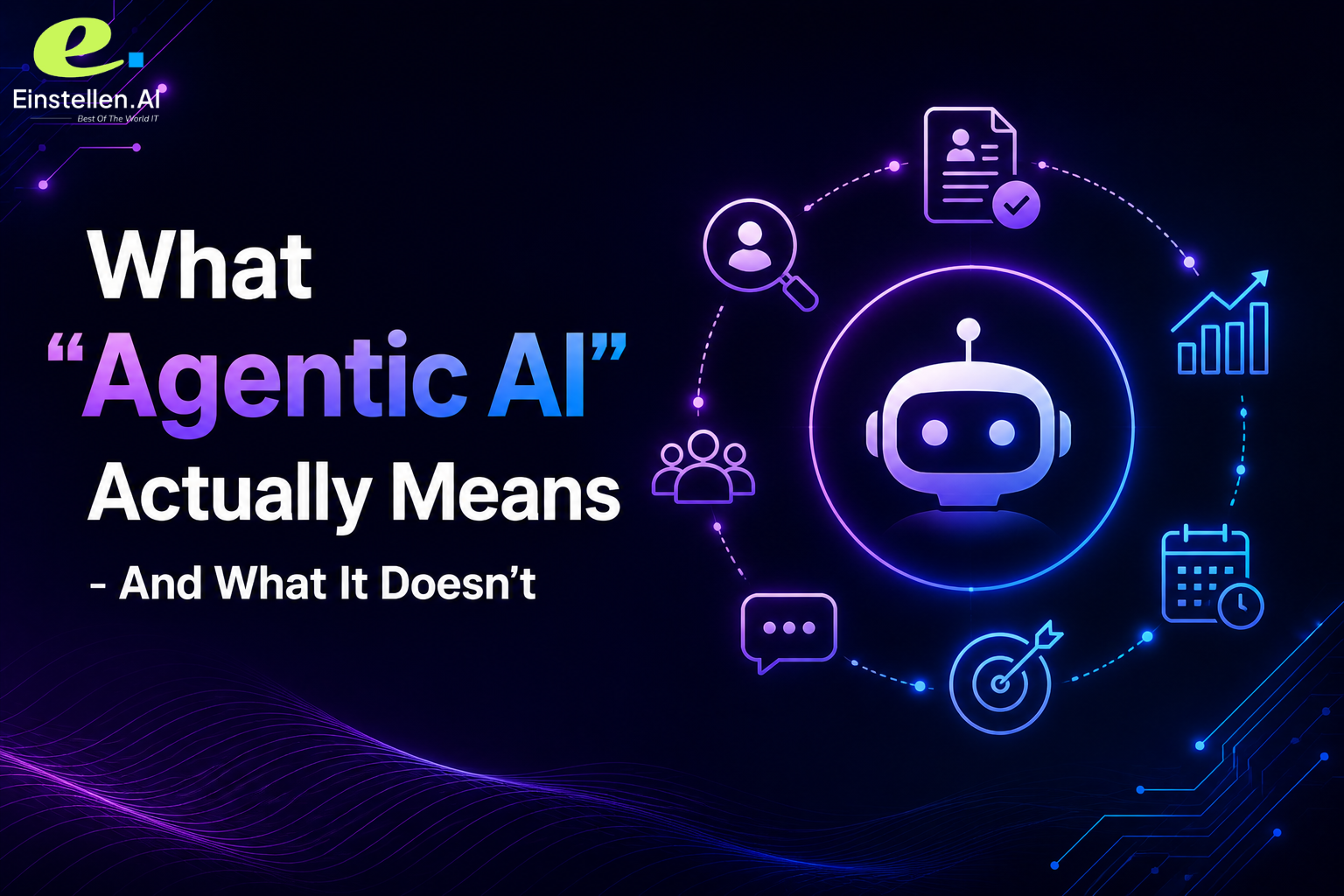
The word "agentic" gets used loosely in HR tech marketing. It is worth being precise about what it actually describes before evaluating any platform that claims the label.
An AI agent, in the technical sense, is a system that can:
- Perceive its environment - Reading job briefs, candidate profiles, ATS data, and interview transcripts
- Plan a multi-step sequence to achieve a defined goal
- Execute each step autonomously - sending outreach, running interviews, scoring responses, updating records
- Adapt when something changes - if a candidate's answer reveals a gap, the system probes deeper rather than moving on
That last point is the one most vendor content skips. True agentic behaviour is not just executing a pre-written script faster. It is reasoning from what actually happened and deciding what to do next based on that reasoning. A system that follows a fixed decision tree more efficiently than it used to is not agentic. A system that listens to a candidate's answer, identifies that it was vague, and generates a targeted follow-up question from the specific content of that answer - that is agentic.
The distinction matters because most "AI-powered" recruiting tools on the market today are the first type dressed up as the second.
Three Tiers of AI in Recruiting
| Tier | What it does | Example |
|---|---|---|
| Automation | Executes rigid if-then rules. No reasoning, no adaptation. | Resume keyword filter, calendar invite on application submission |
| Generative AI | Responds to prompts, creates content on demand. Waits for human input at each step. | AI job description writer, ChatGPT for outreach drafting |
| Agentic AI | Pursues goals across multi-step workflows autonomously. Adapts based on outcomes. Decides what to do next | Adaptive AI interviewer, autonomous sourcing-to-shortlist pipeline |
Most teams currently sit in tier two and think they are in tier three. The difference shows up in whether a human still has to move work between steps.
Read More: AI Hiring Platform Implementation Without ATS Disruption
The State of Agentic AI Adoption in Recruiting: What the Data Shows
The shift from assistive to agentic AI is the fastest-moving part of the entire recruiting software category right now. The adoption numbers make that concrete.
- 52% of global talent leaders plan to add autonomous AI agents to their recruiting teams in 2026 - not "considering," planning. That figure comes from Korn Ferry's 12th Annual Talent Acquisition Trends survey, which drew on insights from over 1,670 external global talent leaders as well as 230 Korn Ferry talent experts spanning industries and regions worldwide. The full report is available at kornferry.com.
- Enterprise AI-agent deployment across all business functions jumped from 11% to 42% in just six months, according to KPMG's Q3 2025 AI Quarterly Pulse Survey of 130 US enterprise leaders - a quadrupling of adoption inside one financial year.
- Deloitte's 2026 Global Human Capital Trends identifies this as a defining tipping point - one that compels organisations to leap to the next curve of capability or risk falling measurably behind.
- The agentic AI in HR and recruitment sector was valued at $842.3 million in 2024 and is projected to reach $23.2 billion by 2034, a 39.3% compound annual growth rate, per Market.us research.
- 85% of recruiters want to keep final decision authority over AI recommendations, per Aptitude Research's 2026 Recruiting Automation study - which is the right instinct, and the right design for responsible agentic deployment.
The adoption gap tells the real story. Today, 42% of enterprises have deployed agents - and Korn Ferry's survey shows adoption is accelerating fastest in its agentic form. That gap represents teams still running pilots, stuck in procurement, or waiting for clearer compliance guidance. The next 12 months will determine which organisations build genuine competitive advantage from this shift and which fall behind while still discussing it.
What an Agentic AI Recruiting System Actually Does - Funnel Stage by Stage
Abstract definitions are easy to write. Here is what agentic AI for recruiting looks like in practice, across each stage of the hiring funnel.
Stage 1: Job Brief Intake and Candidate Profile Building
When a new requisition is approved, an agentic system reads the job brief and autonomously builds an ideal candidate profile. This is not keyword extraction from a job description. A genuinely agentic system analyses the role's requirements in context - required skills, seniority signals, past successful hires for similar roles, and team composition data - and constructs a dynamic profile it will use to evaluate candidates throughout the process.
At Einstellen.AI, this means Magic OS reads the role parameters and configures the humAIn interview engine accordingly - setting the depth of technical probing, the seniority level of follow-up questioning, and the evaluation criteria the MAGIC model will apply to every candidate's responses.
Stage 2: Autonomous Screening and Prioritisation
Rather than waiting for a recruiter to open an inbox and start reviewing applications manually, an agentic system processes applications as they arrive. It is not just keyword-matching. A genuine agentic screener evaluates contextual signals: career trajectory, demonstrated competency from project descriptions, patterns in how experience is described, and red flags that keyword filters miss entirely.
The output is not a ranked list for a recruiter to re-review. It is a prioritised shortlist with structured reasoning attached - specific evidence for each candidate's prioritisation that a hiring manager can audit, not a black-box score to take on faith.
Stage 3: Adaptive AI Interviewing - the Most Consequential Stage
This is where the gap between agentic and non-agentic tools shows up most clearly.
A fixed-script video interview tool asks every candidate the same five questions regardless of what they say. Give a vague answer about a specific project? The system moves on to the next scripted question anyway. That design produces shallow, inconsistent signal - and it is what most AI interview tools currently deliver.
Einstellen.AI's humAIn engine works differently. It listens to what a candidate actually said in each answer and generates the next question from the specific content of that response. The mechanism is straightforward: the system evaluates whether an answer is specific enough to move forward from, or incomplete enough to probe further.
Give a clear answer with a real example, a specific outcome, and a measurable result - the system moves on. Give a vague answer ("I worked on optimising the database") with no detail - the next question goes directly into that gap ("What specifically did you change about the indexing structure, and what was the measured query time improvement?"). That follow-up question was not on any pre-written list. It was generated from what the candidate actually said.
This is the practical difference between a decision tree that selects a pre-written branch and a genuinely adaptive system that reasons from the conversation. The signal quality difference is significant: adaptive questioning extracts information no one anticipated when building the interview, because it responds to the specific content the candidate introduced.
Read More: AI Hiring Platform Interview Etiquette: What to Do and Never Do
Stage 4: Explainable Scoring and Justified Reporting
This is the stage that most agentic AI content skips - and it is the stage that determines whether a hiring manager will actually trust and act on the system's output.
An AI that produces a ranked shortlist with no visible reasoning behind it forces the hiring manager into one of two positions: blindly trust the number, or manually re-interview to verify it. Either way, the efficiency gain from autonomous screening is partially undone.
Einstellen.AI's MAGIC model produces something structurally different: a per-answer scored report with a full transcript. Every score comes with a structured justification showing exactly which answer drove which part of the result. A hiring manager reviewing a borderline candidate can see the actual reasoning - not just a final number they are expected to accept without basis.
This matters for two reasons. First, it removes the manual re-verification step that stalls offer cycles after autonomous screening. Second, it creates the audit trail that regulators and cautious HR teams are now explicitly requiring - a specific, documented reason for every hiring decision that AI influenced.
Stage 5: ATS Synchronisation and Audit Logging
A truly agentic system does not produce outputs that need to be manually copied into the ATS. Scores, transcripts, justified reports, and candidate status updates flow directly into the existing ATS record - bidirectionally, without additional setup cost.
Magic OS integrates with any ATS a company is already using, including native, bidirectionally-synced connections with Greenhouse, Lever, and Workday, at no additional cost. The result is that every agentic hiring workflow produces a documented, traceable record inside the system the team already works in.
Agentic AI vs Generative AI in Recruiting: The Distinction That Actually Matters
The confusion between agentic AI and generative AI causes real procurement mistakes. Here is the clearest way to draw the line.
Generative AI waits for a prompt. You tell it to write a job description, it writes one. You tell it to summarise a resume, it summarises. It produces content on demand, one task at a time, and stops when you stop asking. It is a powerful tool. It is not an agent.
Agentic AI pursues a goal. You define the outcome ("shortlist the top 20 candidates for this role"), and the system plans and executes the steps required to reach it - autonomously, adapting as it encounters new information along the way.
The practical test: if a human still has to trigger each step of the workflow manually, it is not agentic. If the system decides what to do next and does it - without a per-step prompt - it is.
| Objectives | Generative AI | Agentic AI |
|---|---|---|
| Trigger | Human prompt required each time | Goal-directed - executes independently |
| Scope | Single task per session | Multi-step workflow execution |
| Adaptation | None - responds to what you asked | Adapts based on what it encounters |
| Output | Content on demand | Decisions, actions, structured reports |
| Example in hiring | AI writes a job description | AI interviews a candidate and produces a scored report |
What Agentic AI in Recruiting Is Not Ready to Replace
Honest evaluation of agentic AI requires being clear about where human judgment is still not just valuable - it is irreplaceable.
Relationships and negotiation. An agentic system can screen, interview, score, and shortlist. It cannot build the kind of trust that makes a strong candidate choose your company over a competing offer. Recruiter relationship skills are not a casualty of agentic AI - they become the primary differentiator once administrative screening is automated.
Cultural judgment calls. AI can evaluate demonstrated competency from interview responses. It cannot fully assess whether a candidate will thrive in a specific team's working culture, how they will respond to a particular manager's style, or whether the role is genuinely a good long-term fit. These are judgment calls that require human context.
Final hiring decisions. Einstellen.AI's position on this is consistent with the regulatory consensus: 85% of recruiters want to keep final decision authority over AI recommendations. The agentic system produces the evidence and the shortlist. The human makes the final call. That division of labour is not a limitation - it is the right design.
Emotionally complex candidate interactions. A candidate who is anxious, confused, or in genuine financial distress during a job search needs a human response. Agentic AI handles volume and consistency. Human recruiters handle the moments that require genuine empathy.
Compliance and Risk: What Every Team Must Know Before Deploying Agentic AI in Hiring
Regulatory scrutiny of AI in hiring is real, moving fast, and no longer optional to understand.
EU AI Act - Now in Force as of August 2026
As of 2 August 2026, AI systems used for recruitment and candidate evaluation are classified as high-risk under the EU AI Act. The practical requirements for high-risk AI in hiring include:
- Explainability: The system must provide a documented reasoning log for every candidate it ranks or screens
- Human oversight: High-risk AI must be designed so that trained personnel can intervene or override any decision
- Audit trail: Every action the agentic system takes must be logged and reviewable
- Transparency to candidates: Candidates must be informed that AI is evaluating them and on what basis
- Non-compliance penalties: Up to €15 million or 3% of global annual turnover
This is precisely why Einstellen.AI's structured justification reports are not a feature - they are a compliance requirement. A score without a reasoning log attached is, under current EU law, a liability for any organisation that uses it to make or influence hiring decisions.
NYC Local Law 144
New York City's Local Law 144 requires employers using automated employment decision tools to conduct bias audits and publish the results. The law applies to hiring decisions involving NYC-based candidates, regardless of where the employer is headquartered.
India's DPDP Act
India's Digital Personal Data Protection Act establishes consent and transparency requirements for data processing, including candidate data collected during AI-assisted hiring. Platforms operating in India and processing candidate data - including interview recordings, transcripts, and biometric signals - are subject to these requirements. Einstellen.AI's ISO/IEC 27001:2022, SOC 2 Type II, and GDPR certifications, with viewable certificates on the Trust Center, reflect preparation for exactly this regulatory environment.
The Audit Trail Requirement
The practical implication for any agentic AI in hiring: every system you evaluate needs to answer this question clearly: "If a candidate disputes a hiring decision that your system influenced, can you produce a specific, documented reason for that outcome?" If the answer is "we can show you a score," that is not sufficient. If the answer is "we can show you the transcript, the per-answer breakdown, and the specific reasoning behind each score component," that is a defensible audit trail.
Read More: AI-Based Hiring Platform ROI: A Model for Founders and CFOs
How to Evaluate an Agentic AI Recruiting Platform: Eight Questions That Separate Genuine From Marketed
If you are currently in procurement for an agentic AI hiring platform, these eight questions will separate systems that are genuinely agentic from systems that use the word in their marketing.
- Does the interview adapt from what the candidate actually said, or does it select from a pre-written decision tree? If the follow-up question was written before the interview started, the system is not agentic - it is a branching script.
- What does the output look like? A score is not sufficient. Ask to see an actual candidate report. If you cannot see specific reasoning for each component of the score, the system cannot be audited or trusted at scale.
- What does ATS integration actually cost? Many platforms charge separately for ATS connectivity. Full bidirectional integration should be standard, not a premium add-on.
- What fraud and proxy detection does the system include? At scale - campus drives, bulk enterprise rounds - proxy interviewing is a real risk. Ask specifically how the system detects and flags it.
- What happens when the AI is wrong? A responsible agentic platform tells you explicitly what the system cannot do and how to override it. If a vendor cannot answer this, their human oversight design is incomplete.
- How does the system comply with the EU AI Act's high-risk classification? Ask specifically about the reasoning log, the human override mechanism, and what happens to candidate data after the process.
- Is pricing transparent? Agentic AI platforms that require a demo-gated sales call before disclosing pricing are adding friction that costs procurement time. Einstellen.AI publishes a flat rate of ₹249 per interview, pay-per-use, no subscriptions, no contracts.
- Can you see the candidate's experience, not just the recruiter's dashboard? An agentic hiring platform that is opaque to candidates - no explanation of the score, no basis for the outcome - creates trust deficits that damage employer brand and increase candidate drop-off.
Agentic AI for Recruiting in India: The Local Market Picture
India's AI hiring platform market has specific dynamics that make agentic AI adoption both more urgent and more impactful than in Western markets.
Volume is the defining constraint. A mid-size Indian IT services company processing 10,000 campus applications across 50+ institutions in a six-week placement season cannot solve that problem with manual screening. The maths do not work at any seniority of recruiter. Agentic AI is not a convenience at that scale - it is an operational necessity.
The product-versus-services salary gap creates a signal problem. A resume from a Tier-2 engineering college listing "Python, Django, REST API" experience could represent a candidate who built a production API handling 50,000 daily requests, or one who completed a Udemy course. Keyword filters cannot tell the difference. Adaptive AI interviews can - because they generate follow-up questions from what the candidate actually says about their work, not just what they listed on a CV.
The DPDP Act creates a compliance opportunity. Organisations that implement agentic hiring with full audit trails and candidate-facing transparency now are building a compliance advantage over competitors who will scramble to retrofit it later. Einstellen.AI's design - per-answer justified reports, full transcripts, data encrypted in transit and at rest - is specifically suited to this environment.
The cost equation is different. At ₹249 per interview with no subscription and no volume commitment, the barrier to deploying agentic AI interviewing at scale is lower in India than in any Western market pricing model. A 100-interview pilot costs ₹24,900. The decision to test is not a procurement committee discussion. It is a line manager's decision.
The Einstellen.AI Model: What Agentic Recruiting Looks Like in Practice
Einstellen.AI's Magic OS is built as an end-to-end agentic hiring operating system - not a collection of AI features bolted together, but a system designed from the ground up to execute multi-step hiring workflows autonomously and produce outputs a hiring manager can act on without manual re-verification.
The humAIn engine runs adaptive, autonomous interviews that generate questions from what the candidate actually said. The MAGIC model evaluates every response against structured criteria and produces a per-answer scored report with a full transcript. The output flows directly into any ATS at no additional cost. And every score comes with the documented reasoning that EU AI Act compliance and responsible hiring practice both require.
Across 30,000+ AI interviews conducted on the platform across 1,200+ institutions - backed by IIM Lucknow and NASSCOM - every single interview has produced a transcript-backed, justified report, not a standalone number. That design is the difference between an agentic AI platform a hiring manager can trust and an opaque ranking system they quietly ignore.
For high-volume contexts specifically: the TestCrew case study documents what this looks like at scale. Interview review time per candidate dropped from 30-45 minutes to 5 minutes. Decision confidence was 100% because the evidence was visible, not inferred. Global benchmarks were established across teams because every evaluation used the same structured criteria, not a different interviewer's intuitions.
The Bottom Line for TA Teams in 2026
Agentic AI for recruiting is not a trend to monitor. It is a structural shift that is already separating hiring teams that scale from teams that stall.
The teams that will benefit most are the ones that understand what agentic actually means - and evaluate platforms accordingly. Not every tool that calls itself agentic can execute autonomous, adaptive, multi-step hiring workflows and produce the justified, audit-ready outputs that both compliance requirements and hiring managers actually need.
The teams that will fall behind are the ones still adding point-solution tools to a fundamentally manual process and calling it AI-powered hiring. Deloitte's 2026 Global Human Capital Trends identifies organisations that move beyond the hype to intelligently embed autonomous AI as structural components of their TA operating model as the ones targeting greater hiring velocity, better candidate quality, and real cost reduction. The others are watching.
Frequently Asked Questions
What is agentic AI for recruiting?
Agentic AI for recruiting refers to autonomous AI systems that execute multi-step hiring workflows - sourcing, screening, interviewing, scoring, and ATS synchronisation - without a human triggering each step. Unlike rule-based automation or generative AI tools that respond to prompts, agentic systems pursue hiring goals independently, adapting their actions based on what they encounter along the way. The defining characteristic is autonomous, goal-directed execution across a sequence of steps - not just faster automation of individual tasks.
How is agentic AI different from AI in traditional applicant tracking systems?
Traditional ATS AI applies fixed, rule-based filters: keyword matching, boolean search, and pre-set scoring rubrics. These systems execute instructions they were given in advance and cannot adapt to new information during the process. Agentic AI reasons from what it encounters in real time - it generates adaptive interview questions based on candidate answers, adjusts its evaluation depth based on response quality, and produces outputs that reflect the actual conversation rather than a pre-written script applied to every candidate identically.
Is agentic AI in hiring compliant with the EU AI Act?
The EU AI Act, in force as of August 2026, classifies AI systems used in recruitment and candidate evaluation as high-risk. This does not mean they cannot be used - it means they must meet specific requirements: documented reasoning logs for every candidate decision, human oversight mechanisms, bidirectional audit trails, and transparency to candidates about how their evaluation was conducted. Platforms that produce only a score with no visible reasoning behind it are not compliant with these requirements. Einstellen.AI's per-answer scored reports with full transcripts are designed specifically to meet these standards.
Can agentic AI replace human recruiters?
No - and any platform that claims otherwise deserves scepticism. Agentic AI handles the high-volume, repeatable, data-processing components of hiring: screening, interviewing at scale, consistent evaluation, and shortlisting. It cannot replace the relationship-building, negotiation, cultural judgment, and emotionally intelligent candidate interactions that define the recruiter's highest-value work. 85% of recruiters in 2026 want to retain final decision authority over AI recommendations - that is the right instinct, and the right design.
How does adaptive AI interviewing differ from a standard video interview?
A standard video interview, or a fixed-script AI interview, presents every candidate with the same set of pre-written questions regardless of how they answer. An adaptive AI interview generates each follow-up question from what the candidate actually said in their previous answer. If a candidate gives a vague answer about a specific project, the system probes that project specifically rather than moving on to the next scripted question. This produces significantly richer signal about real competency - and cuts both types of screening errors: false positives who coast through generic questions, and false negatives who phrased their first answer poorly but would have performed strongly under deeper questioning.
What should a company look for when evaluating an agentic AI recruiting platform?
The core questions to ask: Does the interview adapt from actual candidate answers, or from a pre-built decision tree? Does the output include documented reasoning for each score, or just a ranking? Is ATS integration bidirectional and included at no additional cost? Does the platform include fraud and proxy detection built into the interview flow?
Is pricing transparent without requiring a sales call? And critically: does the platform produce the kind of audit-ready output that EU AI Act compliance now requires? A score without a reasoning log is not compliant, and it is not useful to a hiring manager who needs to defend a borderline decision.
Is agentic AI for recruiting relevant for Indian enterprises in 2026?
Particularly so. The combination of high application volumes, a significant talent identification gap between campus-listed skills and demonstrated competency, the DPDP Act's data handling requirements, and the relatively low per-interview cost of platforms like Einstellen.AI makes the case for agentic AI deployment stronger in the Indian market than in most Western contexts. Campus placement drives of 500-5,000 candidates are exactly the use case where the operational difference between manual screening and autonomous adaptive interviewing is largest and most measurable.
Einstellen.AI's Magic OS is the world's first AI-native hiring operating system - built on adaptive, agentic AI interviewing, explainable scoring, and pay-per-use pricing at ₹249 per interview, no contracts. Post your next role on Einstellen.AI and see what agentic hiring actually produces.






Leave a Comment
Share your perspective. Comments are moderated before publishing.