
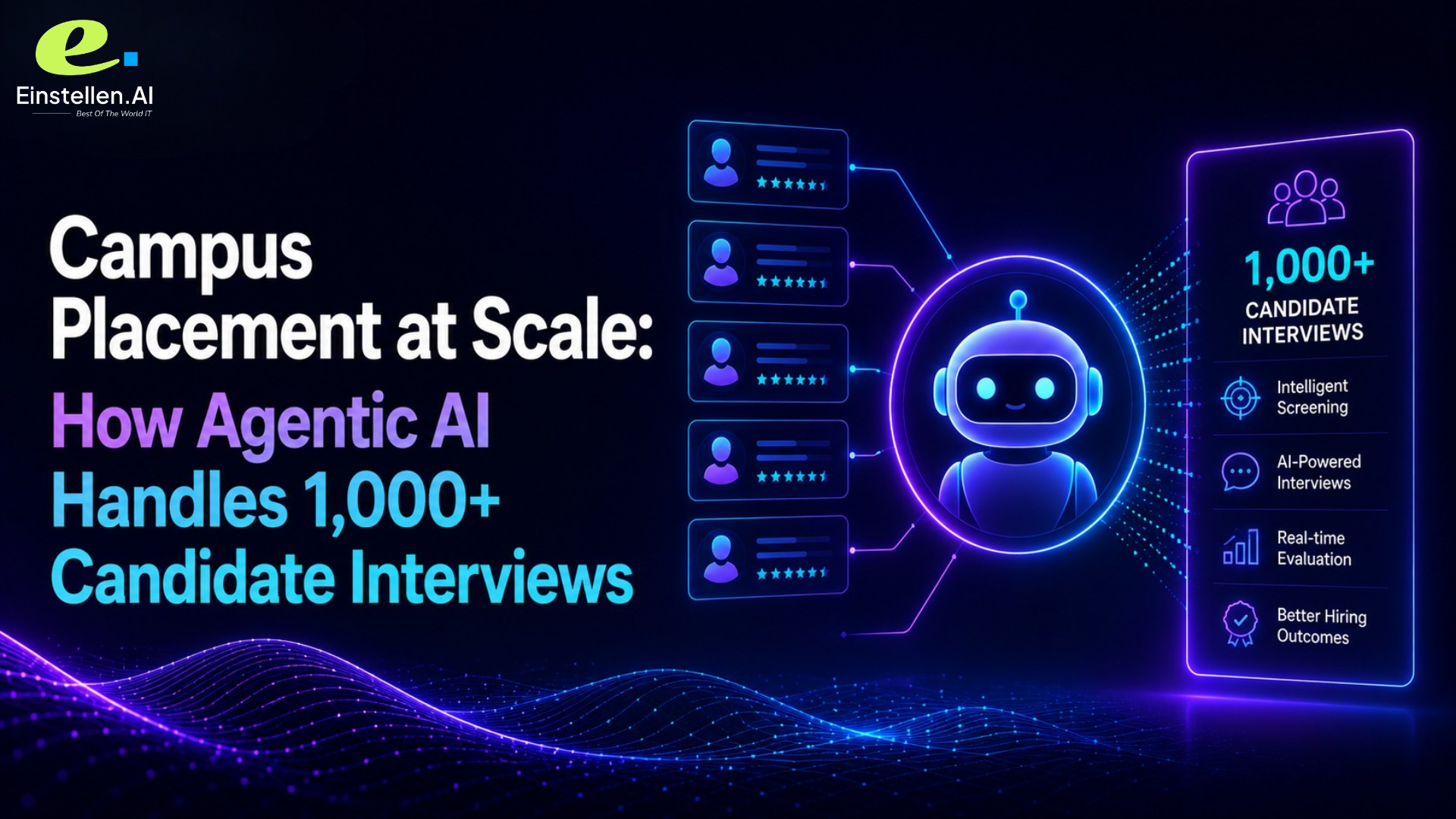
Quick Answer: Agentic AI campus placement bulk screening lets a placement cell run 1,000+ interviews in parallel using adaptive questioning that reacts to each answer, not a fixed script. Every response gets a structured, justified score with a full transcript, plus fraud and proxy detection, so results scale without losing evaluation quality or explainability.
According to Deloitte India's Campus Workforce Trends 2026 report, 86% of organisations say AI or Agentic AI is now transforming their hiring processes. The pressure is landing most acutely on placement cells, where volume and deadline pressure have always been highest.
Picture a Tier 1 engineering college with 1,400 final-year students and a placement window of eight working days. Three visiting companies want first-round interviews wrapped up before their HR teams even land. A placement officer with four staff members simply cannot interview 1,400 students in that time. And a panel that tries anyway will be running on fumes by day three, cutting question depth just to keep the line moving.
This is the exact scenario agentic AI campus placement bulk screening was built for. Instead of a placement cell rationing interviewer time across thousands of students, an adaptive AI interview engine runs conversations in parallel, at whatever volume the drive needs, and still produces a structured, explainable score for every single candidate. The real difference between this and the older "automated" screening tools isn't just speed. It's whether the system actually listens to what a student says or just fires off the next question on a checklist, no matter what the answer was.
How Does Agentic AI Work for Campus Placement?
An agentic AI interview engine, like humAIn on Einstellen.AI's Magic OS, listens to a candidate's actual answer and generates the next question based on what was just said. Give a vague answer about a final-year project, and the system doesn't move on. It probes that specific project further instead of jumping to the next item on a script.
That matters more in campus placement than almost anywhere else, because answers vary wildly in depth and confidence within the same batch. A fixed-script tool asks the same five questions to a student who built a genuinely original capstone project and to a student who memorized a tutorial the night before. An adaptive engine goes deeper exactly where the conversation reveals something worth exploring. What comes out the other end looks a lot more like what a sharp human panelist would dig up, not a static form filled in twice.
Every interview then runs through the MAGIC model, Einstellen.AI's evaluation framework, which produces a structured, justified score rather than an opaque number. So when a placement officer is looking at a borderline student, they can actually see which answer drove which part of the score. Not just a final figure with no reasoning behind it.
Can AI Conduct 5,000 Campus Interviews in a Week?
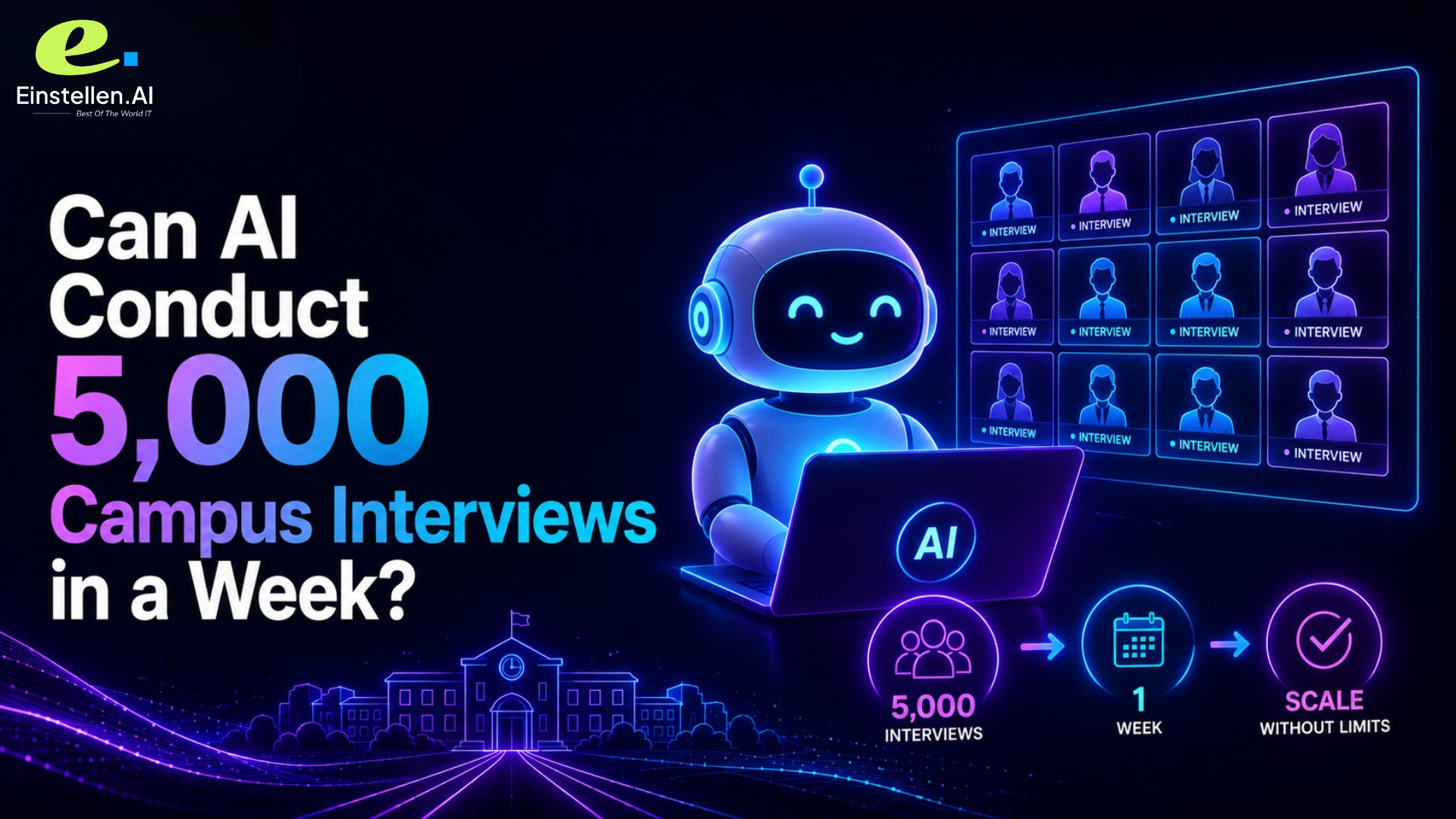
Can AI Conduct 5,000 Campus Interviews in a Week HirePro's State of College Hiring India 2026 found that only 21% of organisations have fully transitioned to skills-first hiring, meaning the gap between what employers want to assess and what traditional screening delivers is still wide. Volume is really the whole point of this category of tools, and this is where the gap between an AI interview platform and a human panel stops being incremental and becomes structural. A human panel scales linearly: more interviews mean more interviewer-hours, more scheduling headaches, and more risk that fatigue quietly degrades question quality by the fourth hour of the day.
An AI interview engine scales differently. It runs conversations concurrently. There's no real reason a 5,000-student drive spanning multiple departments can't be completed inside a week, since each interview is an independent adaptive conversation between the system and one candidate, not a sequential slot on a single panel's calendar. Einstellen.AI has conducted 150,000+ AI interviews across 1,200+ institutions to date, which is proof that this isn't theoretical.
The real constraint at that scale usually isn't the engine itself. It's about making sure the process still catches impersonation and answer-sharing across thousands of simultaneous sessions, and that's exactly why fraud and proxy detection need to be built into the interview flow itself. Not bolted on afterward as a separate audit step, nobody has time to run.
Explainable Scoring at Scale: Why It Matters More, Not Less
There's a common assumption that explainability is a nice-to-have, something you sacrifice for speed once volume gets high enough. For campus placement specifically, it's the opposite. When one placement officer has to defend 1,000+ outcomes to students, parents, faculty, and visiting company HR teams, an unexplained ranking turns into a liability the second a single student or company pushes back on a result.
A score without justification isn't AI-powered screening. It's a black box with a confidence interval attached, and at 1,000+ candidates, the number of people who could reasonably ask "why did I get this score?" is enormous. The MAGIC model's structured justification report exists for exactly this reason: so that a dispute gets answered with a transcript and a reasoning trail, not a shrug.
This is also the direct counter to most competitors in the AI interview category, where scoring output with no accessible reasoning trail behind it is still the norm rather than the exception. Explainability at scale isn't a defensive feature bolted on for optics. It's what makes bulk screening actually sustainable to run, instead of a liability sitting there waiting to surface.
Campus Recruitment AI Software vs a Human-Only Panel Process
The honest comparison here isn't "AI vs no screening." It's AI-assisted screening vs a human panel process that, in practice, already compromises on depth once volume climbs. Placement cells running manual first rounds at scale routinely shorten interview time per student, skip follow-up questions, and lean on resume shortlisting alone for lower-priority companies. Not because they want to, but because there just aren't enough interviewer-hours in the drive window.
Campus recruitment AI software removes that time constraint without removing question depth, because the adaptive engine doesn't get tired on interview 900 the way a human panelist does by interview 40. Interview one and interview one thousand get probed the same way when the answer is vague.
 The other structural advantage is consistency across the entire batch. A human panel's standards can drift over a multi-day drive, sometimes department to department, sometimes just interviewer to interviewer, depending on who's had lunch. An AI interview engine applies the same MAGIC model framework to every student, so scores stay comparable across the full cohort in a way a multi-panel manual process genuinely struggles to guarantee.
What Is the Difference Between Agentic and Automated Campus Screening?
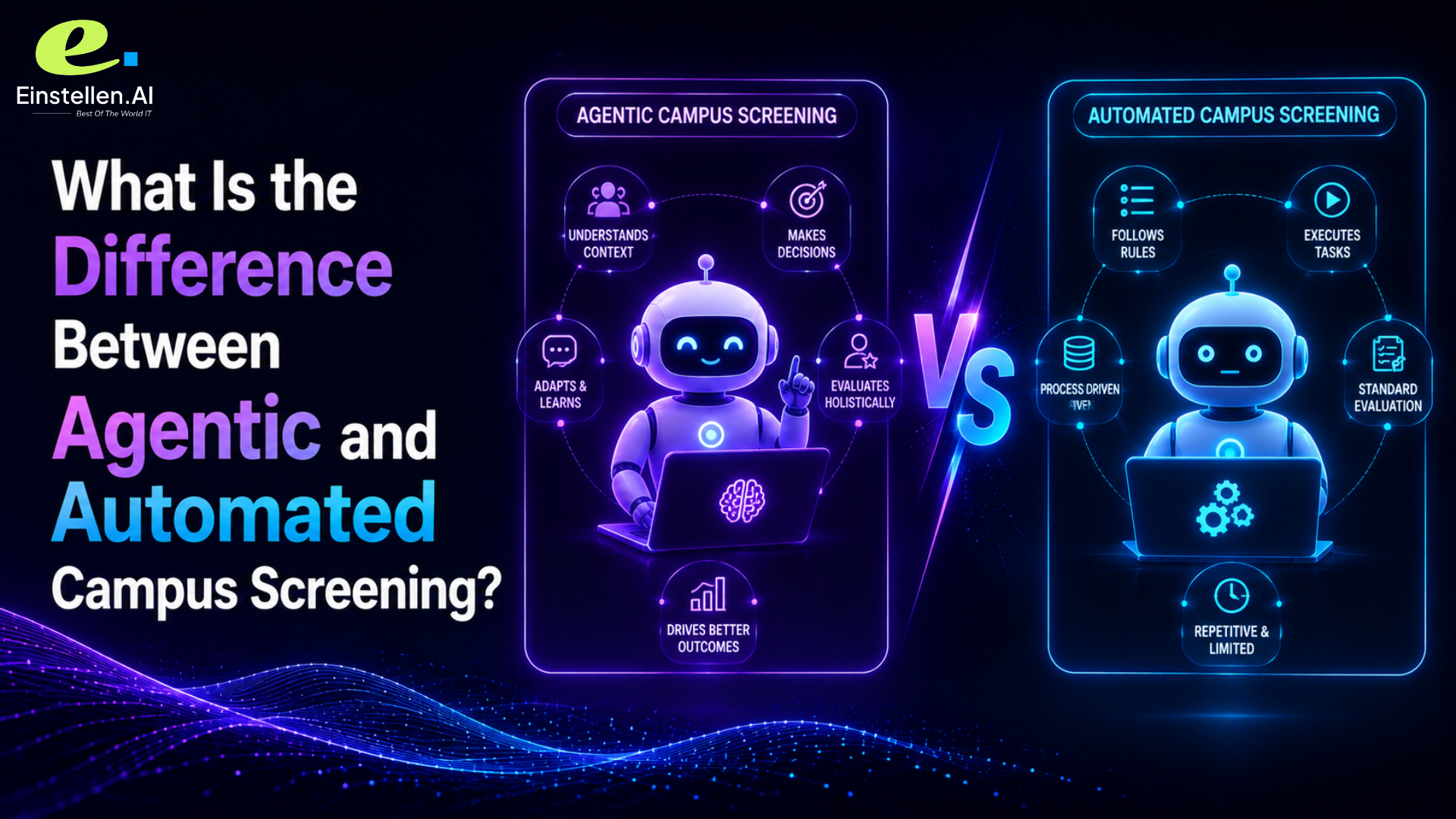
What Is the Difference Between Agentic and Automated Campus Screening "Automated" AI screening usually just means a fixed script: the same questions, in the same order, to every candidate regardless of what they say, sometimes with basic keyword matching thrown in to flag responses. It's faster than a human panel, sure, but it isn't adaptive, and it produces the same shallow signal whether a candidate gave a rich answer or a thin one.
"Agentic" AI interviewing works on a different mechanism entirely. The system generates each next question based on the specific content of the previous answer, so two students who both claim expertise in the same skill can end up in genuinely different follow-up conversations depending on how convincingly each of them actually explains it. That's the literal technical basis for calling an interview engine adaptive rather than scripted, and it's why agentic tools produce richer, more differentiated signal at the same interview volume a fixed-script tool would churn through.
For a placement cell trying to figure out whether a tool is genuinely agentic or just automated with a nicer interface, the test is simple: does the system's third question change based on the candidate's second answer? If it doesn't, it's running a script, not a conversation.
Campus Placement Bulk Screening: Key Figures
| Metric | Figure |
|---|---|
| AI interviews conducted to date (Einstellen.AI) | 150,000+ |
| Institutions using the platform | 1,200+ |
| Institutional backing | IIM Lucknow, NASSCOM |
| Core evaluation framework | MAGIC model (structured, justified scoring) |
| Interview integrity feature | Fraud and proxy detection built into interview flow |
| ATS/placement system integration cost | No additional cost, integrates with existing systems |
Proof Point: Einstellen.AI has conducted 150,000+ AI interviews across 1,200+ institutions, backed by IIM Lucknow and NASSCOM. MediAssist's enterprise deployment on the platform produced 92.5% fewer screening interviews, 15-day average fulfillment, 100% position closure rate, and 60% interview-to-deployment conversion; every score was delivered with a structured justification report so hiring managers could defend every shortlisting decision with documented evidence.
FAQ
How does agentic AI work for campus placement?
An agentic AI interview engine listens to a candidate's actual answer and generates the next question based on what was just said, rather than following a fixed script. That lets it probe deeper into a specific project or claim when a student's answer is vague, producing richer signal than a static checklist-style AI tool, while still scoring every response through a structured, justified framework.
Can AI conduct 5,000 campus interviews in a week?
Yes, because each AI interview is an independent, adaptive conversation running concurrently rather than a slot on one panel's calendar. Volume scales by running more conversations in parallel, not by adding interviewer-hours. Einstellen.AI has already conducted 150,000+ AI interviews across 1,200+ institutions, so this isn't just a theory; it's already happened at real institutional scale.
What is the best AI tool for campus hiring in India?
It really comes down to whether the tool can explain its scores and whether it genuinely adapts to answers instead of running a fixed script. Einstellen.AI's humAIn engine, backed by IIM Lucknow and NASSCOM, produces structured, justified scoring plus fraud and proxy detection, which matters most in high-volume placement drives, where disputes and impersonation risk both climb as scale goes up.
What is the difference between agentic and automated campus screening?
Automated screening runs the same fixed set of questions no matter what a candidate says. Agentic screening generates each next question based on the specific content of the previous answer, so the conversation actually shifts depending on what the candidate says. The practical test: if the third question never changes based on the second answer, the tool is scripted, not agentic.
Work With Einstellen.AI on Your Next Placement Drive
Einstellen.AI operates across India's enterprise hiring and higher education markets, backed by IIM Lucknow and NASSCOM, with 150,000+ AI interviews already conducted across 1,200+ institutions.
If your placement cell is planning a drive that needs to move fast without cutting corners on evaluation depth or defensibility, an adaptive interview engine with explainable scoring and built-in fraud detection is built for exactly this kind of volume.
Set up your next placement drive on Einstellen.AI and run 1,000+ adaptive AI interviews with explainable scoring and built-in fraud detection, without adding a single interviewer-hour to your team's workload.








Leave a Comment
Share your perspective. Comments are moderated before publishing.