
Quick Answer: An AI job search platform in Pune works best for DevOps engineers when it matches you to active, current listings rather than a static database and explains each interview score instead of returning an opaque ranking. Pune DevOps salaries range from ₹5-9L (fresher) to ₹30-55L (senior), with Kubernetes and Terraform multi-cloud skills commanding the top end.
Three years running Kubernetes clusters. Terraform modules written for a Pune-based GCC. And yet every job board search turns up the same 1,000+ generic "AI jobs in Pune" results, most of them unrelated GenAI or data science postings with your actual DevOps stack buried somewhere in a skills tag. You apply anyway, because what else is there to do? Two weeks pass. No response, no explanation, no idea whether a human or a script rejected you.
That's the real problem with most platforms marketed as AI job search platforms that Pune candidates rely on today. They're job aggregators wearing an AI label, not tools actually built to evaluate you fairly or match you against your specific DevOps profile. This guide covers what to look for instead, what Pune companies are actually paying for DevOps skills in 2026, and how an explainable AI interview process is different from the black-box screening most engineers have already run into and stopped trusting.
What an AI Job Search Platform Should Actually Do for DevOps Engineers
Most platforms ranking for "AI job search Pune" are, if you strip away the marketing, listing feeds. Filter by Kubernetes, Docker, or CI/CD, scroll a few hundred postings, apply, hear nothing. None of them tell you how they screen you. None of them accounts for the specific reality of a DevOps search, where a Terraform module you wrote for AWS matters a lot more than whether your resume contains the right keyword.
A platform genuinely built for DevOps job searching needs to do three things a listing feed simply can't: surface roles that are actually open right now instead of stale reposts, run an interview that adapts and probes your real infrastructure experience instead of firing off a fixed five-question script, and hand you back a scored report you can actually read rather than a silent rejection.

Einstellen.AI's humAIn interview engine listens to what you say about, say, a Kubernetes migration project, and builds the next question off that specific answer instead of jumping to an unrelated scripted item. Give a vague answer about a CI/CD pipeline, and the system goes deeper into that pipeline specifically. That's the actual difference between adaptive questioning and a checklist wearing an AI badge.
DevOps Engineer Salary Pune 2026: What the Bands Actually Look Like
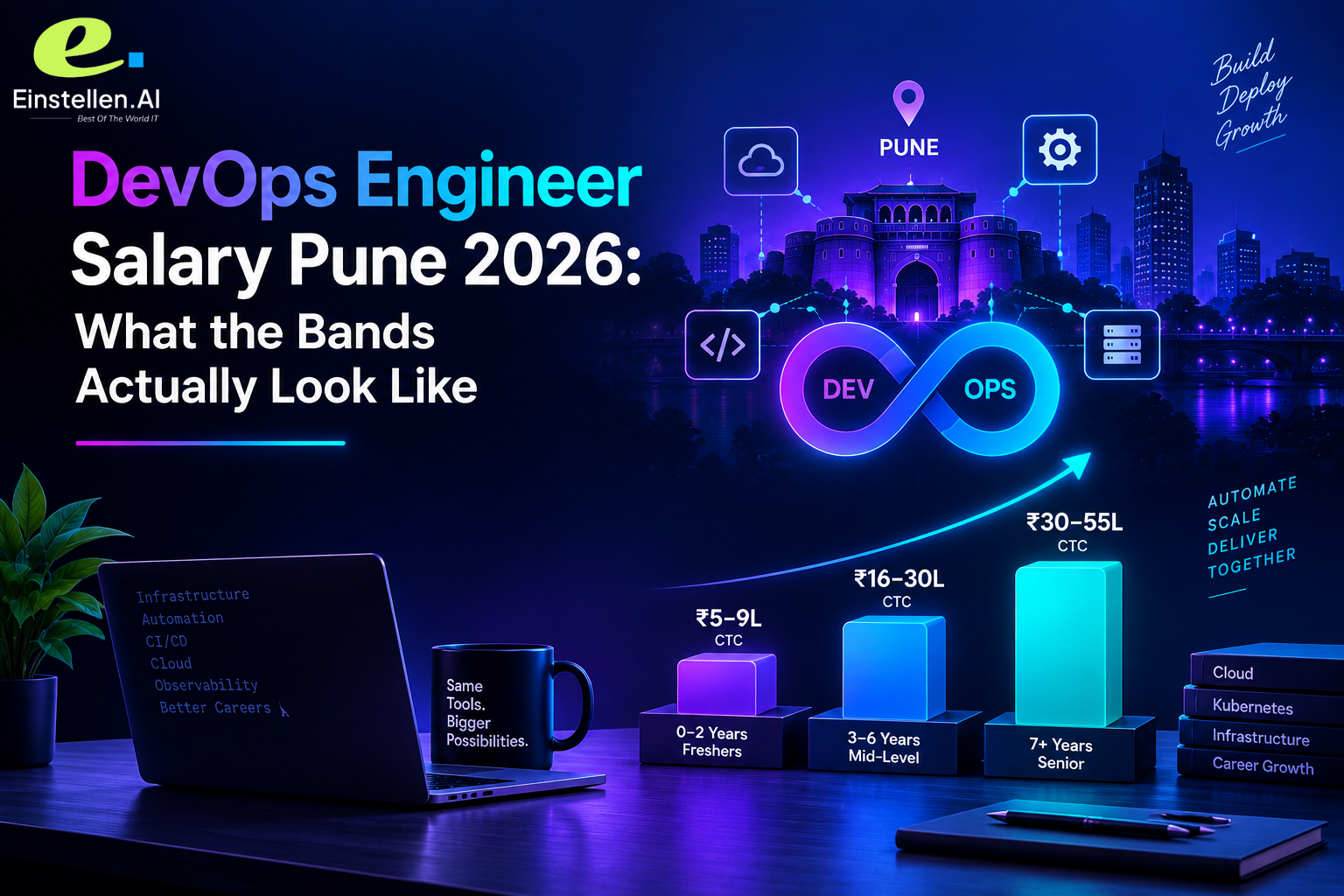
DevOps and SRE pay in Pune tracks close to national metro averages, though with a slightly lower cost-of-living adjustment than you'd see in Bangalore or Mumbai, per Einstellen.AI's salary benchmark data. Freshers with 0-2 years land ₹5-9L CTC. Mid-level engineers with 3-6 years of hands-on infrastructure work earn ₹16-30L. Senior engineers, 7+ years, multi-cloud ownership, cross into ₹30-55L territory.
The gap between these numbers and Bangalore's is real, but it's narrower than you'd see for general software engineering roles. Pune's DevOps and engineering services hiring has been strong for a while now, and product companies keep expanding their footprint here. So if you're a mid-level SRE in Pune quoting ₹18L and a recruiter counters at ₹14L, that's below the current market band. Don't mistake it for a normal negotiation move.
Product versus IT services still matters enormously in this equation. A DevOps role at a product company generally sits toward the top of these bands and comes with more infrastructure ownership. A role at a Tier 1 services company like TCS, Infosys, Wipro, HCL, or Cognizant usually pays lower in the band but offers a more standardized project structure. Neither option is wrong for every candidate, but treating them as interchangeable when you're setting salary expectations is a mistake people make all the time.
Kubernetes, Terraform, and the Multi-Cloud Premium
Not every DevOps skill earns the same premium in Pune's 2026 market. Engineers who can show genuine multi-cloud experience, meaning actual production Terraform modules across AWS and Azure, or AWS and GCP, not just "I've clicked around both consoles", sit well above the median for their experience band.
Kubernetes at the orchestration layer is the single most consistently rewarded skill for mid-to-senior DevOps profiles in Pune right now. Not just running kubectl day-to-day, but designing cluster architecture, managing Helm charts, handling autoscaling under real production load. Candidates who can talk concretely about incident response inside a Kubernetes environment, rather than describing it in the abstract, interview noticeably better. It's usually obvious within the first two follow-up questions who's actually done the work.
This is exactly where an adaptive AI interview beats a fixed-script one for technical roles. A scripted interview asks "Do you have Kubernetes experience?" and moves on no matter what you say. An adaptive interview that hears "yes, I managed a 40-node cluster migration" will push on that migration specifically: what broke, how you diagnosed it, what you'd do differently next time. That follow-up produces interview data that actually resembles what a skilled human interviewer would dig out, not a checkbox someone ticked.
Pune GCC Companies and DevOps Hiring in 2026
Pune's Global Capability Center ecosystem has become one of the city's strongest DevOps demand drivers, right alongside fintech and product engineering teams. GCCs typically run infrastructure at a scale that needs dedicated SRE and platform engineering functions, not generalist DevOps hires, which shifts hiring toward candidates who can talk about observability, incident management, and infrastructure-as-code maturity, not just basic pipeline setup.
That has a direct effect on how you should use an AI job-matching DevOps roles Pune platform. Filtering purely by job title misses the distinction between a "DevOps Engineer" title that's really a platform engineering function inside a GCC and a smaller startup role that's closer to a generalist sysadmin-plus-CI/CD job. These two pay differently. They expect different depths of Kubernetes and Terraform fluency too.
Product companies with a strong Pune presence, plus the city's growing GCC and fintech-adjacent hiring, mean the DevOps talent pool is being pulled in several directions at once. A platform that only shows you a job title and a list of skill tags, without telling you what kind of organization is actually behind the listing, leaves you applying blind to roles with mismatched expectations.
How Explainable AI Interviews Change the DevOps Job Search
The biggest trust gap in AI-powered hiring right now isn't whether AI can interview technical candidates at all. It's whether the score at the end of that process means anything. Companies aren't rejecting AI interviews as a concept; they're rejecting AI interviews that can't justify their own output, and DevOps candidates in particular, people used to debugging systems by tracing exact root causes, are unforgiving of a rejection with zero visible reasoning.
Einstellen.AI's MAGIC OS model produces a structured, justified score for every interview instead of an opaque number. The report shows exactly which answer drove which part of the score. So if you got marked down on infrastructure automation but scored well on incident response, you can actually see that distinction instead of guessing at it over coffee with a friend. Every interview also runs fraud and proxy detection, which matters a lot at the volume at which Pune's GCC and enterprise hiring rounds operate.
This matters because a black-box AI ranking with no justification isn't meaningfully different from a coin flip, as far as the candidate on the receiving end is concerned. According to the World Economic Forum's Future of Jobs Report, automation and AI-related skill shifts are reshaping technical hiring broadly across markets, which makes transparent evaluation more relevant, not less, as more of the DevOps hiring funnel becomes AI-mediated.
Salary Benchmark Table: DevOps/SRE Engineer, Pune
| Experience Level | Typical CTC Range | Top-End CTC |
|---|---|---|
| 0-2 years (Fresher) | ₹5-9 lakhs | ₹9 lakhs |
| 3-6 years (Mid-level) | ₹16-30 lakhs | ₹30 lakhs |
| 7+ years (Senior) | ₹30-55 lakhs | ₹55 lakhs |
Based on Einstellen.AI's DevOps/SRE Engineer, Pune salary benchmark data and current market activity. Multi-cloud and production Kubernetes experience typically pushes candidates toward the top-end figures within each band.
Proof Point: Einstellen.AI has conducted 150,000+ AI interviews across 1,200+ institutions, backed by IIM Lucknow and NASSCOM. Every interview produces a per-answer scored report with a full transcript, so a DevOps candidate can see exactly which answer drove which part of their score rather than receiving an unexplained ranking. Registration and application are completely free for candidates.
FAQ
What is an AI job search platform, and how does it work?
A genuine AI job search platform matches candidates to currently active roles and uses AI to conduct or screen interviews, rather than just listing postings. Einstellen.AI's version runs adaptive AI interviews through its humAIn engine, generating each next question from your actual previous answer, then scores your responses using the MAGIC model with a full transcript and structured justification. Not a silent ranking.
Are AI interviews fair for technical roles like DevOps?
Fairness comes down to whether the interview adapts to what you actually say and whether the score can be explained afterward. A fixed-script AI interview that asks the same five questions no matter your answers produces a weaker signal for technical roles. Einstellen.AI's adaptive questioning probes deeper into specific projects you bring up, and every score comes with a structured justification report showing exactly what drove it.
How can I prepare for an AI-powered job interview?
Bring specific, detailed examples of real infrastructure work: a Kubernetes migration, a Terraform module you actually wrote, an incident you resolved at 2am. Adaptive AI interviews dig deeper into whatever you mention first, so vague answers get follow-up questions that expose the gap fast. Concrete, detailed stories about your real production experience beat rehearsed generic answers every time.
Is it worth paying for an AI job search platform?
Einstellen.AI's public pricing model is pay-per-use with no subscriptions or contracts, so there's no upfront cost risk tied to using the platform for your job search. The real value for a job seeker is whether the platform gives you active listings and a transparent interview process, not something you weigh by comparing subscription tiers the way you might with other software.
Find Your Next DevOps Role in Pune
If you're a DevOps or SRE engineer in Pune tired of applying to aggregator listings with no feedback loop, Einstellen.AI gives you access to active, currently open roles and an AI interview process that explains every score instead of leaving you guessing. Browse active DevOps roles in Pune on Einstellen.AI and create your profile to start getting matched to roles that fit your actual Kubernetes, Terraform, and multi-cloud experience, not a generic keyword match. Registration and application are completely free for candidates."








Leave a Comment
Share your perspective. Comments are moderated before publishing.