
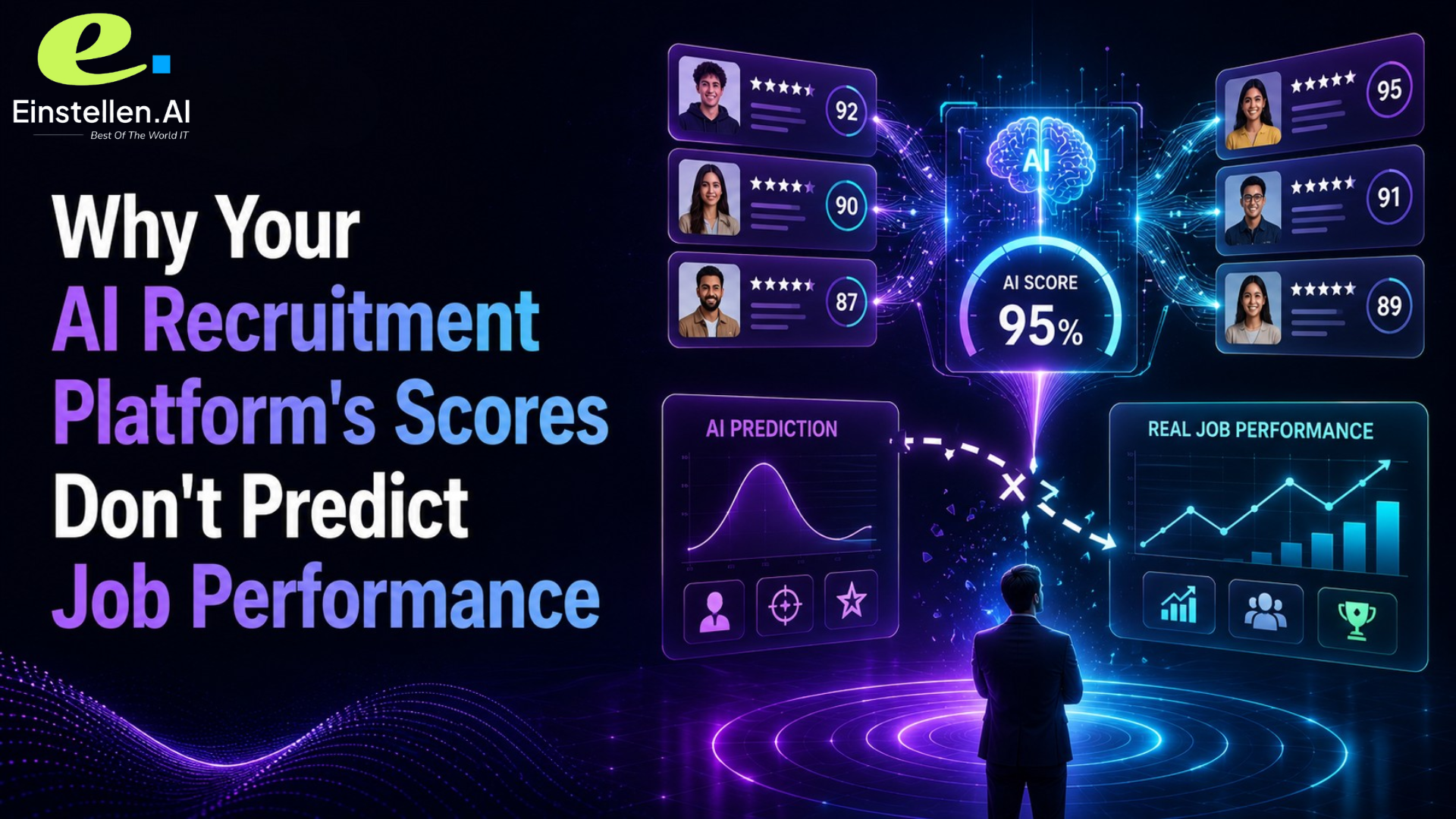
Quick Answer: AI recruitment platform scoring accuracy often fails because scores can't be traced back to specific answers. A number without a structured justification cannot be audited against real job performance. SIOP guidelines require AI-generated scores to predict future job performance, like any other selection method, yet most vendors publish no criterion-related validity evidence to support this.
Your engineering lead just rejected a candidate who scored 62 on your AI interview platform. Six months later, you learn that same candidate is thriving at a competitor, shipping features faster than three people you hired at 85+. Nobody on your team can explain why the score was 62. Nobody can point to the specific answer that tanked it. This is usually the moment a hiring manager realizes their AI recruitment platform's scoring accuracy was never actually tested. It was just trusted.
That gap, between a confident number and a defensible reason, is the real scoring accuracy problem. Not bias. Not compliance, though those matter too. Most platforms hand you a ranking with no visible mechanism connecting the score to the answer that produced it. Which makes the score impossible to audit against what actually happens on the job.
Why Validity Coefficients Alone Don't Settle the Question
Industrial-organizational psychology has measured this for decades. Meta-analytic research cited widely in the field puts structured interviews and cognitive ability tests at validity coefficients around r \= .51 for predicting job performance, according to Cogn-IQ's HR guide. A 2022 re-analysis by Sackett et al. applied more conservative statistical corrections and put structured-interview validity closer to r \= .42, still strong, but a reminder that even 'settled' numbers get revised, which is exactly the point about not borrowing a score's credibility from unrelated research.
Here's the catch: most AI recruitment platforms don't run the same structured methodology those studies measured. They run their own proprietary scoring logic, then borrow the credibility of decades-old psychometric research without publishing their own criterion-related validity study. Cogn-IQ's research is direct on this: most AI hiring tools have not published criterion-related validity studies in peer-reviewed journals. Without that evidence, claims of predictive capability are marketing assertions, not scientific findings.
A validity coefficient from a 1998 meta-analysis of human-conducted structured interviews tells you nothing about whether your specific vendor's specific algorithm, scoring a specific candidate on a specific answer, is actually measuring anything real. The only way to know is to see the reasoning behind an individual score. Not to inherit a borrowed number from unrelated research.

The Black Box Problem Is a Performance Problem, Not Just a Legal One
Most coverage of black-box AI hiring treats explainability as a compliance checkbox, something you need for an EEOC audit or a state disclosure law. The Forbes Tech Council piece on this frames it correctly as a transparency and traceability issue.
But there's a performance-prediction consequence that gets missed. If you can't see which answer drove which part of a score, you can't build a feedback loop. You can't go back six months later, compare the score to actual on-the-job performance, and correct for drift in the model. A black-box score is a dead end. Not a data point.
This is the pattern Einstellen.AI hears constantly from TA heads: AI interview scores from other platforms simply don't correlate with what candidates actually do on the job once hired. The complaint isn't about AI interviewing as an idea. It's specifically about not being able to see why a score was assigned, which makes it impossible to learn from being wrong.
What Adaptive Interviewing Changes About Score Reliability
Static, fixed-script assessments ask every candidate the same five questions regardless of what they say. This is the implicit norm across most of the category, and it's rarely questioned in vendor comparison content. But a fixed script can't calibrate to how complex a candidate's actual project experience was.
Einstellen.AI's humAIn engine works differently. It listens to what a candidate just said and generates the next question based on that specific answer, rather than progressing through a checklist. Say a candidate gives a vague answer about a specific project. The system probes deeper on that project rather than jumping to an unrelated scripted question.
This matters for scoring accuracy because a scripted interview treats a senior architect and a junior developer with identical surface-level answers as equivalent. An adaptive interview goes deeper exactly where the conversation reveals something worth exploring, producing a score calibrated to what the candidate actually demonstrated. Not what a static template assumed they would say.
How to Actually Demand Proof From a Vendor
SIOP's formal position, laid out in its validation guidelines for AI-based assessments, is unambiguous: AI-generated scores must predict future job performance, and there is no exception carved out just because the score came from an algorithm.
Before signing a contract, ask a vendor three concrete questions. Can I see the specific transcript segment that produced this candidate's score, not just the final number? Has this exact scoring model been validated against real hire outcomes, or only against a generic psychometric benchmark? And what happens when I disagree with a score: is there a structured justification to review, or just a ranking to accept?
If a vendor can't answer the first question concretely, the accuracy claim is unverifiable by definition. You're being asked to trust a number, not evaluate a method.
Comparing AI Recruitment Platforms on What You Can Verify
| What You Need to Verify | Black-Box AI Platform | Einstellen.ai (MAGIC Model) |
|---|---|---|
| Score traceable to specific answer | Not shown | Full transcript + per-answer justification |
| Interview adapts to candidate response | Fixed script | Adaptive, agentic questioning |
| Cost to test before committing | Often demo-gated, negotiated pricing | ₹249 flat, pay-per-use, no contract |
| Fraud/proxy detection included | Varies by vendor | Included in every interview |
| ATS integration cost | Frequently a paid add-on | Included at no additional cost |
Proof point: Einstellen.AI's MAGIC model produces a per-answer scored report with a full transcript for every interview, letting a hiring manager trace exactly which answer drove which part of the score, at a flat ₹249 per interview with no contract required to test it. This isn't theoretical; it's the standard across all 30,000+ AI interviews Einstellen.AI has conducted so far. Every one produced a scored, justified report, not an unexplained ranking.
FAQ
How accurate are AI hiring assessment scores?
It depends entirely on whether the scoring model has published validity evidence, and whether individual scores can be traced to specific answers. Most vendors haven't published criterion-related validity studies, per Cogn-IQ's research. That means accuracy claims are often unverifiable rather than proven false or true.
Can AI recruitment tools actually predict job performance?
They can, but only when the scoring methodology is transparent enough to be checked against real outcomes. A structured justification report, showing which answer produced which part of a score, is what lets a hiring manager actually test the correlation themselves instead of taking a vendor's word for it.
Why do AI interview scores not match employee performance?
The most common reason: the score has no visible mechanism connecting it to a specific answer, so there's no way to identify what the model got wrong after the fact. Without that feedback loop, scoring errors repeat instead of getting corrected over time.
How do you validate an AI recruitment tool before buying it?
Ask for a transcript-level breakdown of an actual score, not just a validity coefficient citation. Test the tool on a small, low-cost basis first. Einstellen.AI's ₹249 flat per-interview pricing, no subscription, no contract, makes it possible to test scoring accuracy on real candidates before any larger commitment.
Ready to See the Reasoning Behind Every Score?
If your current AI recruitment platform hands you a ranking with no justification, you're not evaluating candidates. You're guessing with extra steps. Einstellen.AI's structured justification reports show exactly what was asked, what was answered, and why a score landed where it did, with fraud and proxy detection built into every interview and ATS integration included at no additional cost.
Post your role on Einstellen.AI and run your first interview at ₹249. No contract, no volume commitment, so you can verify scoring accuracy yourself before you scale it.





Leave a Comment
Share your perspective. Comments are moderated before publishing.