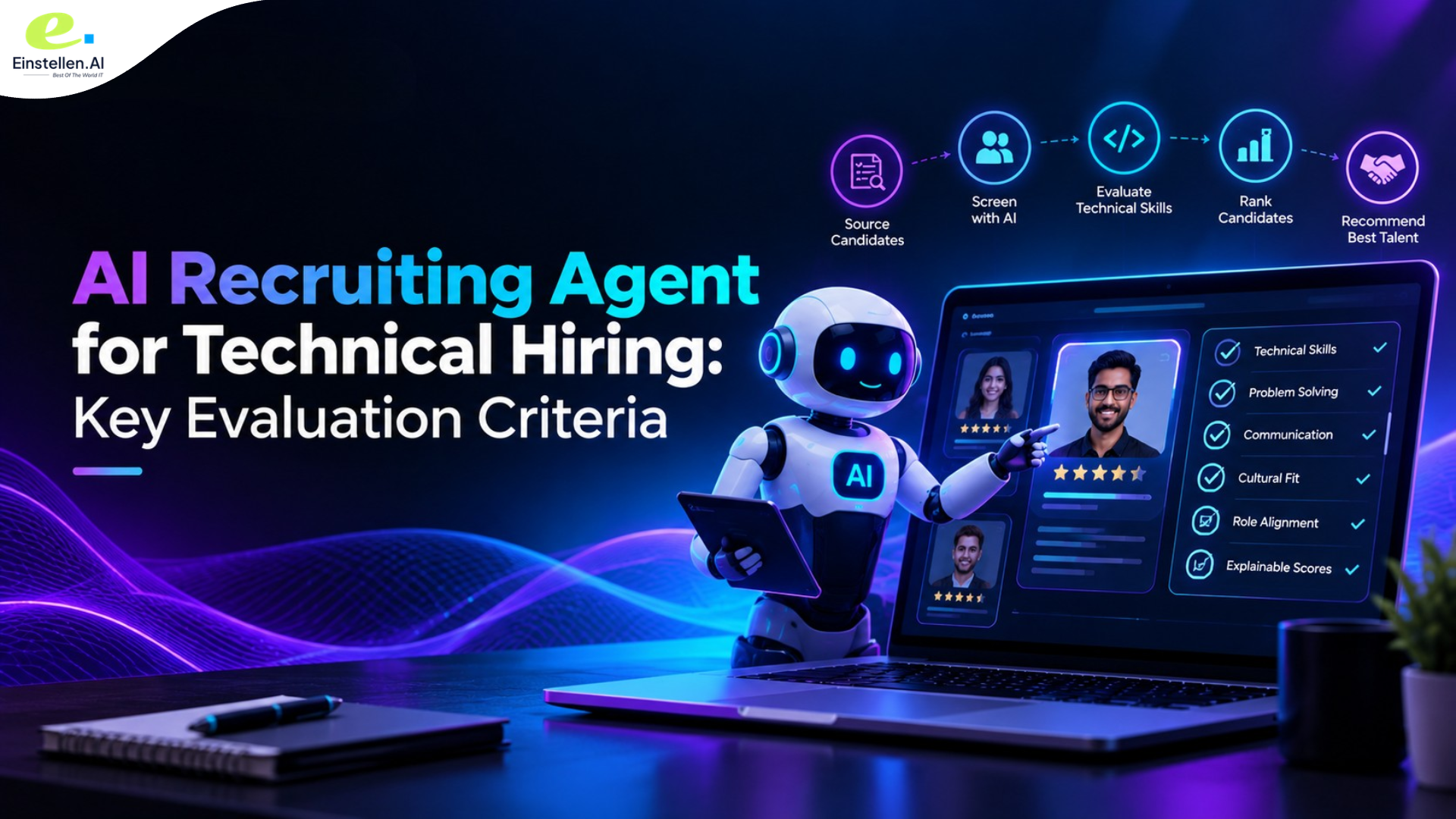
An AI Recruiting Agent for Technical Hiring should do more than automate interviews. It should help hiring teams evaluate technical competencies, examine candidate responses against job-related criteria, and produce structured evidence that supports better-informed hiring decisions.
As software engineering roles become more specialized and AI changes how developers write, test, and debug code, traditional screening methods are increasingly difficult to rely on in isolation. A candidate's resume, coding score, or ability to answer a predefined set of interview questions may not provide a complete picture of their engineering capabilities.
According to CoderPad's State of Tech Hiring 2026 report, 69% of surveyed recruiters use resume reviews to assess technical talent, but only 16% believe these reviews predict performance. The report also highlights the growing importance of evaluating how developers use AI, explain technical decisions, and correct AI-generated mistakes.
For talent acquisition leaders, the priority is therefore not simply to adopt AI recruiting software. It is to determine whether an AI recruiting agent can support meaningful, consistent, and job-relevant candidate evaluation.
This guide examines the key evaluation criteria, assessment methodologies, operational considerations, and governance requirements businesses should consider before selecting an AI recruiting agent for technical hiring.
What Is an AI Recruiting Agent for Technical Hiring?
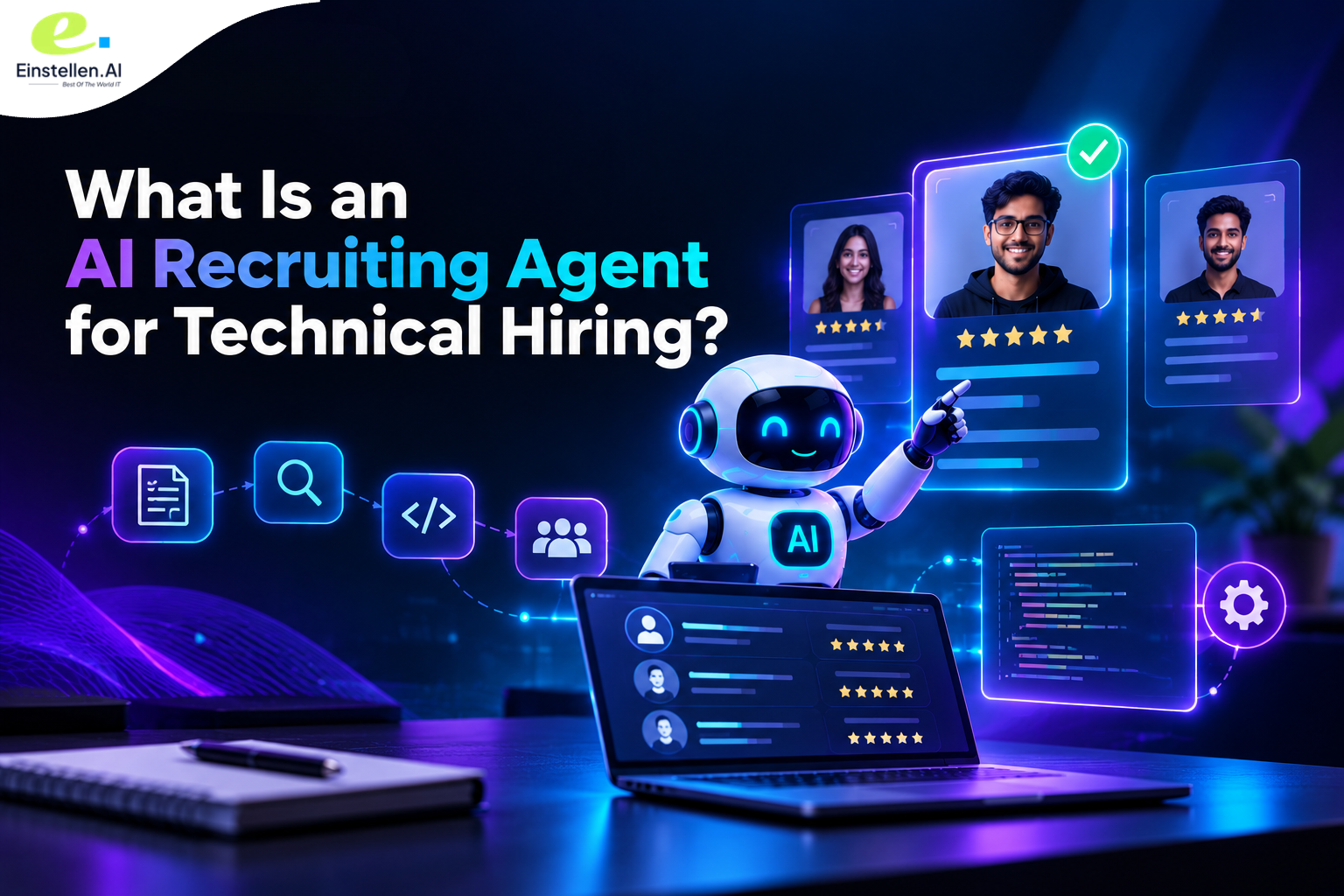
An AI recruiting agent is an AI-enabled system designed to perform or coordinate recruiting tasks toward a defined hiring objective. Depending on its capabilities, it may support candidate screening, interview execution, skills assessment, evaluation reporting, and integration with existing recruitment workflows.
In technical hiring, an AI recruiting agent can support the assessment of software developers, QA engineers, DevOps professionals, data engineers, AI engineers, and other technology specialists.
However, not every tool marketed as an AI recruiting agent offers the same capabilities. Some automate individual steps, while others coordinate multiple activities or conduct adaptive interviews.
AI Recruiting Agent vs. Traditional Recruiting Software
| Evaluation area | Traditional recruiting software | AI recruiting agent |
|---|---|---|
| Candidate screening | May rely on filters, rules, and matching tools | May interpret candidate information against role requirements |
| Interviewing | Usually supports scheduling or interviewer-led sessions | May conduct interviews and adapt questions, depending on the system |
| Skills assessment | Often integrates with dedicated assessment tools | May support or coordinate assessments |
| Candidate evaluation | May organize scores and interviewer feedback | May generate structured evaluations and supporting evidence |
| Workflow execution | Often depends on users initiating each next step | May coordinate multiple steps autonomously |
| Human involvement | Varies by workflow | Should be defined according to the task, risk, and decision authority |
These categories can overlap. A traditional platform may include advanced AI capabilities, and an AI recruiting agent may depend on a separate assessment platform to evaluate coding performance.
The appropriate comparison is therefore based on demonstrated functionality, workflow coverage, and the quality of the evidence produced, rather than the product label alone.
For a broader explanation, explore Einstellen.AI's guide to agentic AI for recruiting and how it works.
Why Technical Hiring Requires More Rigorous AI Evaluation
Technical roles require different combinations of knowledge, practical skills, reasoning, and engineering judgment. A backend developer, for example, may need to demonstrate API design, database optimization, debugging, security awareness, and system performance.
An AI recruiting agent must be evaluated against these role-specific requirements rather than a generic notion of candidate quality
The shift toward practical technical competency
CoderPad's 2026 research highlights several important signals in AI-enabled technical assessments:
- 66% of respondents selected catching and fixing AI mistakes as a signal of real skill when AI is allowed.
- 56% selected the ability to explain trade-offs and correctness.
- 38% of surveyed recruiters reported using real-world scenario simulations in technical tests or live coding interviews.
- 38% reported using system design problems.
These findings suggest that technical hiring is evolving beyond writing code from scratch. Candidates increasingly need to demonstrate that they can evaluate generated code, understand architectural consequences, handle edge cases, and make sound engineering decisions.
What this means for an AI recruiting agent
An effective evaluation process should establish whether the system can:
- Assess competencies relevant to the specific role and seniority.
- Ask meaningful follow-up questions when an answer lacks sufficient detail.
- Distinguish technical correctness from the ability to explain an approach.
- Evaluate debugging, system design, and practical problem-solving where relevant.
- Document the evidence behind candidate scores.
- Flag uncertainty or insufficient evidence instead of presenting every result as definitive.
The purpose of AI technical interviewing is not to produce more scores. It is to help recruiters and engineering leaders obtain useful evidence about a candidate's ability to perform the work.
8 Key Evaluation Criteria for an AI Recruiting Agent
Choosing an AI recruiting agent requires a structured evaluation process. The following criteria can help talent acquisition teams compare vendors and determine whether a system meets their technical hiring requirements.
1. Role-Specific Skills Assessment
The first criterion is whether the AI recruiting agent evaluates skills that matter for the actual job.
A generic interview may capture communication and general technical familiarity without establishing whether a candidate can perform the responsibilities of a particular engineering role.
For example, a senior backend engineer may need to demonstrate database design, API architecture, scalability, and incident diagnosis. A QA automation engineer may need to demonstrate test strategy, automation frameworks, debugging, and test coverage.
What to evaluate:
- Can the system map job requirements to defined technical competencies?
- Does the interview reflect the role's seniority and technology stack?
- Are the questions linked to observable skills rather than vague impressions?
- Can the evaluation distinguish essential competencies from preferred qualifications?
- Does the system explain when a skill has not been sufficiently assessed?
A strong AI skills assessment process should begin with a clear competency framework. It should not assume that one set of questions or one scoring rubric is suitable for every technical position.
2. Adaptive Technical Interviewing
Adaptive interviewing allows subsequent questions to respond to a candidate's previous answers. This can help interviewers investigate incomplete explanations, explore technical trade-offs, and clarify how a candidate approached a problem.
For example, if a candidate explains that they improved database performance, a relevant follow-up might ask which bottleneck they identified, what changes they implemented, and how they measured the outcome.
An AI recruiting agent should be able to conduct this type of targeted questioning when the feature is supported, without losing alignment with the original assessment criteria.
What to evaluate:
- Are follow-up questions relevant to the candidate's actual responses?
- Can the system probe vague or incomplete explanations?
- Does it maintain appropriate coverage of required competencies?
- Can it avoid repetitive or irrelevant questions?
- Does it apply comparable evaluation standards across candidates?
Adaptability should improve the depth of evidence gathered, not introduce uncontrolled differences between interviews.
3. Technical Assessment Depth
An AI interview is not automatically a technical skills assessment. Hiring teams should determine which competencies the system measures directly and which are inferred from spoken or written responses.
Depending on the role, a comprehensive technical evaluation may combine structured interviews with coding exercises, work samples, code reviews, debugging tasks, system design discussions, or practical scenarios.
| Technical role | Relevant assessment areas |
|---|---|
| Software engineer | Coding, debugging, code quality, problem-solving |
| Backend engineer | APIs, databases, scalability, system design |
| QA automation engineer | Test design, automation frameworks, defect analysis |
| DevOps engineer | CI/CD, cloud infrastructure, observability, incident response |
| Data engineer | SQL, data modeling, pipeline design, data quality |
| AI/ML engineer | Model evaluation, data handling, deployment, error analysis |
The appropriate assessment depends on the actual job requirements. Not every role needs a live coding test, and a coding test alone will rarely establish every competency needed for the position.
The key question is whether the AI recruiting agent measures the competencies it claims to assess and identifies areas that require additional evaluation.
4. Evidence-Based Candidate Scoring
Candidate scoring is one of the most important criteria when evaluating AI recruiting agents. A numerical score can make comparison easier, but it is not inherently objective or reliable.
An evidence-based candidate evaluation system should link scores to predefined criteria and specific information from the candidate's responses or assessment performance.
For example, a score for debugging capability should be supported by evidence of how the candidate identified the problem, tested hypotheses, assessed possible causes, and verified the solution.
An evidence-based candidate report should ideally include:
- Defined competencies and scoring criteria.
- Specific examples from the candidate's responses.
- Strengths and weaknesses linked to the job requirements.
- A clear explanation of the score or rating.
- Missing information and assessment limitations.
- A record of human review, where applicable.
Avoid treating a score as a definitive prediction of job performance. Evidence supports better-informed decisions, but its quality depends on assessment design, scoring methods, and the validity of the underlying criteria.
5. Scoring Consistency and Assessment Reliability
An AI recruiting agent should apply evaluation criteria consistently while remaining responsive to relevant differences in candidate responses.
Consistency does not mean asking identical follow-up questions in every adaptive interview. It means assessing the same underlying competencies using equivalent standards, with deviations justified by the information gathered.
The US Office of Personnel Management's guidance on structured interviews explains that structured interviews use defined rules for eliciting, observing, and evaluating responses. Higher levels of structure are associated with stronger interview validity, rater reliability, rater agreement, and lower adverse impact.
Questions to ask vendors:
- Are scoring rubrics defined before candidates are evaluated?
- Does the system apply the same proficiency standards across interviews?
- How are borderline or ambiguous answers handled?
- Can results be checked against independent human reviewers?
- Does the vendor monitor changes in scoring performance over time?
Organizations should pilot AI-generated assessments against job-related benchmarks before relying on them in live hiring decisions.
6. Explainability and Auditability
Hiring teams need to understand how an AI recruiting agent reached its evaluation. A system that provides only a final ranking may be difficult to assess, challenge, or investigate when a result appears inconsistent.
Explainability should be practical. Recruiters and engineering leaders should be able to trace an assessment score back to the relevant criteria and evidence.
A useful AI interview report may include the interview transcript, question-level evaluation, competency scores, supporting examples, limitations, and relevant reviewer comments.
However, a transcript or explanation alone does not prove that a score is correct. The assessment methodology must still be validated.
The NIST AI Risk Management Framework provides a useful foundation for managing AI risks through four functions: Govern, Map, Measure, and Manage. These principles can guide vendor evaluation, ongoing monitoring, and accountability for AI recruiting systems.
7. Bias, Privacy, and Human Oversight
An AI recruiting agent should be assessed for potential bias, accessibility, data protection, and the appropriate role of human judgment.
Bias can arise from training data, assessment design, proxy variables, speech processing, or the way scores are interpreted. Automated systems may also disadvantage candidates who use assistive technologies or communicate differently.
The US Equal Employment Opportunity Commission's guidance on AI explains that existing employment discrimination laws can apply when AI is used in recruiting and hiring.
Depending on the jurisdiction and use case, additional requirements may apply. For example, New York City's Automated Employment Decision Tools law contains bias-audit and notice requirements for covered tools. The EU AI Act also identifies certain AI systems used for recruitment and selection as high-risk, subject to the regulation's applicable provisions and exceptions.
Before deploying an AI recruiting agent, establish:
- Which candidate data is collected and why.
- How long transcripts, recordings, and scores are retained.
- How access to candidate records is controlled.
- How accommodations and alternative assessment methods are provided.
- How potential adverse impact is tested.
- When a recruiter or hiring manager must review the output.
- How candidates can raise concerns or request clarification.
These checks should be tailored to the organization's locations and applicable legal obligations. Vendor assurances should not replace independent legal and technical review.
8. Integration and Enterprise Readiness
Even a technically capable AI recruiting agent can create operational problems if it does not fit the existing hiring workflow.
Enterprise teams should examine how the solution interacts with their applicant tracking system, candidate database, assessment platforms, scheduling tools, and reporting infrastructure.
Evaluate:
- Integration: Can candidate information and assessment results move securely between systems?
- Workflow ownership: Which steps are automated, and which require approval?
- Permissions: Can users access only the information appropriate to their roles?
- Scalability: Can the system support expected hiring volumes?
- Reliability: What happens when an interview is interrupted or an integration fails?
- Reporting: Can teams compare assessment outcomes and identify operational bottlenecks?
- Support: What implementation, training, and ongoing support does the vendor provide?
A successful AI recruiting agent implementation should improve the hiring process without introducing unnecessary duplication, fragmented records, or unmanageable review requirements.
How to Compare AI Recruiting Agents: Evaluation Matrix
A structured vendor scorecard helps hiring teams compare products against consistent requirements rather than relying on feature lists or demonstrations.
The following is a suggested evaluation framework. The weights are illustrative and should be adapted to the organization's role types, risk tolerance, and hiring objectives.
| Evaluation criterion | Suggested weight | Evidence to request |
|---|---|---|
| Role-specific assessment | 20% | Competency mapping and sample evaluations |
| Interview quality and adaptability | 15% | Recorded demonstrations and test scenarios |
| Evidence-based scoring | 15% | Sample candidate reports and scoring rationale |
| Reliability and consistency | 15% | Pilot results and independent reviewer comparisons |
| Governance and bias controls | 15% | Audit documentation, privacy controls, and oversight mechanisms |
| Integration and workflow fit | 10% | Technical documentation and integration demonstrations |
| Reporting and operational measurement | 5% | Analytics, export capabilities, and performance measures |
| Implementation and support | 5% | Deployment plan, service terms, and training resources |
| Total | 100% |
How to use the evaluation scorecard
Ask each vendor to demonstrate the criteria using the same role, competency framework, and representative candidate scenarios.
Score each criterion on a consistent scale, such as 1 to 5, and document the evidence behind each rating. A vendor should not receive a high score simply because a feature appears on a product page.
The scorecard should be used alongside minimum requirements. For example, unresolved security concerns or an inability to explain critical hiring evaluations may disqualify a solution even if its weighted score is high.
How to Validate an AI Recruiting Agent Before Deployment
A pilot provides an opportunity to examine whether an AI recruiting agent works under realistic hiring conditions.
Step 1: Establish a role-specific baseline
Select a defined technical role and document the competencies needed for successful performance. Record existing screening time, interview time, reviewer workload, candidate progression, and relevant quality measures.
Step 2: Design representative assessment scenarios
Include practical cases covering different competency levels, incomplete answers, common technical mistakes, edge cases, and the tools or programming languages relevant to the role.
Where candidates are expected to work with AI coding assistants, include realistic tasks that assess how effectively they use, inspect, and correct AI-generated output.
Step 3: Compare results with qualified reviewers
Ask trained technical reviewers to evaluate a suitable sample independently using the same predefined rubric. Compare score differences, evidence quality, missing information, and cases where the AI's conclusion is not supported by the responses.
Human agreement is a useful comparison, but it is not a perfect ground truth. Reviewers can also disagree or introduce bias.
Step 4: Measure operational performance
Track whether the AI recruiting agent reduces repetitive work without compromising assessment quality or the candidate experience.
Measure time saved alongside review effort, assessment completion, scoring discrepancies, candidate feedback, and relevant downstream hiring outcomes.
Step 5: Define deployment and review thresholds
Set clear conditions for scaling, revising, or discontinuing the pilot. Establish who reviews disputed results, how errors are documented, and how the assessment is periodically revalidated.
The NIST AI Risk Management Framework can help teams organize this work into governance, risk identification, measurement, and ongoing management.
Measuring the Business Value of an AI Recruiting Agent
The value of an AI recruiting agent should be established through measured outcomes rather than vendor promises alone.
| Metric | What it measures | How to interpret it |
|---|---|---|
| Time to shortlist | Time required to identify candidates for further evaluation | Compare before and after deployment |
| Screening turnaround | Time between application and assessment outcome | Examine both speed and error rates |
| Recruiter hours per hire | Recruitment effort required for each successful hire | Include review and exception-handling time |
| Assessment completion rate | Proportion of invited candidates who complete assessments | Examine accessibility and candidate drop-off |
| Scoring disagreement | Difference between AI scores and qualified reviewer ratings | Investigate patterns and high-impact discrepancies |
| Quality of hire | Relevant post-hire performance indicators | Define role-specific measures and follow-up periods |
| Candidate experience | Candidate feedback and process friction | Segment findings by role and candidate group |
| Operational cost | Total implementation and ongoing costs | Include integration, oversight, and support |
Avoid claiming that faster screening automatically improves hiring quality. A system can reduce processing time while producing weak assessments or requiring extensive human correction.
The most useful AI recruiting agent evaluation combines operational efficiency, assessment quality, candidate experience, and responsible use.
How Einstellen.AI Approaches AI Interviewing and Candidate Evaluation
Einstellen.AI's published material describes humAIn Advance as an autonomous AI interview agent designed to conduct interviews, adapt questions, evaluate candidate responses, and generate interview reports.
The humAIn Advance product introduction describes its technical interview workflow and candidate evaluation capabilities. These provide a relevant example of the functionality hiring teams should examine when assessing AI recruiting agents.
When evaluating any platform, including Einstellen.AI, buyers should examine the actual interview experience, how role-specific questions are configured, what evidence supports each score, and how hiring teams can review the output.
For technical recruiting teams, useful questions include:
- Does the interview investigate the competencies required for the position?
- Can follow-up questions clarify a candidate's reasoning?
- Does the report connect evaluation scores to specific answers?
- Can recruiters identify missing evidence or questionable conclusions?
- Can the system fit into the existing hiring workflow?
- Are the appropriate privacy and human-review controls available?
For additional context, read Agentic AI for Recruiting: What It Is and How It Works.
The objective is not to automate every hiring decision. It is to help recruiters and technical leaders obtain structured, useful evidence while retaining appropriate responsibility for candidate selection.
Frequently Asked Questions About AI Recruiting Agents
What is an AI recruiting agent for technical hiring?
An AI recruiting agent for technical hiring is an AI-enabled system that performs or coordinates recruiting activities for technology roles. Depending on its capabilities, it may support screening, adaptive interviews, technical assessment, candidate evaluation, reporting, and integration with recruitment systems.
How does an AI recruiting agent evaluate technical candidates?
It may analyze candidate responses against role-specific competencies, conduct structured or adaptive interviews, assess supported technical tasks, and generate evaluation reports. The reliability of the output depends on the assessment design, evidence available, scoring methodology, and validation process.
Can an AI recruiting agent replace technical interviewers?
An AI recruiting agent can support parts of the interview and assessment process, but it should not automatically replace qualified human judgment. Engineering leaders may still need to validate system design decisions, investigate ambiguous results, evaluate practical context, and make final hiring decisions.
What makes evidence-based candidate scoring important?
Evidence-based candidate scoring links a rating to predefined criteria and observable information from the assessment. This makes the evaluation easier to review, compare, and challenge than a score without a clear rationale. It does not, by itself, guarantee accuracy or fairness.
How can companies measure AI interview quality?
Organizations can evaluate question relevance, competency coverage, follow-up quality, scoring consistency, evidence traceability, candidate feedback, and agreement with trained human reviewers. They should also investigate material discrepancies rather than relying on a single aggregate score.
What should companies look for in AI technical interview software?
Look for role-specific assessment capabilities, structured evaluation, adaptive questioning where appropriate, explainable reports, reliability testing, security controls, integration options, accessibility, and clear human-review mechanisms.
Is AI candidate assessment reliable?
Reliability depends on the task being assessed, the quality of the data, the scoring design, and the validation evidence. Organizations should test the system on representative cases and monitor scoring consistency, job relevance, and potential bias before relying on the results.
How should companies evaluate the ROI of an AI recruiting agent?
Compare baseline and post-deployment measures such as recruiter hours, screening turnaround, assessment completion, operational costs, scoring discrepancies, and relevant hiring outcomes. Include implementation and oversight costs to understand the total value of the deployment.
How can businesses reduce bias in AI recruiting agents?
Use job-related criteria, examine outcomes across candidate groups where lawful and appropriate, test accessibility, document assessment methods, monitor discrepancies, and retain suitable human oversight. Legal obligations vary by jurisdiction and use case.
Conclusion
Selecting an AI Recruiting Agent for Technical Hiring requires more than comparing automation features or accepting vendor claims about accuracy. Hiring teams need to evaluate whether the system assesses the right competencies, conducts useful interviews, produces evidence-based scores, performs consistently, integrates with existing workflows, and supports responsible decision-making.
A structured evaluation framework and a well-designed pilot can help organizations distinguish genuine operational value from unverified promises. By measuring assessment quality alongside speed, cost, candidate experience, and governance, companies can make better-informed decisions about where AI recruiting agents belong in their hiring process.
For technical hiring teams exploring autonomous interviewing and structured candidate evaluation, Einstellen.AI's humAIn Advance is a relevant starting point for examining the capabilities of AI-led interviews and candidate reports.
The ultimate goal is straightforward: use AI to improve the quality of hiring evidence, while keeping candidate evaluation job-relevant, transparent, and appropriately accountable.


Leave a Comment
Share your perspective. Comments are moderated before publishing.