
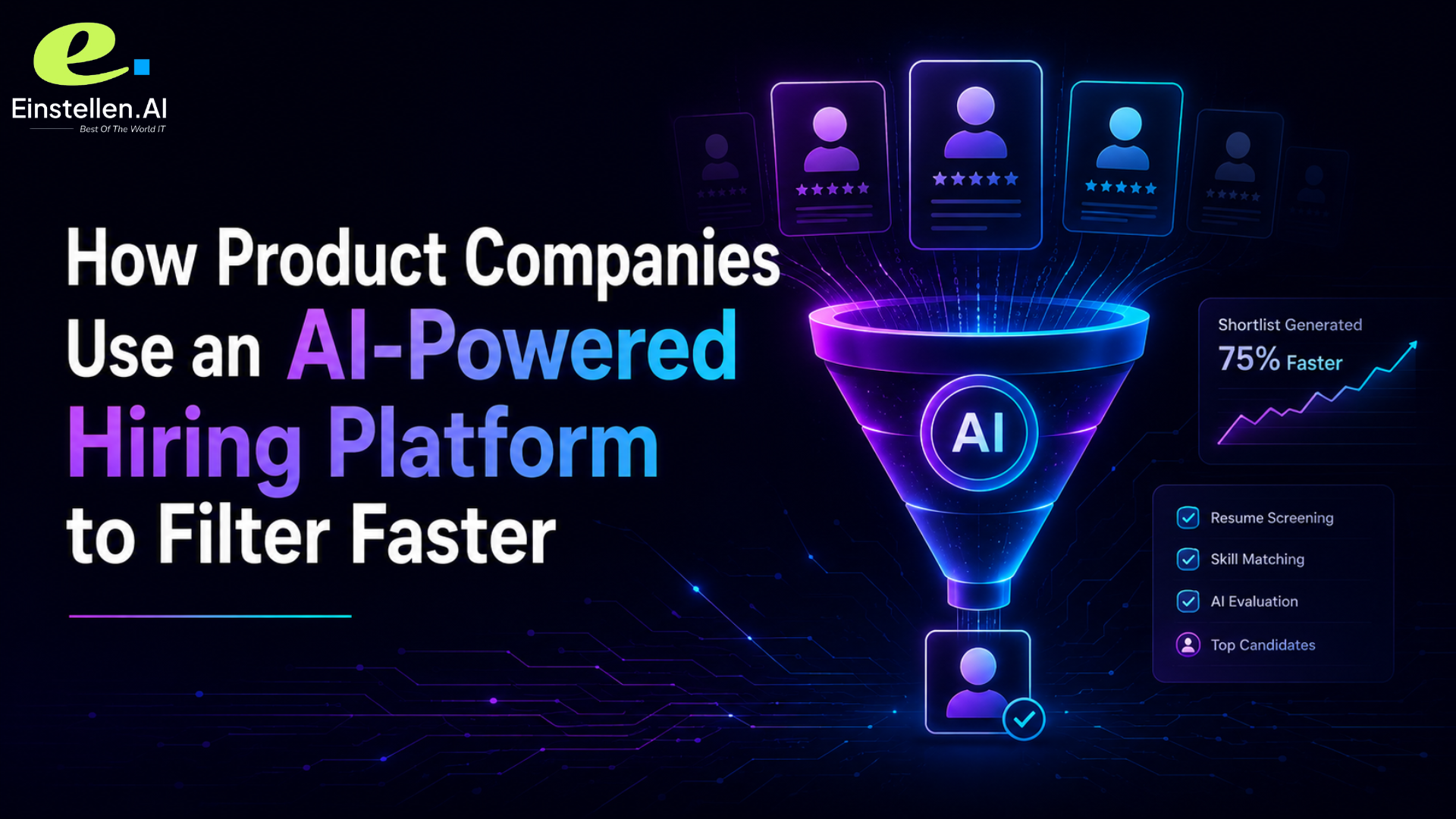
Quick Answer: An AI-powered hiring platform reduces time-to-interview by combining automated resume screening with adaptive AI interviews and skills-based candidate scoring. Instead of manually reviewing hundreds of applications, hiring managers get a shortlist with a structured justification report for every score, showing which answers drove which result, before a single human interview is scheduled.
Picture this: a hiring manager at a Bangalore product company opens 340 applications for one backend engineering role on a Monday morning. By Wednesday, maybe 15 will have been screened manually. The other 325 just sit there, untouched, and the strongest candidate in that pile has probably already accepted an offer somewhere else. This is the exact bottleneck an AI-powered hiring platform is built to remove. Not by lowering the bar. By moving the filtering work to a system that can actually read every application the day it arrives.
Product companies feel this pain differently from service firms. A services company can staff a role with a broader skill match and still make it work. A product company hiring for Flipkart-style scale or Razorpay-style fintech rigor needs candidates who can go deep on one specific stack, and trying to screen for that depth manually across hundreds of resumes is where recruiting teams bleed the most time. The rest of this piece walks through how the filtering mechanics actually work and where they still fall short if a platform can't explain its own output.
AI Resume Screening Automation: What Actually Gets Filtered
AI resume screening automation works by parsing structured and unstructured resume data, skills, tenure, project history, and tech stack mentions against the specific requirements of a role, rather than a keyword match against a job description. This is the first filtering layer, and it's the one most vendors describe only in the abstract as "automated screening" without ever saying what's actually being evaluated.
Here's what matters more: what happens after the resume pass. A resume can say "Kafka" without the candidate ever having built anything real with it. That's why resume screening alone isn't the differentiator. It's the entry filter that decides who moves on to an actual interview, nothing more. Product companies hiring at volume, a Series B startup bringing on five engineers in a quarter, and an enterprise team backfilling 20 roles need resume screening automation to work as a first gate, not the final word.
Where most platforms get weak is in transparency. A resume gets filtered out, and nobody, not even the recruiter, can say exactly why. An AI-powered hiring platform worth trusting should show which specific criteria a resume did or didn't meet, the same way a structured justification report explains an interview score.
Skills-Based Candidate Scoring vs. Keyword Matching
Skills-based candidate scoring goes further than resume parsing. It evaluates what a candidate can actually demonstrate, usually through an assessment or an interview, against the specific skill requirements of the role rather than a generic seniority label. A "5 years experience" tag tells a hiring manager almost nothing about whether that person can debug a production incident while everyone's watching the clock.
This is the layer where humAIn, Einstellen.AI's AI interview engine, works differently from a fixed checklist. The system asks a question, listens to the actual answer, and generates the next question based on what was just said, instead of marching through five scripted prompts no matter how the candidate responds. Give it a vague answer about a specific project, and it probes deeper on that project rather than shrugging and moving to the next scripted item.
That adaptive conversation gets scored through the MAGIC model, Einstellen.AI's evaluation framework, which produces a structured score paired with a specific justification, not a number with no reasoning behind it. A hiring manager looking at a borderline candidate can see exactly which answer drove which part of the score. That's the difference between skills-based scoring you can actually audit and a ranking you're just asked to trust.
AI Candidate Filters and Match Scoring in Practice
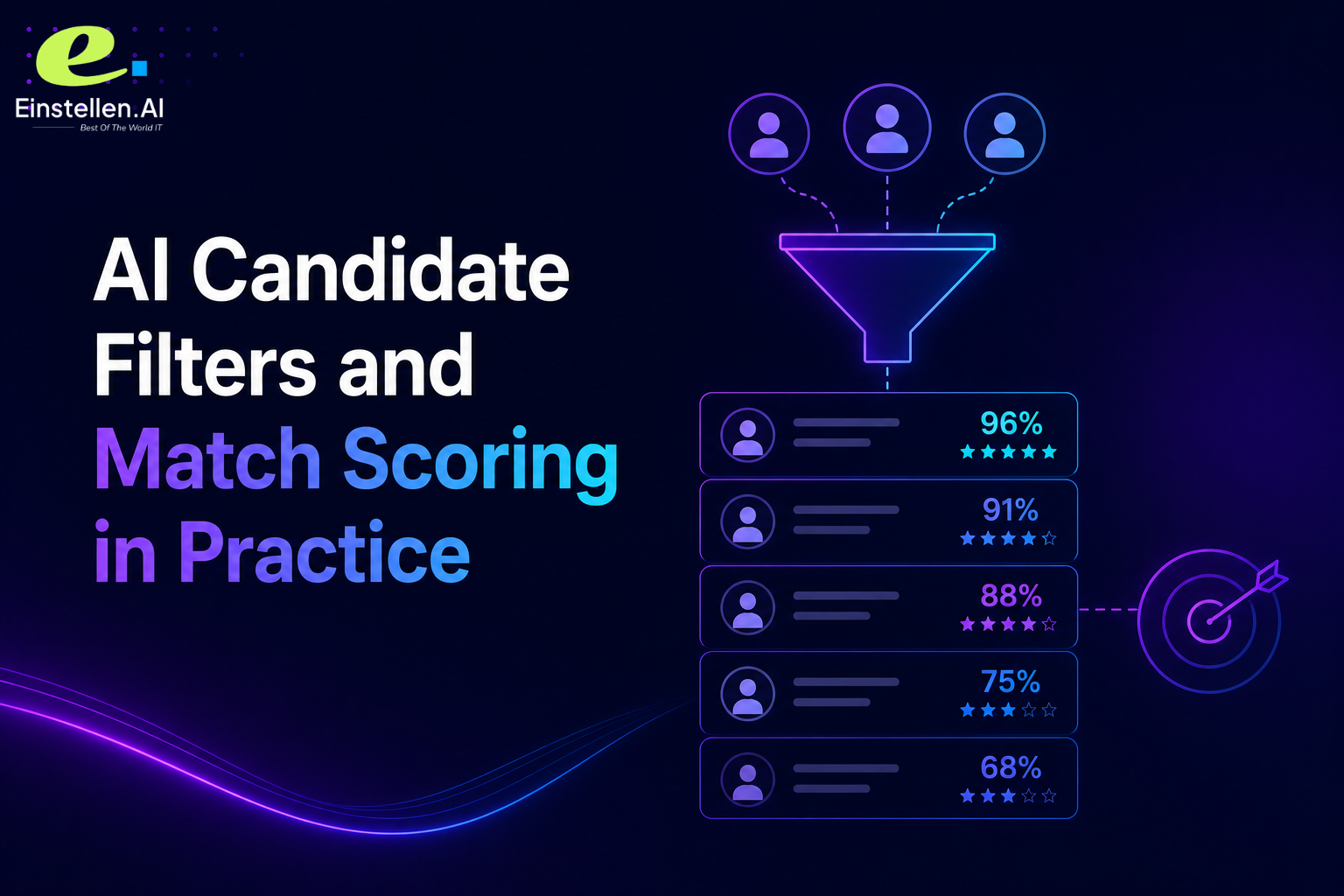
ai-candidate-filters-and-match-scoring AI candidate filters and match scoring let a hiring manager set specific parameters- years of experience, tech stack, product vs. service company background- and get a ranked shortlist against those parameters instead of a raw application queue. For a product company, the product-vs-service distinction matters more than most Western hiring frameworks account for: a candidate coming from a Tier 1 services background like TCS or Infosys often needs different evaluation criteria than one coming out of a product environment like Zomato or CRED.
Some competitor platforms describe their matching as reading "the full candidate profile: skills, experience, career trajectory" and scoring against job requirements, according to vendor marketing from Pin, though that figure is vendor-reported rather than independently verified. The mechanism described is directionally similar to how match scoring works across the category. What's less common industry-wide, per a comparison of AI recruiting vendors reviewed by SelectSoftwareReviews, is any vendor actually showing the reasoning behind a match score instead of just calling it "insights" or "analytics" and leaving it there.
Fraud and proxy detection sit inside this same filtering layer for Einstellen.AI, and it matters most in high-volume screening rounds where nobody has time to manually verify every candidate's identity while the pipeline keeps moving.
Time to Interview Reduction: Where the Real Speed Comes From
Time to interview reduction claims are everywhere in this category. Humanly states that customers using its platform "hire up to 8x faster," and Eightfold has said some clients have "filled roles in as little as 1.3 days," both according to the vendors' own published claims rather than third-party research. These numbers describe end-to-end hiring speed, not just the screening step, so read them as directional vendor positioning, not an industry benchmark you can bank on.
The real mechanism behind any genuine reduction in time-to-interview is simpler than it sounds. Resume screening removes the multi-day manual review queue, and an adaptive AI interview replaces the scheduling back-and-forth of a first-round human screen. A candidate finishes the AI interview on their own time, and the hiring manager reviews a scored, justified report instead of waiting around for a recruiter to type up phone-screen notes.
For product companies, this compounds fast. A team hiring five roles in a quarter isn't just saving a few minutes per candidate. It's cutting an entire screening round out of the pipeline for every applicant who doesn't clear the bar, which frees up the hiring manager's calendar for the ones who do.
AI-Powered Hiring Platform ATS Integration: The Layer Nobody Should Charge For
An AI-powered hiring platform is only as useful as the workflow it slots into. Magic OS integrates with any ATS a company is already using, including Greenhouse, Lever, and Workday, as named, bi-directionally synced integrations, with scores, transcripts, and reports flowing straight into the existing candidate record. No retraining needed for a recruiter's existing workflow.
This matters because companies have historically been charged extra just for ATS integrations, and when told this comes at no additional cost, the typical reaction is disbelief, not mild interest. That's a real pattern we hear often, not a marketing line, and it says a lot about how normalized the extra-fee model has become across this category.
What an AI-Powered Hiring Platform's Filtering Data Actually Looks Like
| Metric | Figure | Source |
|---|---|---|
| AI interviews conducted (Einstellen.AI) | 30,000+ | Einstellen.AI platform data |
| Institutions using the platform | 1,200+ | Einstellen.AI platform data |
| AI interview list price | ₹249 per interview, pay-as-you-go, no contract | Einstellen.AI public pricing |
| Senior Software Engineer CTC, Bangalore (7+ yr) | ₹35-65L | Einstellen.AI salary benchmark data |
| Vendor-claimed hiring speed improvement | "up to 8x faster" | Humanly.io (vendor claim, unverified) |
| Vendor-claimed fastest fill time | "as little as 1.3 days" | Eightfold.ai (vendor claim, unverified) |
Proof point: Einstellen.AI has conducted 30,000+ AI interviews across 1,200+ institutions, backed by IIM Lucknow and NASSCOM, with every score generated through the MAGIC model's structured justification report. Not an unexplained ranking a recruiter has to take on faith.
FAQ
What is an AI-powered hiring platform?
An AI-powered hiring platform automates candidate screening, interviewing, and scoring using AI rather than relying purely on manual resume review. Einstellen.AI's version runs on Magic OS, which powers humAIn, the adaptive AI interview engine, and the MAGIC model, which produces a structured, justified score rather than an unexplained number for every candidate evaluated.
How does AI help filter job candidates faster?
AI filters candidates faster by parsing resumes against role-specific requirements the same day applications arrive, then routing qualified candidates directly into an adaptive AI interview instead of a manual phone screen. The interview adjusts its questions in real time based on what the candidate actually says, producing a scored report a hiring manager can review immediately instead of waiting on a recruiter's notes.
Is AI hiring software biased or unfair?
Bias risk is real across the category, and most vendors talk about reducing bias without ever showing the reasoning behind a score. Einstellen.AI's approach is to pair every score with a structured justification report showing exactly which answers drove which part of the result, so a hiring manager can review the actual reasoning instead of trusting an opaque ranking.
How much does AI recruiting software cost?
Einstellen.AI's AI interview product is priced at a flat ₹249 per interview, pay-as-you-go, with no subscriptions, no contracts, and no volume-based pricing tiers, whether a company runs one interview or ten thousand. The full report, including video, transcript, and skill scoring, is included in every credit with no separate premium tier.
Post Your Product Company's Next Role on Einstellen.AI
If your team is filtering hundreds of applications manually for a single engineering or product role, the bottleneck isn't your recruiters. It's not having an AI-powered hiring platform built for that volume. Einstellen.AI's adaptive AI interview engine and structured justification reports let you review a scored shortlist instead of a raw application queue, with ATS integration into Greenhouse, Lever, Workday, or whatever you already run, at no additional cost.
Post your role on Einstellen.AI and see the reasoning behind every candidate score before you schedule a single human interview.








Leave a Comment
Share your perspective. Comments are moderated before publishing.