
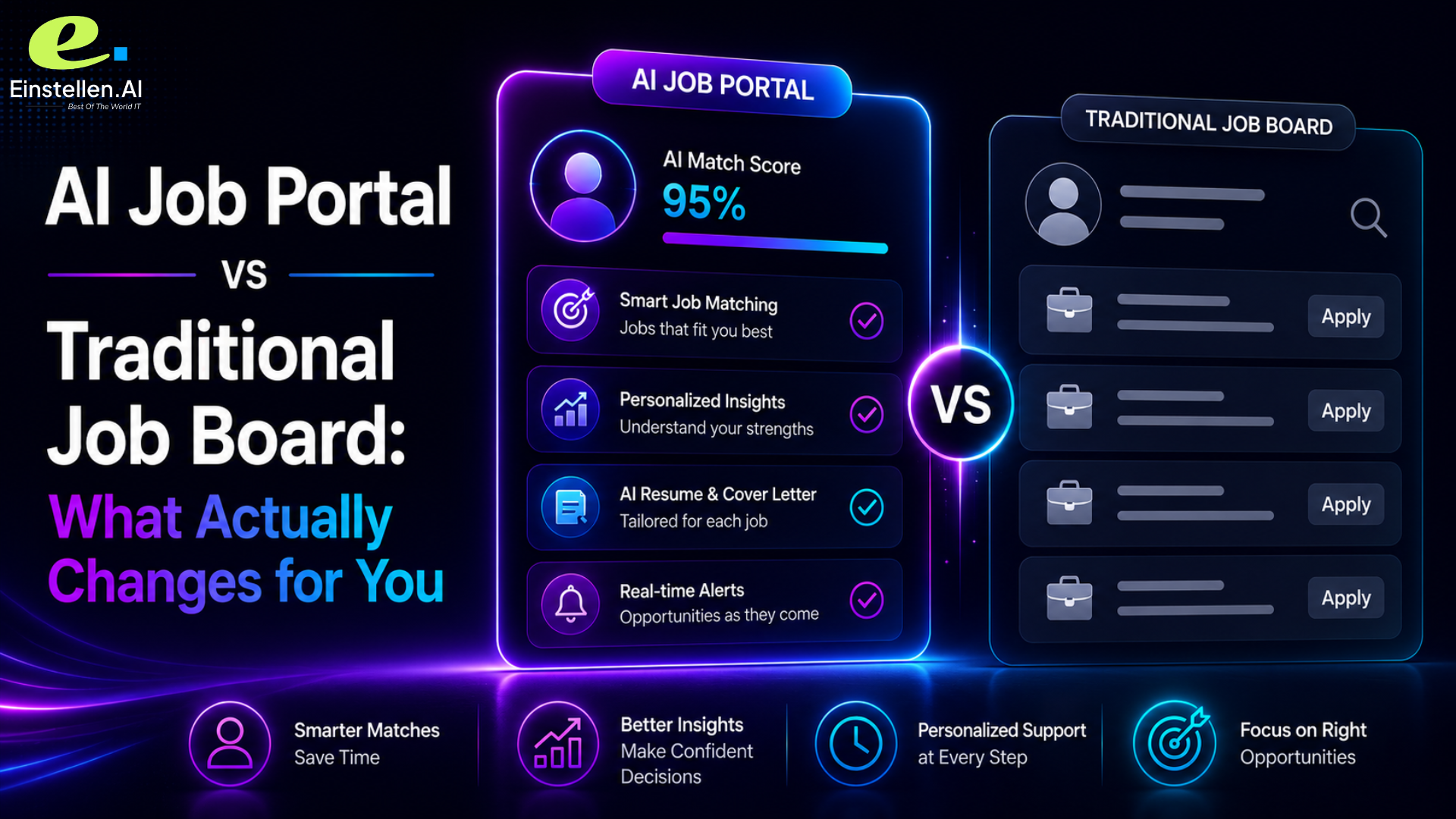
Quick Answer: An AI job portal matches you to roles using semantic search on skills and context, not just exact keywords, and often includes AI-driven interviews with visible scoring. A traditional job board matches on keyword overlap in your resume. The practical difference: fewer irrelevant applications, faster shortlisting, but AI portals can still miss hyper-local or niche-title roles.
Forty tabs open. Sixty applications this month. Four replies. If you're a mid-level developer in Bangalore or a marketing associate in Pune, none of this is hypothetical for you. It's just Tuesday.
| AI Job Portal | Traditional Job | |
|---|---|---|
| Matching | Semantic | Keyword |
| Screening | AI | Manual/ATS |
| Interview | Adaptive | Employer-dependent |
| Feedback | Potentially & explainable | Usually limited |
| Application volume | Lower/more targeted& | High |
| Best for | Skill-based roles | Broad listing search |
Here's the actual problem: Jobs aren't missing; matches are. A traditional job board matches your resume to a listing by scanning for identical words, so a "Data Analyst" resume can sit buried under 200 applications for a "Business Intelligence Analyst" role that needs the same skill set. An AI job portal exists to fix that mismatch by using semantic search instead of keyword search. Let's compare both approaches honestly, without pretending either one is perfect.
AI Job Matching: Semantic Search vs Keyword Search
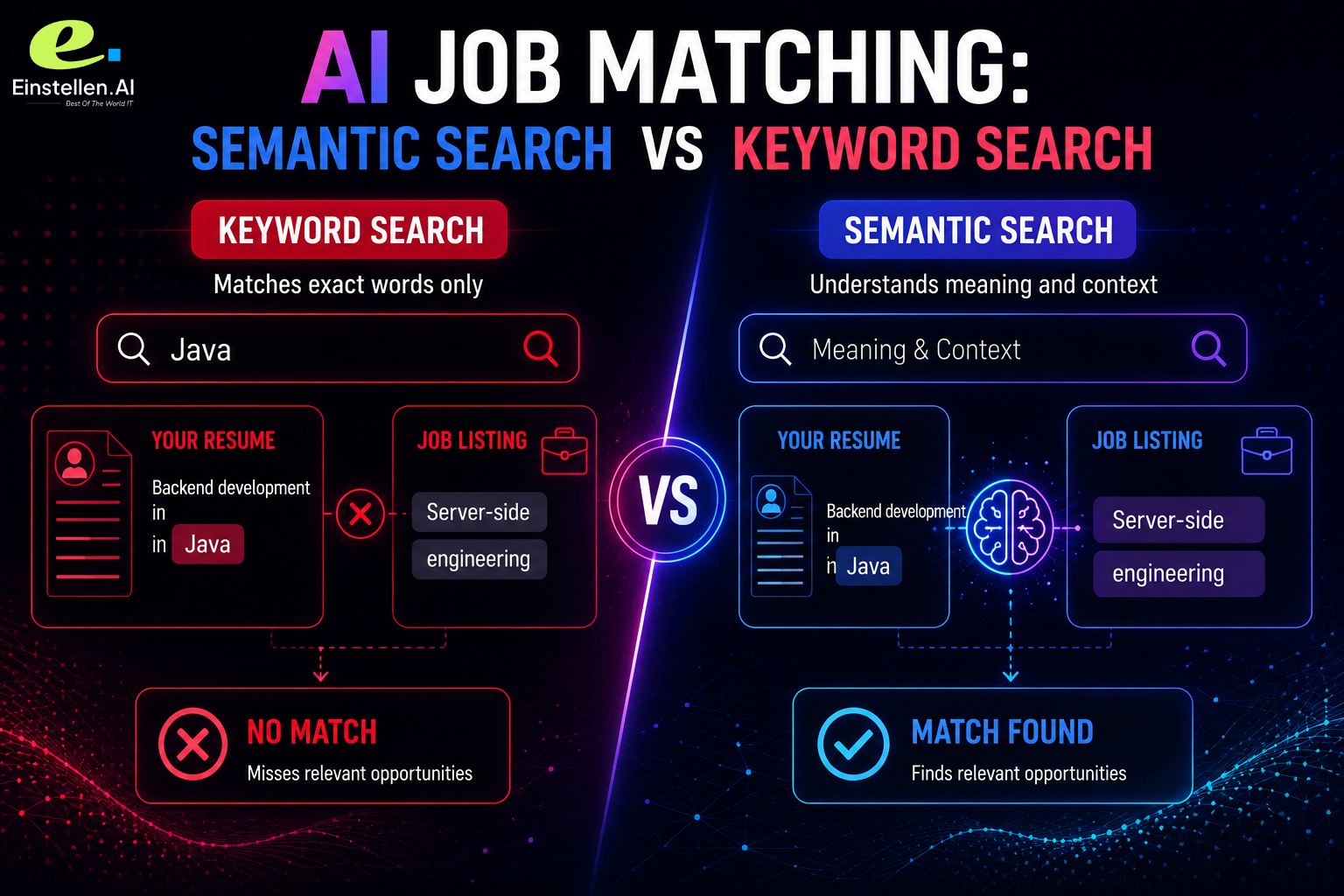
ai-job-matching ai-job-matching ai-job-matching Traditional job boards run on keyword matching. Your resume says "Java," the listing says "Java," you match. But say your resume reads "backend development in Java" and the listing says "server-side engineering." A purely keyword-driven system might not connect those two phrases at all, even though any recruiter reading both would spot the overlap instantly.
AI job matching works differently. It uses semantic search, which reads context instead of just counting tokens. It understands that "reduced churn by analyzing customer data" and "customer retention analytics" describe the same capability, even with zero shared words. Keyword matching structurally misses valid skill matches whenever the phrasing differs; "backend development in Java" and "server-side engineering" describe overlapping work, but a literal string match won't connect them. This is a well-documented limitation of exact-match search, not an edge case. Semantic and vector-based matching, the technology category behind modern AI job portals, exists specifically to close that gap by matching intent rather than exact phrasing.
For a candidate, this translates into wider visibility. A "Software Engineer" posting and a "Full Stack Developer" posting requiring the same skills can both surface for you, not just the one that happens to use your exact job title.
AI Resume Optimization: How It Actually Works
AI resume optimization tools parse your resume into structured data, skills, years of experience, tools used, and outcomes delivered, and compare that structure against what active listings are actually asking for. Then they flag the gaps or the phrasing mismatches. That's a different job than a generic "resume checker" that just counts keywords and tells you to cram more in.
A good AI resume tool will call out that "led a team" doesn't say how big the team was or what happened because of it. Structured data extraction depends on specificity like that. It'll also flag when your title doesn't match how the industry usually describes your actual skill set, because that exact mismatch is what trips up keyword-based ATS filters before a human ever opens your application.
Worth being honest about the limitation here: AI resume optimization improves how a system reads your resume. It doesn't invent experience you don't have, and it can't paper over a genuine skills gap for a role you're not qualified for. Think of it as a translation layer between how you describe your work and how the market's software actually parses that description.
ATS and Traditional Job Board Limitations
Applicant Tracking Systems (ATS) are the software layer sitting underneath most traditional job boards and company career pages. Their core limitation matches the keyword problem above: a resume gets scored or filtered by exact phrase overlap with the job description, so qualified people who describe their work in different words get filtered out before anyone sees the application.
This shows up on the employer side too, and it's well documented. Companies running older, unexplained ATS filtering often genuinely can't tell you why a candidate got rejected, because the filter is a black-box keyword threshold, not a reasoned decision. On the candidate side, that translates into silence. No rejection email. No feedback. Just nothing.
Traditional job boards also lean on static listing volume rather than freshness. A posting live for six weeks might already be filled, but it stays indexed and searchable anyway, wasting your time on an application for a role that was never really open.
AI Job Search Time Savings
The time-savings argument for AI job portals comes down to two things: better initial matching, so fewer irrelevant applications to wade through, and faster resume-to-role alignment, so less manual rewriting per application. The time saved isn't really about the speed of applying; it's about not wasting time deciding what to apply to.
Read More: AI Job Portal Profiles: How to Get Noticed by Real Recruiters
The mechanism matters more than the headline number, honestly. If an AI portal surfaces 15 genuinely relevant roles instead of forcing you to sift through 150 loosely related ones, the time saved isn't in applying. It's in not having to decide what's even worth applying to.
Where this falls apart: if the AI portal's underlying listing pool is thin or stale, semantic matching against a small dataset just returns a small, possibly irrelevant result set. The technology multiplies the value of a genuinely active, current listing pool. It doesn't manufacture one out of nothing.
Where Traditional Job Boards Still Win
AI job portals aren't universally better, and a fair comparison has to say so plainly. Traditional job boards still hold the edge in a few specific spots: government and public-sector postings, which typically run through official portals rather than AI-native platforms; hyper-local roles, think a specific retail store or a specific school, where volume is too low for meaningful matching to even be trained; and highly niche or company-invented job titles unique to one internal taxonomy, which semantic models can struggle to map without enough training examples.
If you're chasing a state government exam-based role or a single-location retail job in a small town, a traditional listing search is often still your fastest route, simply because that's where those postings concentrate.
Comparison Table: AI Job Portal vs Traditional Job Board
| Criteria | AI Job Portal | Traditional Job Board |
|---|---|---|
| Matching Method | Semantic search (context, skills) | Keyword/phrase overlap |
| Best For | Skill-based, product, and corporate roles | Government, hyper-local, and niche title roles |
| Listing Freshness | Depends on active talent pool size | Static volume; may include filled or outdated roles |
| Speed to Relevant Shortlist | Fewer, more relevant matches | More matches, requiring greater manual filtering |
Proof point: Einstellen.AI has conducted 30,000+ AI interviews across 1,200+ institutions, with each interview producing a per-answer scored report and full transcript, so a candidate or hiring manager can see exactly which answer drove which part of the outcome, not just a final number.
FAQ
What is the difference between an AI job portal and a traditional job board?
An AI job portal uses semantic search to match your actual skills and experience to roles, even when the wording differs. A traditional job board matches on keyword overlap between your resume and the listing text. The practical result: fewer irrelevant matches and faster shortlisting on an AI-native platform, though listing freshness still matters more than the matching method alone.
Do AI job search tools actually help you get hired faster?
They help you reach the right interviews faster by cutting the time you'd otherwise spend on poorly matched applications. Better matching cuts the time spent on applications that were never a real fit, which is where most job-search hours actually go. Getting hired faster after that depends on interview performance and role fit, which AI matching narrows down but can't guarantee on its own.
Are traditional job boards still relevant in 2026?
Yes, particularly for government postings, hyper-local roles, and niche internal job titles that AI matching models haven't been trained on at scale. For broad tech, product, and corporate roles, AI-native platforms with active listing pools typically offer faster, more relevant matching. But traditional boards remain the default source for those specific categories.
How does AI resume optimization work?
AI resume optimization parses your resume into structured data, skills, tools, years of experience, and measurable outcomes, and compares it against what active listings are actually requesting. It flags vague phrasing or title mismatches along the way. It improves how systems read your existing experience. It does not invent qualifications you don't have.
What are the downsides of AI-powered job portals?
The main risks are false negatives, a qualified candidate getting mismatched because of unusual phrasing, over-reliance on automated scoring without any human review, and limited transparency in how some platforms calculate a match or score in the first place. Regulatory frameworks like the EU AI Act are starting to require transparency disclosures specifically for AI-based candidate ranking systems, which reflects a genuine, documented concern here, not a fringe worry.
Should I use both AI tools and traditional job boards together?
Yes, and honestly, this is the most practical approach for most people. Use an AI job portal for skill-based, product, and corporate roles where semantic matching adds real value. Check traditional boards or official portals for government postings, hyper-local roles, or niche titles where AI matching pools are still thin.
How does AI job matching handle different job titles for the same skills?
Semantic matching models compare the underlying skills and responsibilities described, not just the title itself. So a "Data Analyst" posting and a "Business Intelligence Analyst" posting requiring the same core skills can both surface for one candidate. That's the specific mechanism that keyword-based systems, which match literal title and phrase overlap, generally can't replicate.
Are AI job portals free to use?
This varies by platform, and pricing models differ significantly between AI hiring tools aimed at employers and job seeker-facing portals. Check each platform's specific terms directly, since some AI-driven interview and matching tools charge employers per use rather than charging candidates anything at all.
Is AI hiring or matching regulated in 2026?
Increasingly, yes. The EU AI Act classifies AI systems used in recruitment and candidate evaluation as high-risk, requiring transparency and documentation around how automated ranking or scoring decisions are made. This is a genuine, developing regulatory pattern relevant to any platform using AI to rank or score candidates, not some hypothetical future concern.
Find Roles Matched to What You Actually Do
Tired of rewriting the same resume five different ways just to beat a keyword filter? An AI job portal built around active listings and explainable evaluation, not a static database, is what actually closes that gap. Einstellen.AI's marketplace focuses on current, active roles across product and service companies, with an interview process where every score comes with a visible, structured justification instead of an unexplained ranking.
Create your profile on Einstellen.AI to see roles matched to your actual skills, not just your resume's exact wording, and go through an interview process where you can see exactly how you were evaluated.






Leave a Comment
Share your perspective. Comments are moderated before publishing.