
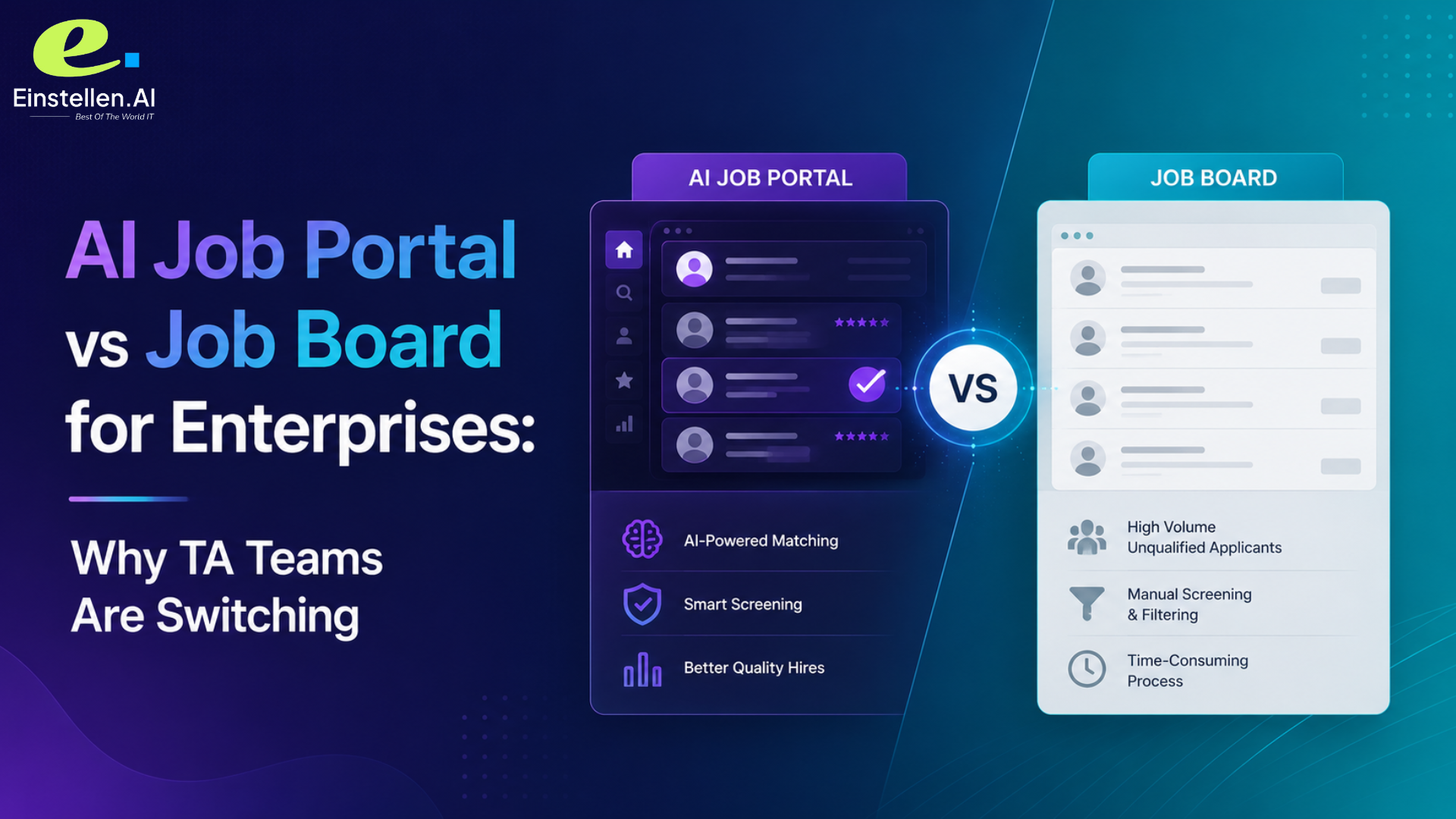
Quick Answer: An AI job portal beats a traditional job board for enterprises because it screens with adaptive, agentic interviews and explainable scoring instead of a static CV database. Job boards deliver volume; AI job portals like Einstellen.AI deliver curated, currently active candidates plus a structured justification report behind every score, cutting time-to-shortlist without added ATS cost.
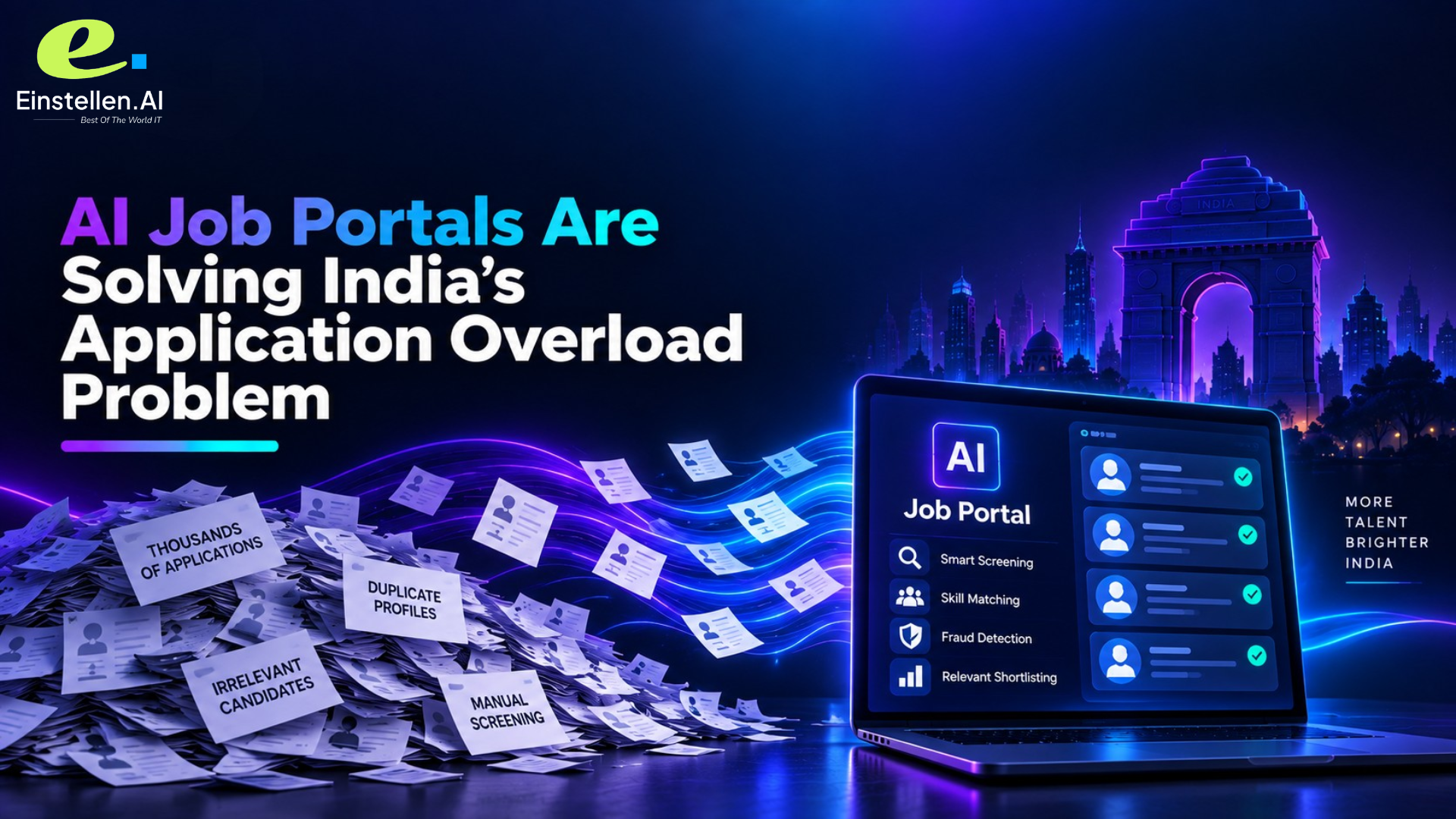
Picture this: a TA head at a mid-size enterprise posts a role on a major job board Monday morning. By Friday, 400 applications are sitting in the ATS, and three recruiters have burned the whole week filtering resumes that don't even match the job description. Sound familiar? This is the exact pain point pushing enterprise hiring teams toward a decision that used to feel optional. It doesn't anymore.
Here's the thing: the problem was never application volume. It's that volume without signal wastes recruiter hours and lets your strongest candidates walk straight to a faster-moving competitor. Job boards were built to maximize postings and applications, full stop. They were never built to explain why any one candidate is actually worth a manager's time. That gap is exactly what AI job portals exist to close.
Agentic AI Recruiting: What "Adaptive Interviewing" Actually Means
Most platforms marketed as "AI recruiting" still run a fixed script. Five preset questions, no matter what the candidate says. Agentic AI recruiting works differently. Einstellen.AI's interview engine, humAIn, listens to a candidate's actual answer and generates the next question based on what was just said.
Say a candidate gives a vague answer about a specific project. The system probes deeper on that project instead of jumping to an unrelated scripted question. What you get is interview data that resembles what a skilled human interviewer would actually extract, not a checklist running on autopilot.
For a TA team, this matters most at the shortlist stage. A fixed-script tool asks a strong candidate and a weak one the same five questions, and both transcripts end up looking superficially similar. An adaptive interview surfaces the gap in depth, not just a gap in some final number. That's the real difference between "agentic" as a marketing word and agentic as a mechanism you can actually watch play out in a transcript.
Internal Talent Marketplace vs Job Boards: Curated Pools vs Static Databases
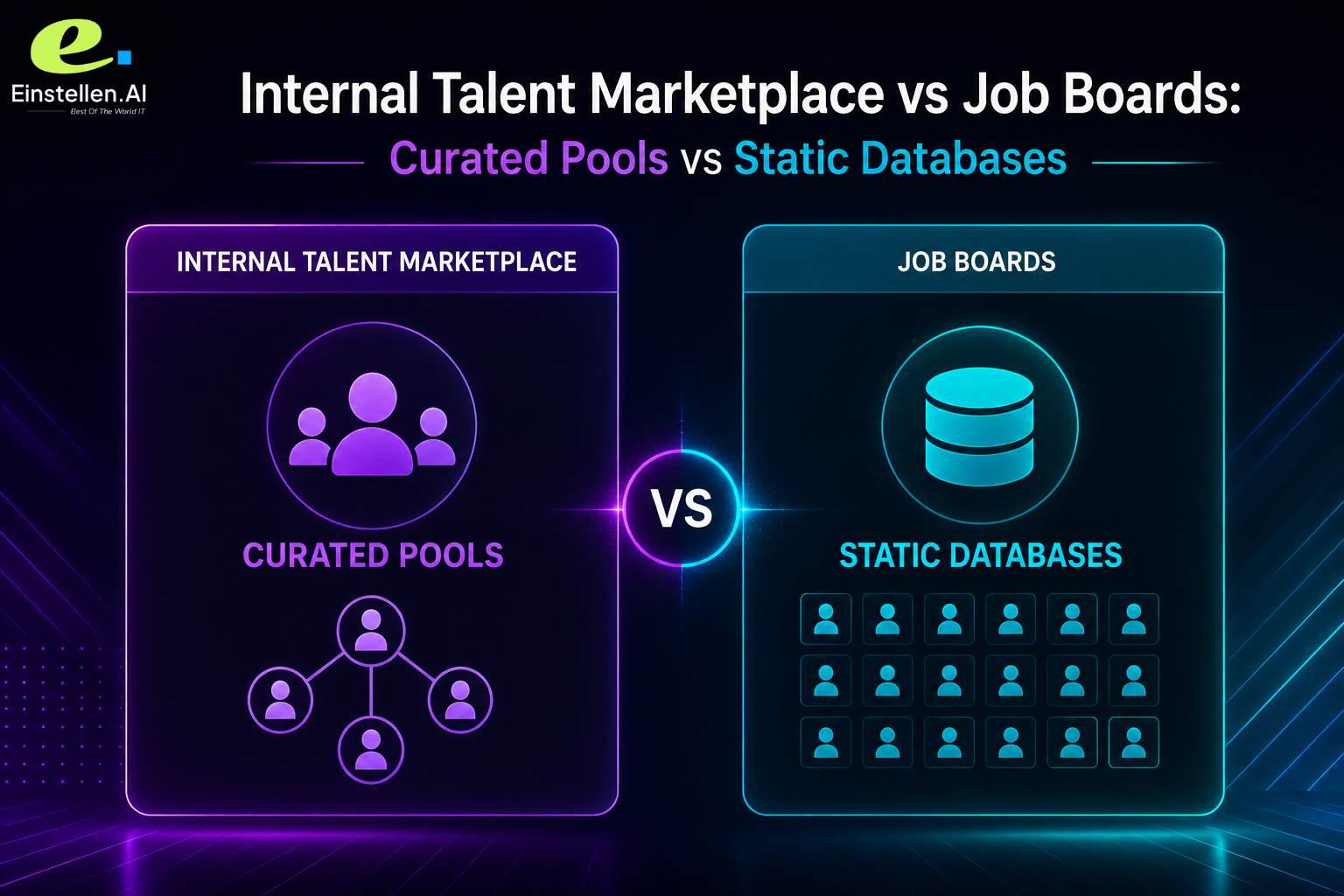
Structurally, job boards are just a CV database. Upload a resume once, and it sits there indefinitely, whether or not that person is still job-hunting six months later. Recruiters searching that database have no reliable way of knowing who's actually active right now.
An AI job portal built as a talent marketplace works differently. Einstellen.AI positions itself around "active listings" and "active candidates," which means the pool reflects people currently, genuinely looking, not a decade of accumulated, stale profiles. Even though it's sourcing external candidates, this looks a lot more like an internal talent marketplace in structure than a traditional external job board.
This distinction matters most when you look at fill rate. A recruiter searching a static database has to manually verify interest and availability before spending time on outreach. A curated active pool skips that verification step entirely, because just being in the pool already signals live intent.
AI Candidate Sourcing vs Passive Talent Pools: Why Explainability Changes the Shortlist
Passive sourcing, whether it's a job board database or a LinkedIn-style network, gives you a pool of people who might respond. AI candidate sourcing through an adaptive interview engine gives you a pool of people who've already been evaluated, with a report the hiring manager can actually sit down and read.
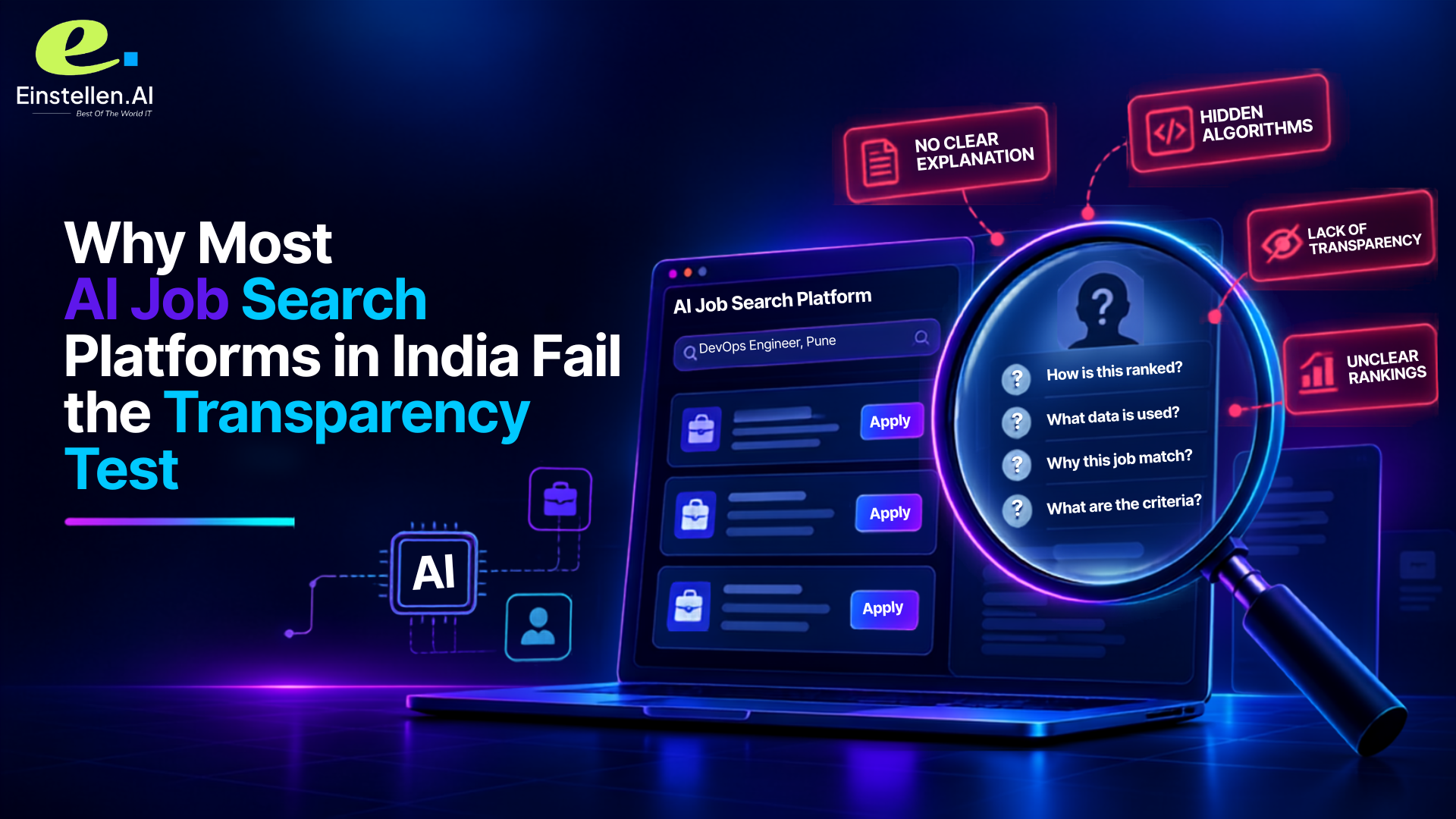
This is the direct counter to something TA heads keep bringing up in real conversations: AI interview scores from other platforms that just don't correlate with actual on-the-job performance. And the complaint was never about AI interviewing as a concept. It's specifically about a score with no justification behind it, a ranking candidates and hiring managers are asked to trust rather than evaluate.
Einstellen.AI's MAGIC model produces a structured, justified score for every interview, never a standalone number. The report shows exactly which answer drove which part of the score, so when a hiring manager is reviewing a borderline candidate, they can see the actual reasoning, not just a ranking. That's a genuinely different artifact than a resume-matching algorithm spitting out a percentage match score that explains nothing about how it got there.
Recruiting Automation ROI and Fill Rate: Where the Time Actually Goes
Enterprise TA teams evaluating recruiting automation ROI tend to fixate on cost per hire. But time-to-shortlist is usually the bigger lever, and it's the one that gets overlooked. Long time-to-offer cycles are a documented pain point in Indian tech hiring specifically, because top candidates get pulled by faster-moving competitors while an internal process is still filtering resumes by hand.
Automation improves fill rate in two concrete ways. First, adaptive AI interviews handle first-round screening at scale, so recruiters end up reviewing 20 scored, justified reports instead of wading through 400 unfiltered resumes. Second, fraud and proxy detection built into the interview process protects the integrity of high-volume rounds, which matters a lot for bulk enterprise hiring and campus placement drives, where impersonation risk is genuinely real.
 There's also a cost angle competitors don't usually spell out plainly. Companies have historically been charged extra for ATS integration on top of a platform's base fee, which is honestly a strange norm when you think about it. Einstellen.AI includes ATS integration, including Greenhouse, Lever, and Workday by name, plus any other ATS a company already uses, at no additional cost. When TA heads hear this, the typical reaction is disbelief, not mild interest. That alone tells you how normalized that surcharge had become across the category.
How an AI Job Portal Actually Compares to a Job Board
| Dimension | Traditional Job Board | AI Job Portal (Einstellen.AI) |
|---|---|---|
| Candidate pool | Static CV database, includes stale profiles | Curated pool of active, currently-looking candidates |
| Screening method | Manual resume review or basic keyword match | Adaptive AI interview with autonomous questioning |
| Scoring | None, or unexplained ranking | Structured justification report per answer |
| Fraud/proxy risk | Not addressed | Fraud and proxy detection built into the interview |
| ATS integration cost | Often a paid add-on | Included at no additional cost |
| Pricing model | Subscription or job-posting fees | ₹249 per interview, pay-per-use, no contracts |
Proof point: Einstellen.AI has conducted 30,000+ AI interviews across 1,200+ institutions, backed by IIM Lucknow and NASSCOM, and integrates with any existing ATS, including Greenhouse, Lever, and Workday by name, at no additional cost.
SHRM's 2025 AI in HR research found that recruiting remains the primary AI use case, with TA leaders increasingly citing responsible use and explainability, not just speed, as their core adoption criteria for AI screening tools. That lines up with what we hear directly in our own sales conversations: the objection was never to AI interviewing itself. It's to AI interviewing that can't explain itself.
FAQ
How is an AI job portal different from a black-box AI interview tool?
The core difference is explainability. A black-box tool produces a ranking with no accessible reasoning behind it. Einstellen.AI's platform pairs every score with a structured justification report, and the interview itself is adaptive, meaning it responds to what a candidate actually says instead of running a fixed script no matter what the conversation looks like.
Can an AI job portal integrate with our existing ATS?
Yes. Magic OS integrates with any ATS an enterprise is already using, at no additional cost. Greenhouse, Lever, and Workday are publicly named as native, bi-directionally synced integrations, with scores, transcripts, and reports flowing straight into the existing candidate record.
How accurate is AI interview scoring?
Accuracy depends on what you're measuring. What Einstellen.AI can tell you concretely: every score comes paired with a structured justification report showing exactly which answers drove which part of the result, so a hiring manager can evaluate whether the reasoning makes sense rather than trusting a number with nothing behind it.
What does an AI job portal cost compared to a job board subscription?
Einstellen.AI runs open, public pay-per-use pricing at ₹249 per interview, with no subscriptions, no contracts, and no volume commitments. Same rate whether a company runs one interview or ten thousand. The full report, including video, transcript, and fraud detection, is included in every credit with no premium add-on tier.
Ready to Move Past the Resume Pile?
Enterprise TA teams tend to stop relying on static job boards the moment they compare what an AI job portal delivers- a scored, justified transcript- against the unexplained ranking a standard listing produces. Einstellen.AI gives your team a curated, active candidate pool, adaptive AI interviews, and ATS integration that costs nothing extra, all on transparent, published pricing.
Post your next role on Einstellen AI and see the difference between a resume pile and a report you can actually defend to a hiring manager.








Leave a Comment
Share your perspective. Comments are moderated before publishing.