Quick Answer: Compare AI job portal vendors on four deliverables, not promises — a structured explainability report (not a checkbox answer), named ATS integrations with no surcharge, published certifications (ISO 27001, SOC 2, GDPR), and contract flexibility. Ask for the actual artifact a hiring manager sees, not a vendor's description of it.
A TA head at a 400-person product company told our team something we hear in almost every vendor evaluation call. Three different AI interview tools. Three different candidate rankings. None of them explained why. Worse, the scores didn't line up with how those candidates actually performed once they were hired. That's the real cost of an AI job portal buyer's guide built around "questions to ask" instead of artifacts to demand.
Most guides in this category tell you to ask a vendor if their AI is explainable, if it integrates with your ATS, if it's compliant. Almost none show you what that answer should actually look like on a screen. This guide skips the polite questions and focuses on deliverables you can hold a vendor to, not answers they can talk their way around in a demo.
Explainability as a Deliverable, Not a Demo Answer
Every vendor in this category will say yes when you ask "can you explain the score?" The real test is what lands on a hiring manager's screen once the interview ends. A structured justification report should show which specific answer drove which part of the score, with a full transcript attached. Not a single number with a confidence percentage bolted on for show.
Einstellen.AI's MAGIC model produces exactly this: a per-answer scored report where a hiring manager reviewing a borderline candidate can trace the reasoning back to what was actually said, instead of just trusting a ranking. This matters more than it sounds like it should. Regulatory scrutiny of automated hiring decisions is only increasing, and the EU AI Act treats certain employment-related AI systems as high-risk, with documentation and transparency obligations attached.
So when you ask a vendor about explainability, ask for a sample report. Not a description of one. If they can't produce it on the spot, showing video, transcript, and scoring together, you have your answer already. A score without an accessible reason behind it isn't AI-powered hiring. It's a ranking you're asked to trust, not evaluate.
HRIS Integration and ATS Sync: What "Integration" Actually Means
"We integrate with your ATS" can mean anything from a CSV export to true bidirectional sync, and vendors know most buyers won't push past the word itself. Ask specifically: do candidate scores, transcripts, and reports flow directly into the candidate record automatically? Or will your recruiters end up copying data between two systems by hand at 6 pm on a Friday?
Magic OS, the platform underlying Einstellen.AI's product, integrates with any ATS an enterprise is already using. On the Enterprise page, Greenhouse, Lever, and Workday are named specifically as native, bi-directionally synced integrations. Scores and reports land in the existing candidate record, and there's no retraining required for recruiter workflows that are already in place.
Here's the detail enterprise TA heads consistently miss until it's too late: plenty of vendors charge extra for ATS integration as a separate line item. It's become so normalized in this category that TA heads are often genuinely surprised, not mildly interested, when told a platform includes it at no additional cost. Get this in writing before you sign anything. Not as a verbal assurance during the sales call.
Compliance Certifications: What to Actually Verify
"Compliant" is not a certification; it's a word. Ask for the specific standards a vendor holds and whether the certificates are viewable, not just claimed somewhere on a marketing page. The three that matter most for enterprise procurement here are ISO/IEC 27001, SOC 2 (specifically Type II, which requires an independent audit over time rather than a one-off point-in-time assessment), and GDPR readiness with documented data subject request support.
Einstellen.AI publicly displays viewable certificates for all three on its Trust Center. Beyond the certifications themselves, dig into how candidate data is actually handled. Is there end-to-end encryption for interview recordings and transcripts, both in transit and at rest? Are there role-based access controls with audit logs limiting who inside your organization can actually view a candidate's recording? Is there a stated policy on whether candidate data is ever used to train external models?
Data retention policy is worth asking about directly too. Personal data (transcripts, candidate records) and usage data (platform analytics) should be governed by distinct retention rules, not folded into one blended statement that sounds tidy but says less than it seems to. If a vendor gives you one number covering both, push them to separate it. Vague answers to specific questions are the real tell here, not the certifications themselves.
Read More: AI-Based Hiring Platform Data Security: What Enterprises Must Verify
End-to-End Platform vs. Point Solution: The Real Trade-off
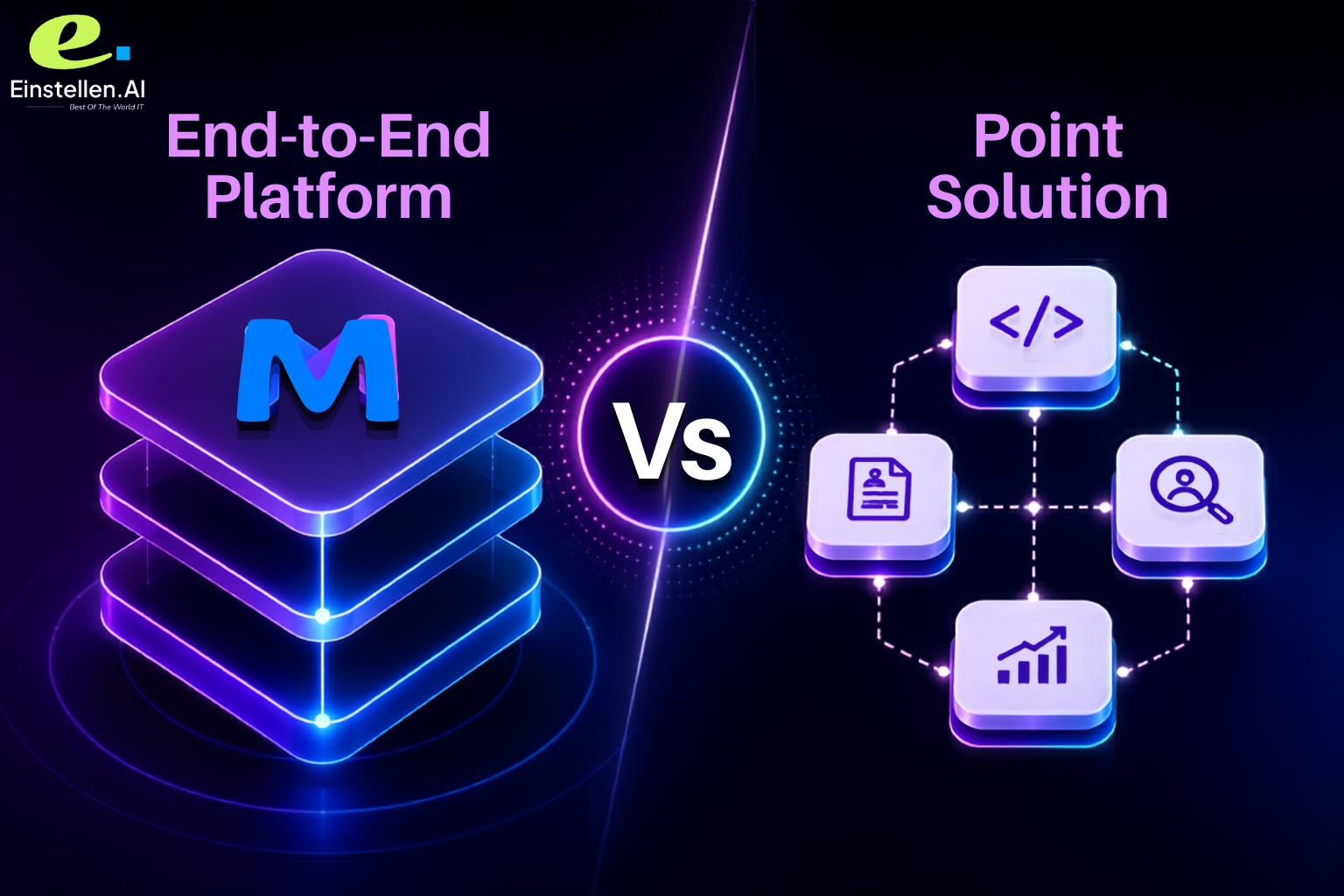
Deloitte's 2025 Talent Acquisition Tech Trends framework splits tools into three tiers: AI-assisted tools that automate a single repetitive task, AI-augmented tools that generate insights within a broader workflow, and AI-powered tools using multiple coordinated agents with minimal human intervention across a process. Most vendors in this space are point solutions. A coding-test tool here, a resume parser there, a sourcing engine somewhere else, each one solving its own narrow piece.
An end-to-end platform combines the interview engine, evaluation framework, and in some models the deployment mechanism, under one system. Magic OS runs the AI interview engine (humAIn), the MAGIC scoring model, and a candidate-to-employer pipeline, all as one connected system rather than three tools bought separately and stitched together.
There's a genuine trade-off worth naming. Point solutions can go deeper in their narrow lane; a dedicated coding-assessment tool will likely out-test a generalist platform on pure coding rigor. But stitch together three or four point solutions, and you multiply integration overhead, and now there are three separate places where "explainability" has to be independently verified instead of one. For a TA head trying to standardize an enterprise-wide process, fewer connected systems usually means fewer places for the explainability story to quietly fall apart.
Contracts and Implementation Timeline: The Question Nobody Else Asks
Nearly every buyer's guide in this category just assumes an annual or multi-year enterprise contract is the default, then only asks how to maximize ROI within that structure. That assumption itself deserves a hard look before a pilot even starts. A custom-quoted, multi-year contract carries real lock-in risk if the AI scoring doesn't hold up against actual on-the-job performance six months in.
Einstellen.AI's public list pricing is a flat ₹249 per interview, pay-per-use, with no subscriptions, no contracts, and no volume commitments. Same rate whether a client runs one interview or ten thousand. That structure changes the risk calculus for a TA head who wants to pilot AI interviewing on a single open req before rolling it out enterprise-wide, rather than negotiating a locked-in annual deal upfront and hoping it works out.
On implementation timeline specifically: ask any vendor how long it takes from signed contract to first live candidate interview, and whether that figure includes ATS integration time or assumes it happens separately. A platform with native, pre-built ATS integrations should have a materially shorter runway than one that requires custom integration work before the first interview can even run.
Comparing the Category at a Glance
| Evaluation Criterion | What to Ask For | Why It Matters |
|---|---|---|
| Explainability | A sample structured justification report, not a description | Distinguishes a real deliverable from a sales claim |
| ATS Integration | Named platforms, bidirectional sync confirmed, cost model in writing | Integration surcharges are common and often undisclosed upfront |
| Certifications | Viewable certificates for ISO 27001, SOC 2 Type II, GDPR | Claimed compliance without viewable proof is not verifiable |
| Contract Model | Per-use vs. multi-year lock-in, minimum commitment terms | Determines pilot risk before enterprise-wide rollout |
| Interview Method | Adaptive/agentic questioning vs. fixed-script rubric | Adaptive interviews probe deeper where answers reveal more |
Note: Table reflects evaluation criteria and Einstellen.AI's publicly stated model; verify each vendor's current terms directly, as pricing and contract structures vary by provider and change over time.
Proof point: Einstellen.AI's platform has conducted 30,000+ AI interviews across 1,200+ institutions, backed by IIM Lucknow and NASSCOM, with every score delivered as a structured justification report rather than an unexplained ranking.
FAQ
What questions should I ask an AI recruiting vendor before signing a contract?
Ask for a sample explainability report showing transcript and per-answer scoring together, not just a verbal confirmation that scoring is "explainable." Ask whether ATS integration carries a separate fee, what the minimum contract term is, and whether pricing is published or requires a custom quote. Vendors that hedge on any of these deserve a second, more skeptical look.
What's the difference between AI-assisted, AI-augmented, and AI-powered hiring tools?
This framework, used by Deloitte and referenced widely across the AI recruiting category, splits tools by autonomy level: AI-assisted tools automate one repetitive task, AI-augmented tools generate insights within a broader workflow a human still runs, and AI-powered tools coordinate multiple functions with minimal human intervention across the process. Most point solutions fall into the first two buckets.
Is AI in hiring legal and compliant with the EU AI Act?
The EU AI Act treats certain employment-related AI systems, including candidate screening and evaluation tools, as high-risk. That brings documentation, transparency, and human-oversight obligations along with it. This is exactly why explainability, a structured, reviewable justification behind every score, is becoming a compliance requirement rather than just a nice-to-have product feature, for any enterprise operating under or adjacent to EU jurisdiction.
How is Einstellen.AI different from a black-box AI interview tool?
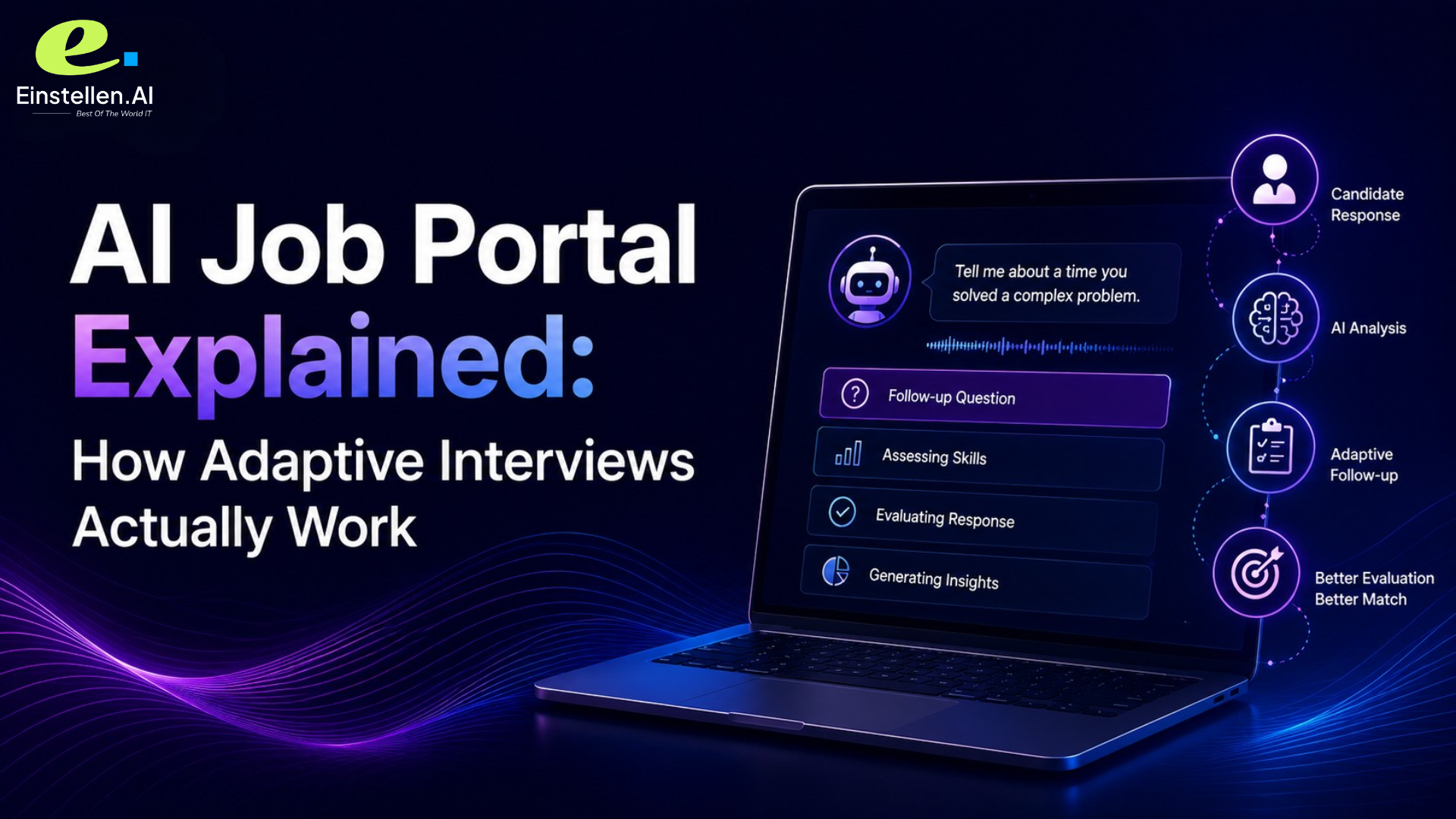
Every Einstellen.AI interview score comes from the MAGIC model paired with a structured justification report, so a hiring manager can see exactly which answer drove which part of the result instead of accepting a number on faith. The interview itself is adaptive too: humAIn generates each next question based on what the candidate just said, rather than working through a fixed script regardless of where the conversation actually goes.
Ready to Evaluate on Deliverables, Not Demos?
If your team is evaluating an AI job portal for an enterprise-wide rollout, ask every vendor on your shortlist for the artifacts in this guide before your next call: a sample explainability report, written ATS integration terms, and viewable certifications. Einstellen.AI's Enterprise page shows exactly what a structured justification report looks like, with native Greenhouse, Lever, and Workday integration at no additional cost, and flat, published pricing with no contract required to pilot.
Explore Einstellen.AI for Employers to see the MAGIC Report format directly, or post a role to run your own side-by-side comparison against your current shortlist.




Leave a Comment
Share your perspective. Comments are moderated before publishing.