
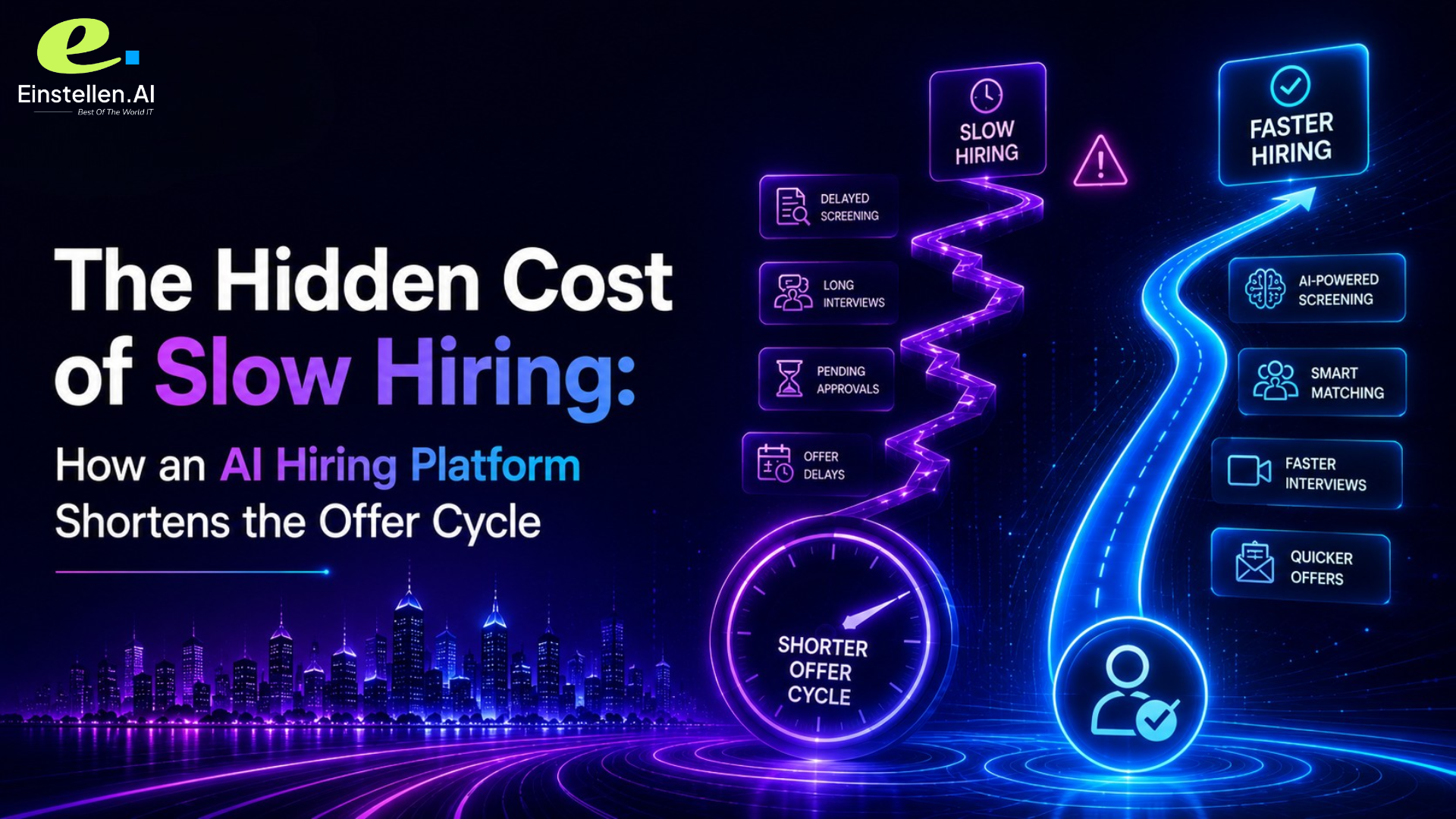
Quick Answer: An AI hiring platform shortens time to offer by fixing two separate problems: slow screening and slow manager trust in the shortlist. Adaptive interviews with structured, explainable scoring let hiring managers approve offers without re-reviewing candidates manually, a step generic AI screening tools don't solve.
Picture a hiring manager in Bangalore. She gets a shortlist of eight AI-screened candidates on a Tuesday. By Friday, none of them have moved to the offer stage. Not because the candidates were wrong. Because she quietly re-interviewed three of them anyway. The AI score gave her a number. It didn't give her a reason to trust that number.
This is the part of the offer cycle most AI hiring platform content conveniently skips over. Vendors love talking about sourcing speed and screening automation, and then the conversation just stops there. But the real drag on time to offer usually starts after screening is technically "done," right when a human still has to decide whether to believe the machine or not. An AI hiring platform that closes this trust gap, not just the sourcing gap, is the one that actually moves time to offer.
Time to Fill vs Time to Hire: Why the Distinction Matters
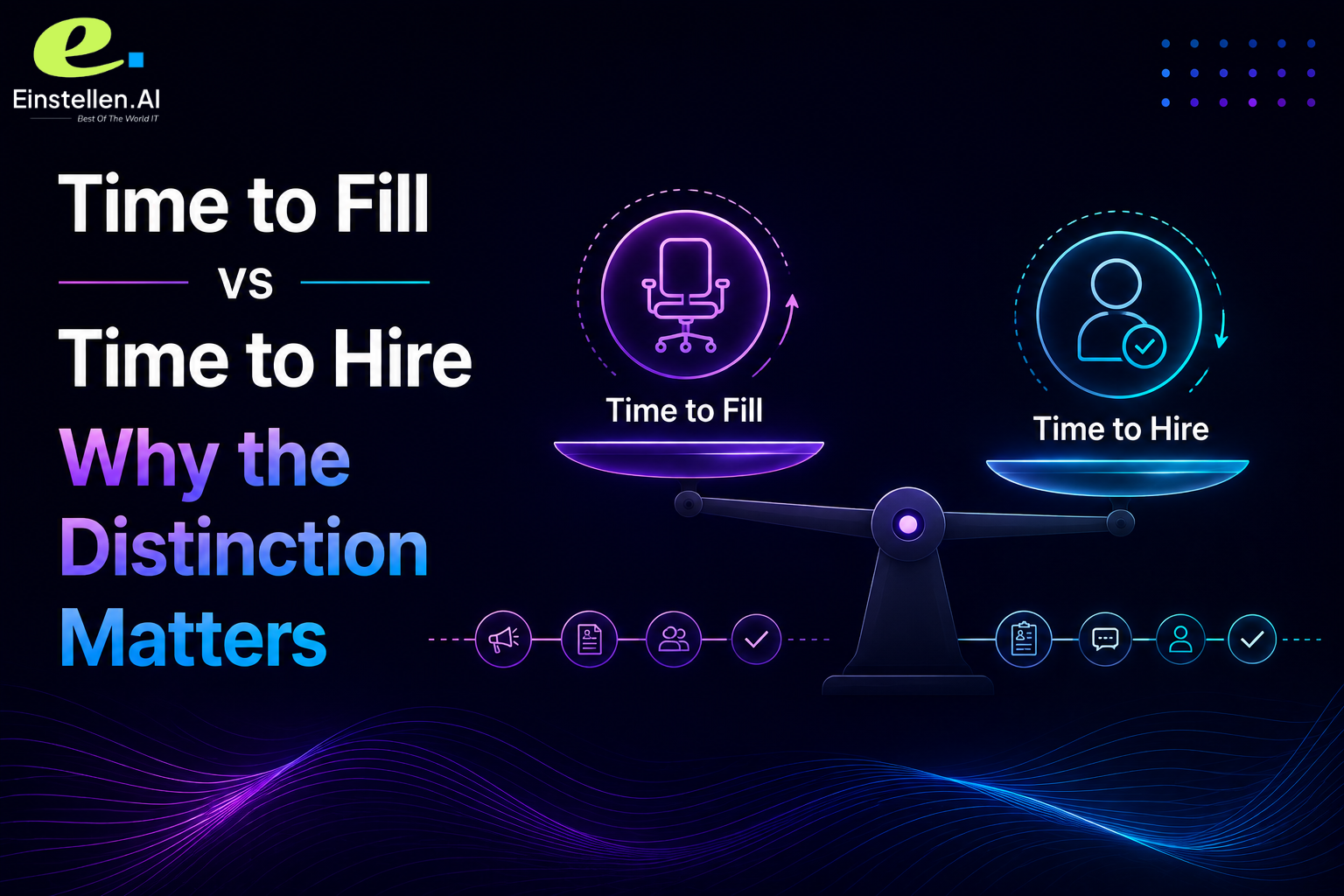
Time to fill measures the days from job requisition to accepted offer. Time to hire measures the days from a candidate's first application or interview to the offer decision. Companies love to say "we hire fast," but they often just mean fast sourcing. The interview-to-offer stretch, which is the part actually inside a company's own control, stays untouched.
The average time to fill a role across software, tech, business services, retail, hospitality, and manufacturing was 63.5 days in 2025, according to Employ's benchmark data reported by Management.org. That same dataset put average offer acceptance at 83.9%. Which means roughly one in six accepted offers still falls through somewhere else in the process.
Sourcing delays are easy to fix first because they're easy to point at. Someone can literally see the empty req sitting there. The interview-to-offer stretch is quieter. This is where hiring managers stall, asking for a second opinion, a re-interview, one more data point, because the first evaluation didn't hand them anything they could actually defend. That stall never shows up as a line item on a dashboard. It shows up as a slipped week nobody can quite explain in the retro.
Read More: AI Recruitment Platform Mis-Hire Risk: How Explainable Scoring Cuts Bad Hires
The Real Cost of Vacancy, Per Day
Cost of vacancy isn't some abstract HR concept. It ranges between €3,800 and €9,300 per month depending on the role, according to SHRM and Oxford Economics data cited in TieTalent's hiring speed research. Do the math and a mid-level vacancy costs a company somewhere between roughly €125 and €310 every single day it stays open. That's before you even count recruiter time or lost output.
Deloitte's Cost-Per-Hire Benchmark Report found organizations save an average of $4,000 per hire simply by cutting time-to-hire by one week, a figure reported by Softwareoasis. That's not from finding better candidates, to be clear. It's purely from removing a week of delay between "we found the right person" and "we made the offer."
For a startup or scaling company juggling five to ten open reqs at once, a one-week average delay across the funnel compounds fast. That's real budget, not a scheduling inconvenience. And the delay tax applies whether the role sits genuinely vacant for want of applicants, or sits filled-on-paper while a manager re-checks a shortlist that already had answers attached to it.
Why Structured Interview Rounds Reduce Time to Hire
Fixed-script AI interviews ask every candidate the same five questions no matter what they say back. Someone gives a thin answer on a specific project? The interview moves on anyway. That leaves a gap, and the hiring manager ends up filling it with an extra round later. That extra round is exactly where days get lost.
humAIn, Einstellen.AI's AI interview engine, works differently. It runs adaptive questioning: it listens to what a candidate actually said and generates the next question based on that answer, instead of marching through a fixed script. If a candidate is vague about a specific project, the system probes that project further rather than jumping to an unrelated scripted question.
The practical effect? Fewer necessary re-interview rounds, because the first interview already went deep where it needed to. Every interview also produces a per-answer scored report with a full transcript, so a hiring manager reviewing a borderline candidate can see which specific answer drove which part of the score. Not just a final number they're supposed to take on faith.
Explainability Is a Speed Lever, Not Just a Trust Feature
Most AI interview platforms in this category, including tools commonly discussed alongside HireVue and Spark Hire, are frequently associated with producing a candidate ranking without any accessible justification behind it. That absence of justification is exactly what makes a hiring manager pause and re-verify manually. And every re-verification adds days.
Einstellen.AI's MAGIC OS model produces a structured, justified score instead of an opaque one. The report shows exactly which answer drove which part of the score, so a hiring manager reviewing a borderline candidate can see the actual reasoning, not just a number. That's the entire difference between a manager approving an offer in one sitting versus scheduling a follow-up call "just to be sure."
The fraud and proxy detection built into the interview process adds another layer of confidence at high volume, which matters a lot for campus placement drives and bulk enterprise hiring rounds. A single manager might be reviewing dozens of reports in a day there, and simply cannot afford to second-guess each one individually.
Offer Acceptance Drops the Longer Top Candidates Wait
Strong candidates don't wait around passively, ever. The 83.9% average offer acceptance rate reported by Management.org reflects a market where a meaningful share of extended offers just don't convert, often because the candidate accepted somewhere else first. Every extra day between interview and offer is a day a competing employer has to go close that same person.
Adoption data on AI in recruiting, aggregated by StealthAgents, suggests 89% of organizations using AI for recruiting report greater efficiency and 77% report measurable cost savings. Worth treating those as directional industry sentiment rather than a single verified study, to be fair. But the pattern lines up with what Einstellen.AI hears directly from TA heads: the complaint was never really about AI interviewing as a concept. It's about scores that don't correlate with actual job performance, and that's exactly what triggers the re-review cycle that ends up costing the offer.
Procurement friction adds its own delay before a company even starts using a tool, too. Einstellen.AI runs flat, open pricing at ₹249 per interview, pay-per-use, with no subscriptions, no contracts, and no volume negotiation required. So a hiring team can start running interviews the same week they decide to, instead of losing weeks to a demo-gated sales cycle.
Read More: Implementing an AI Hiring Platform Without Disrupting Your ATS
Benchmark Snapshot: Where the Time Actually Goes
| Metric | Figure | Source |
|---|---|---|
| Average time to fill (2025, across sectors) | 63.5 days | Employ data via Management.org |
| Average offer acceptance rate (2025) | 83.9% | Employ data via Management.org |
| Cost saved per hire from cutting time-to-hire by 1 week | \~$4,000 | Deloitte Cost-Per-Hire Benchmark Report, via Softwareoasis |
| Average cost of vacancy per month | €3,800–€9,300 | SHRM / Oxford Economics, via TieTalent |
| Organizations reporting efficiency gains from AI recruiting | 89% | StealthAgents (directional, vendor-aggregated) |
Proof point: Einstellen.AI has conducted 30,000+ AI interviews across 1,200+ institutions, with every score delivered as a structured justification report rather than an unexplained ranking. That's the specific mechanism that lets hiring managers move to offer without a manual re-review cycle.
FAQ
What is the difference between time to hire and time to fill?
Time to fill counts days from requisition open to accepted offer, covering sourcing and process end to end. Time to hire counts days from a candidate's first interaction to offer decision, isolating the part of the funnel a company directly controls. Both matter. But time to hire is where an AI hiring platform's screening and interview speed shows up most clearly.
How much does a slow hiring process actually cost a company?
The cost of vacancy runs between roughly €3,800 and €9,300 per month depending on the role, per SHRM and Oxford Economics data. Deloitte's benchmark research separately found that cutting time-to-hire by just one week saves an average of $4,000 per hire. So the cost compounds daily, and that's even before counting lost productivity or recruiter hours.
Is AI hiring software reliable enough for hiring managers to actually trust?
The reliability gap isn't really about AI interviewing as a concept. It's about unexplained scores. Einstellen.AI's MAGIC model pairs every score with a structured justification report showing exactly which answer drove which part of the result, so a hiring manager can review the actual reasoning instead of taking a ranking on faith. That's what removes the manual re-verification step that stalls offers.
How much does an AI hiring platform cost?
Einstellen.AI runs flat, open, pay-per-use pricing at ₹249 per interview, with no subscriptions, no contracts, and no volume commitments, whether a company runs one interview or ten thousand. The full report, including video, transcript, and skill scoring, is included in every credit with no separate premium tier.
Post Your Role and Shorten Your Offer Cycle
Every extra day between interview and offer is a day a strong candidate can accept somewhere else. Einstellen.AI's adaptive interview engine and structured justification reports let your hiring managers approve offers on the first review, not the third. ATS integration with tools like Greenhouse, Lever, and Workday comes at no additional cost, so your existing workflow doesn't need to change to get there.
Post your role on Einstellen.AI and start reviewing explainable, justified candidate reports today.






Leave a Comment
Share your perspective. Comments are moderated before publishing.