
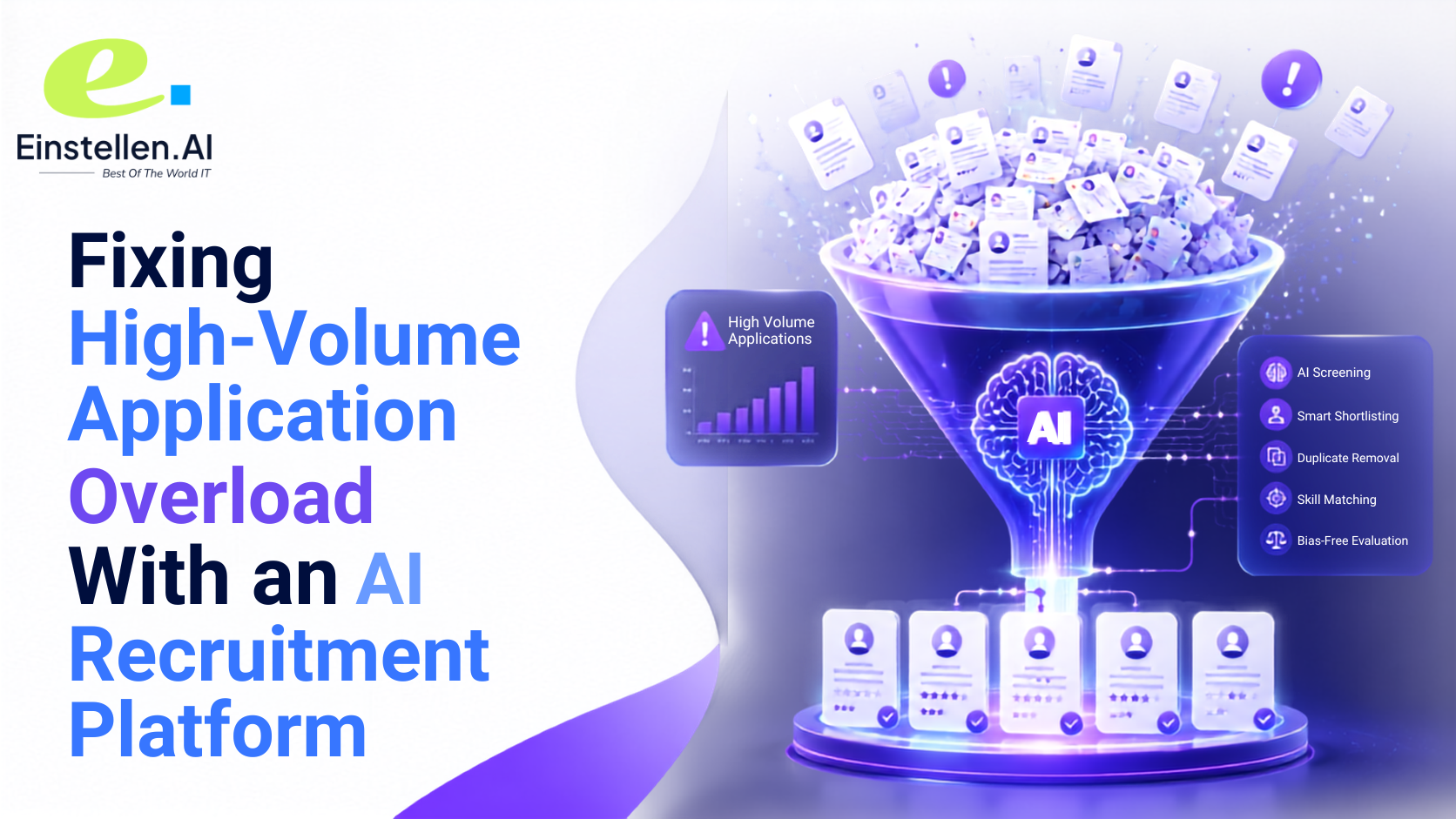
Quick Answer: An AI recruitment platform for high-volume hiring cuts through application overload by combining adaptive AI interviews, explainable scoring, and fraud/proxy detection, so a TA team can screen hundreds of applicants a day without losing signal quality. Einstellen.AI runs this on a flat ₹249-per-interview, no-contract model, and every score comes with a structured justification report behind it.
Picture this: a TA head at a 300-person product company opens the applicant tracker on a Monday morning and finds 1,800 unread applications sitting there for six open roles. Somewhere in that pile is a strong candidate. Nobody has time to find them before they take an offer somewhere else. That's the exact bottleneck an AI recruitment platform for high-volume hiring is built to solve, and not by bolting on another dashboard, but by swapping manual screening for adaptive AI interviews that hand back a scored, explainable shortlist in hours instead of weeks.
This problem isn't unique to Einstellen.AI's customers either. Recruiters spend an average of just seven seconds reviewing each resume, according to Indeed data cited by thejobcenterstaffing.com, and a 200:1 applicant-to-hire ratio is normal in high-volume roles per cs-recruiters.com. Meanwhile 52% of talent acquisition leaders say screening large applicant pools is their hardest task, according to x0pa.com. Volume by itself isn't the enemy. Unscreened, unexplained volume is.
What Counts as High Volume Hiring
The quick answer for high volume hiring generally indicates the process of filling dozens to hundreds of similar roles in a very short timeline. This process includes seasonal retail ramp-ups, campus placement drives, BPO and support hiring. On the other hand, it indicates a Series C startup trying to scale technical headcount fast. Therefore, the number of open roles does not define high-volume hiring; it's the applicant-to-hire ratio, which comes somewhere between 150:1 and 500:1 as per pinpointhq.com.
At that ratio, manual resume screening just can't keep up. Something gives: either strong candidates get missed, or the TA team burns out trying to catch them all.
The real cost shows up further downstream. A 2025 iHire survey found 59.7% of employers receive too many unqualified applications through job boards, and 41% of recruiting leaders point to a lack of qualified candidates as their top bottleneck, according to jobscore.com. So an AI recruitment platform for high-volume hiring has to solve both ends of this at once. Filter the volume down. Surface the quality up. Same pass, not two separate steps.

And delay makes everything worse. Nearly half of candidates, 48% according to x0pa.com, say waiting to hear back from an employer is highly frustrating, and a lot of them just take a competing offer while they're waiting. Speed and explainability need to move together here. Treating them as a tradeoff is where most of this breaks down.
Why Generic AI Screening Tools Fall Short As Compared To AI Recruitment Platforms
Most AI screening tools out there right now, including well-known names like HireVue and Spark Hire in the interview category, spit out a candidate score with zero reasoning attached to it. A hiring manager sees a number. They don't see the why. When a borderline candidate gets rejected, nobody on the TA team can actually explain that decision, not to the candidate, not to the hiring manager, and definitely not to a compliance auditor asking questions later.
This isn't a hypothetical worry either. TA heads keep telling Einstellen.AI's own team, in real conversations, that AI interview scores from other platforms simply don't line up with how someone actually performs on the job. The complaint is rarely about AI interviewing as an idea. It's specifically about the missing reasoning behind the score, and this pattern shows up often enough that it's shaped how Einstellen.AI built its own scoring layer from the very start.
There's a second problem too, related but distinct: the fixed script. Most of the AI recruitment platform generally asks repetitive questions to every single candidate, no matter what they just said. Moreover, that effectively scales on paper; however, it flattens signal quality at exactly the moment the volume is at peak. Hence, this approach necessarily requires human judgement to separate a genuinely strong candidate from others who are well-rehearsed.
How Adaptive AI Interviews Preserve Signal at Volume
humAIn, the AI interview model of Einstellen.AI, runs on autonomous adaptive questioning. Basically, this AI recruitment platform listens to the responses from candidates and generates next questions according to their answers. This does not rely on any fixed script. For instance, if a candidate provides a vague answer for a specific project. humAIn digs deeper into the details of that project instead of jumping to any unrelated scripted questions.
This matters most exactly when volume is at its highest. Picture 200 applicants for one role. A fixed-script tool asks the same generic questions 200 times over and gets back 200 similarly shallow transcripts. An adaptive interview goes deeper wherever the conversation actually reveals something worth exploring, which produces interview data that looks a lot more like what a skilled human interviewer would pull out, even at scale.
The magic OS model, Einstellen.AI's underlying evaluation framework, takes that transcript and turns it into a structured, justified score instead of some opaque number. Every score arrives with a report showing exactly which answer drove which part of the result. A hiring manager looking at a borderline candidate can see the actual reasoning behind it, not just a ranking on a list.
AI Recruitment Platform: Explainability and Fraud Detection as Trust Infrastructure
Application overload pushes teams to move fast, and speed at scale is exactly where fraud, proxy test-takers, and rehearsed answers tend to slip through the cracks. Einstellen.AI's platform builds fraud and proxy detection directly into the interview process itself, which matters a great deal for high-volume situations like campus placement drives and bulk enterprise hiring rounds, where the same person could otherwise sit multiple interviews under different names.
Paired with structured justification scoring, this gives a TA team something most AI recruitment platforms for high-volume hiring simply don't offer: an auditable answer to "why did this candidate move forward and this one didn't," available for every applicant, not just the handful a recruiter happened to have time to review by hand.
For a healthcare, BFSI, or enterprise employer dealing with internal audit requirements, this kind of auditability isn't some nice extra. It's the difference between an AI hiring process a compliance team can actually sign off on and one that turns into a liability the moment a rejected candidate asks why.
Pricing That Doesn't Punish Volume
Most enterprise AI recruiting tools price through annual contracts, often quote-based, often gated behind minimum commitments that shut out smaller companies and seasonal hirers who need to scale screening up and down without warning. Einstellen.AI's public model is a flat ₹249 per interview, pay-as-you-go, no subscriptions, no contracts, no volume pricing tiers, whether a company runs 10 interviews a month or 10,000. Credits never expire. And the full report, video, transcript, skill scoring, fraud detection, all of it, comes included in every credit. No premium add-on tier hiding behind it.
ATS integration is included too, at no extra cost. Magic OS works with whatever ATS a company is already using, and for teams who want a concrete example, Greenhouse, Lever, and Workday are available as named, bi-directionally synced integrations. Scores, transcripts, and reports flow straight into the existing candidate record. Recruiters don't need to relearn a single workflow they already have in place.
| Experience Level | Typical CTC Range | Top-End CTC |
|---|---|---|
| 0-2 years (Fresher) | ₹4-8 lakhs | ₹8 lakhs |
| 3-5 years (Mid-level) | ₹18-35 lakhs | ₹35 lakhs |
| 6-9 years (Senior) | ₹28-52 lakhs | ₹52 lakhs |
| 10+ years (Lead/Principal) | ₹35-65 lakhs | ₹65 lakhs |
Proof point: Einstellen.AI has conducted 30,000+ AI interviews across 1,200+ institutions, backed by IIM Lucknow and NASSCOM, and every single one of those interviews produced a per-answer scored report and full transcript rather than an unexplained ranking.
FAQ
What is high-volume hiring and when does a company need an AI recruitment platform for it?
High-volume hiring means filling many similar roles in a short window, common in campus placements, seasonal retail, BPO, and startups scaling fast. Once applicant-to-hire ratios climb past roughly 150:1, manual screening stops being sustainable, and that's when an AI recruitment platform for high-volume hiring becomes genuinely necessary to keep speed and quality intact together.
How does AI recruitment software reduce application overload without losing candidate quality?
It replaces manual resume screening with adaptive AI interviews that ask deeper follow-up questions based on what a candidate actually says. Einstellen.AI's humAIn engine handles that side while the MAGIC model produces a structured, justified score for every candidate, so volume drops without the signal quality dropping along with it.
Is AI hiring software biased, and how do you audit AI interview decisions?
This is exactly why explainability matters so much. A platform that only spits out a ranking gives you nothing to actually audit. Einstellen.AI's structured justification report shows precisely which answer drove which part of the score, giving a hiring manager or compliance reviewer a specific, reviewable reason behind every decision instead of a black-box number.
How much does an AI recruiting platform cost, and are there no-contract options?
Einstellen.AI's public pricing is a flat ₹249 per interview, pay-as-you-go, no subscriptions, no contracts, no volume commitments, whether you run 1 interview or 10,000. Credits never expire, and the full MAGIC Report comes included in every credit with no separate premium tier tacked on.
Ready to Fix Your Application Overload?
If your team is drowning in a pool of unqualified applications and losing strong and knowledgeable candidates to a slower internal process. You can post your next high-volume role on Einstellen.AI and let adaptive AI interviews with explainable scoring handle the first-pass screening. Additionally, this AI recruitment platform includes ATS integration with no extra cost. Therefore, the pricing stays flat and contract-free, and every candidate you shortlist arrives with a structured and detailed interview report that your hiring managers can actually trust. Post your job on Einstellen.AI and reach an active, current candidate pool built for exactly this kind of volume.








Leave a Comment
Share your perspective. Comments are moderated before publishing.