
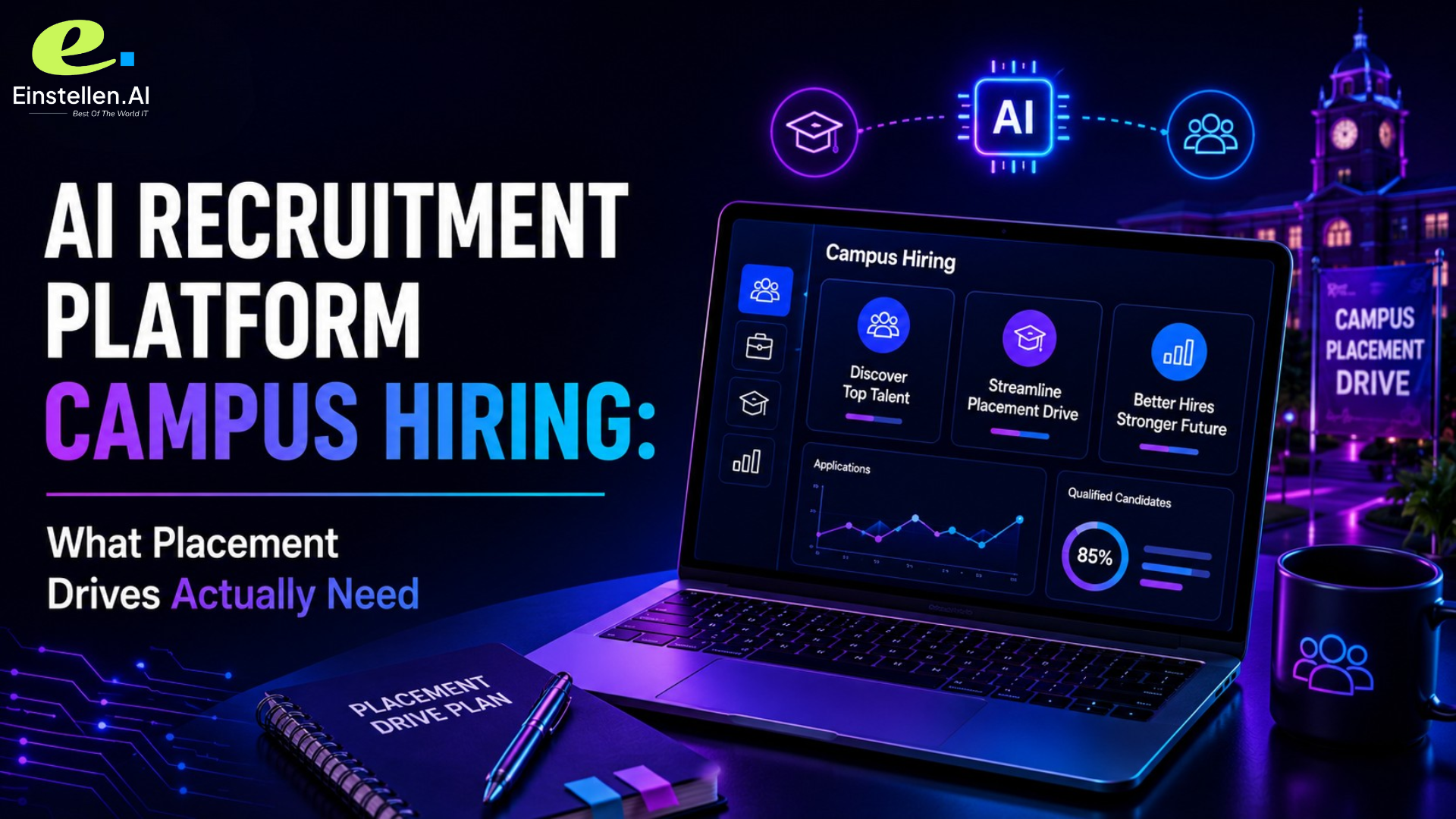
Quick Answer: An AI recruitment platform helps campus hiring by automating high-volume screening, running adaptive interviews instead of fixed scripts, and using proctored assessments to protect drive integrity. The gap in most platforms is explainability: employers need to see why a candidate scored as they did, not just a rank, before rejecting thousands of applicants at once.
Picture a campus drive at a mid-size product company: one TA manager, three engineering leads, and 4,000 applications for 40 roles, all inside two days. Manual shortlisting just collapses under that math. So most companies now bring in an AI recruitment platform to survive the volume. But here's the catch — the tools they end up adopting usually solve only the visible half of the problem. They get you through the applications faster. They don't help you defend the decisions you made along the way.
That second half matters more than most vendor pages let on. When a placement cell or a rejected candidate asks why someone scored low, "the algorithm said so" isn't an answer, and it never will be. Deloitte's Campus Workforce Trends: Placement Cycle 2025 found a 38% uptick in GenAI adoption across recruitment functions this cycle, alongside a 15% increase in hiring budgets. Which means more automated decisions are being made at exactly the moment employers can least afford to make them opaquely.
AI Campus Recruitment Funnel Automation: Where the Bottleneck Actually Sits
Ask most vendors what funnel automation means and you'll hear the same three things: resume parsing, auto-scheduling, bulk communication. Useful, sure. But none of that is where hiring managers actually lose their afternoons. The real bottleneck sits at the interview-to-decision step, where someone has to turn a raw score into a hire-or-reject call for a candidate they've never laid eyes on.
Magic OS, the platform underlying Einstellen.AI's interview engine, goes after this directly at the scoring layer instead of just the scheduling layer. Every interview conducted through humAIn produces a per-answer scored report with a full transcript. So a recruiting lead working through 200 borderline candidates in an afternoon can actually see which answer drove which part of the score. That's a different category of automation than a calendar sync — it's the piece that removes real review time from a hiring manager's day instead of just shoving the bottleneck further down the line.
For campus volumes specifically, this matters because rejection defensibility scales right along with applicant count. A drive with 4,000 applicants and 40 offers throws off thousands of rejections in a single week. An unexplained score attached to each one isn't just an inconvenience at that scale — it's a liability.
One-Way Video Interview Campus Hiring: Why Fixed Scripts Miss Signal
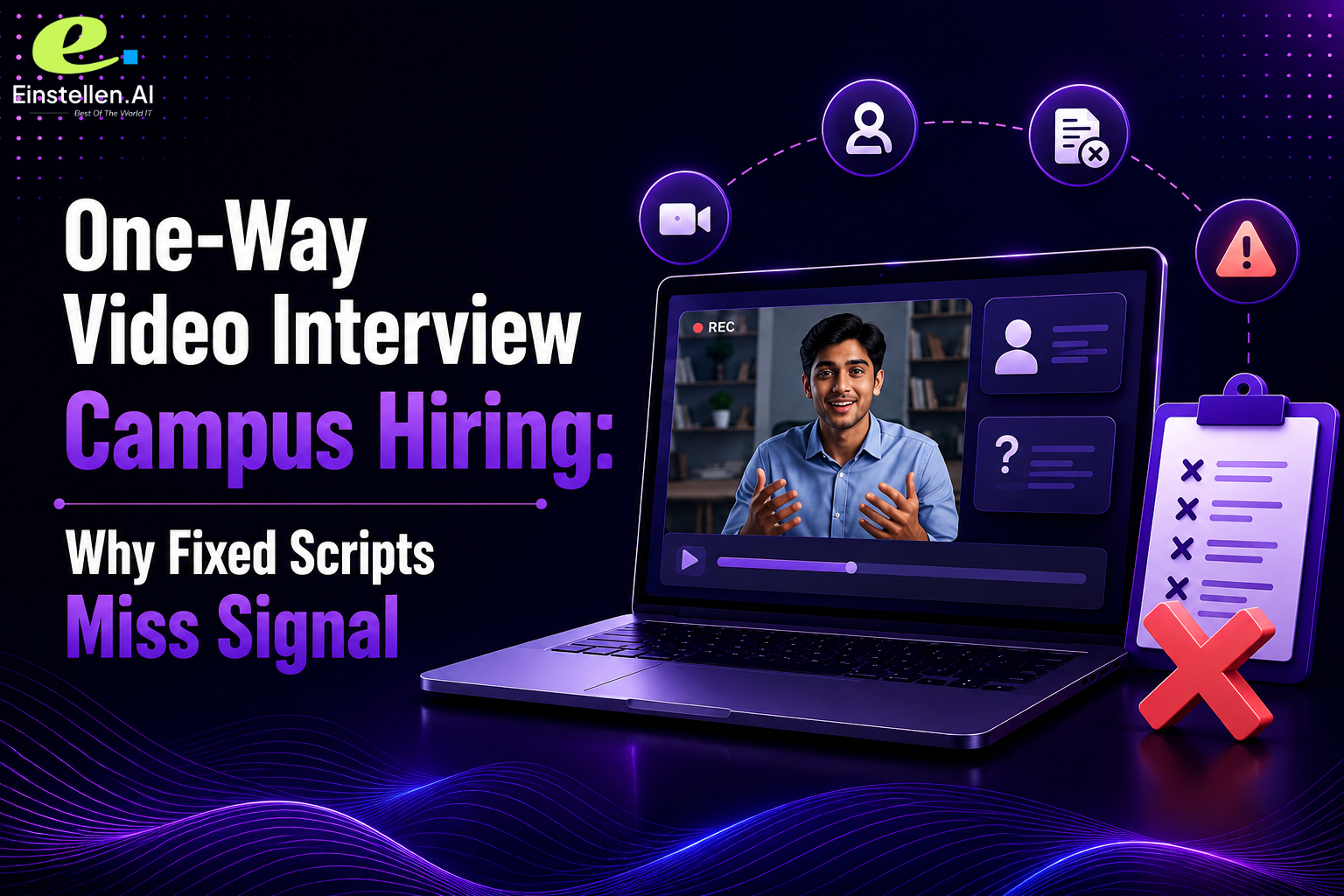
One-way video interviews became the default in campus hiring for one reason: they let a single job requisition absorb thousands of candidates without eating up live interviewer time. The tradeoff has always been signal quality. Five fixed questions, asked identically to every candidate no matter what they say, tells you whether someone can talk on camera. Not a lot more than that.
humAIn's adaptive questioning works differently. It listens to what a candidate actually said and builds the next question out of that answer, rather than marching through a static script regardless of the conversation. Say a fresher gives a vague answer about a capstone project — the system digs into that specific project instead of jumping to some unrelated scripted question next.
The result is interview data that looks a lot more like what a skilled human interviewer would pull out of a live conversation. That's really the whole point of moving past a checklist-style video interview. For campus hiring in particular, where candidates have thin work history and the interview is doing most of the evaluation heavy-lifting, that depth difference adds up across every single hire made from the drive.
Skills-Based Campus Hiring vs Degree Pedigree
India produces roughly 15 lakh engineering graduates every year, spread across more than 10,000 AICTE-approved institutions. Only about 40% of them get placed through campus recruitment, even as NASSCOM's Strategic Review 2025 projects direct tech employment reaching 60 lakh by FY26. That gap isn't mainly a supply problem. It's a filtering problem. Pedigree-based shortlisting, tier of college, CGPA cutoff, screens out plenty of candidates who'd actually perform well on the job but never clear an arbitrary academic bar.
The India Skills Report 2025 (Wheebox, CII, AICTE) put graduate employability at 51.25% in 2024, rising to 54.81% by 2025, and NIRF data consistently shows that outside the top 50 engineering institutions, placement rates fall significantly below 40%, a structural gap in how campus hiring flows toward established colleges rather than demonstrated ability. A skills-based evaluation, where the interview itself measures demonstrated ability rather than institutional tier, is one of the few levers an individual employer can actually pull to move that number, without waiting around for the broader education system to fix itself.
This is exactly where structured, justified scoring earns its keep. A hiring manager weighing a Tier 2 college candidate against a Tier 1 candidate needs more than a ranking to justify picking the former. A report showing which specific answers demonstrated the skill in question gives that decision an actual paper trail.
Read More: How Product Companies Use an AI-Powered Hiring Platform to Filter Faster
Virtual Proctored Assessment Campus Drive: Integrity at Volume
Campus drives are, honestly, the highest-fraud-risk format in Indian tech hiring. Proxy candidates, screen-sharing, coached answers — these show up often enough at scale that most large drives now require some form of proctoring. Einstellen.AI builds fraud and proxy detection into the interview process itself, which matters most for exactly this kind of high-volume use case: campus placements and bulk enterprise hiring rounds, where putting a human proctor on every screen just isn't realistic.
Here's the detail worth flagging for anyone evaluating vendors: proctoring that only flags suspicious behavior after the fact is weaker than proctoring embedded right into the adaptive interview flow. A candidate who can't answer a natural follow-up about their own stated project gives themselves away in real time. Fixed-script tools depend entirely on the proctoring layer to catch that kind of thing. Adaptive tools catch some of it through the interview mechanism itself, before proctoring even has to step in.
AI Recruitment Platform Pricing: What Campus Drive Operators Actually Pay
Most campus-hiring vendor pages sell you "solutions," not prices — which forces every prospective buyer onto a sales call before they even know the shape of the cost. Einstellen.AI runs the opposite model: ₹249 per interview, flat, whether a company runs 1 interview or 10,000. No subscription, no contract, no volume negotiation. The full report — video, transcript, skill scoring, fraud detection — is included in that rate. No add-on tier hiding behind it.
For a campus drive specifically, where volume is basically the entire operating challenge, a flat per-interview rate with no demo gate is a genuinely different buying experience than the enterprise-quote model most competitors run.
| Drive Element | What Most AI Recruitment Tools Offer | What to Check Before Buying |
|---|---|---|
| Screening automation | Resume parsing, auto-shortlisting | Table stakes across nearly every vendor |
| Interview format | Fixed-script one-way video | Ask if it adapts to answers or repeats a checklist |
| Scoring output | A rank or percentile score | Ask if a structured justification report is included |
| Proctoring | Post-hoc flagging of suspicious behavior | Ask if fraud detection is built into the interview itself |
| Pricing | Enterprise quote, demo-gated | Ask for a flat, published rate with no volume tiers |
Proof point: Einstellen.AI has conducted 30,000+ AI interviews across 1,200+ institutions, backed by IIM Lucknow and NASSCOM, with every interview producing a per-answer scored report and full transcript rather than an unexplained rank.
FAQ
What is an AI recruitment platform and how does it work in campus hiring?
It's a platform that automates screening, interviewing, and scoring for high-volume hiring drives. In Einstellen.AI's case, the AI interview engine (humAIn) runs adaptive interviews that build follow-up questions out of a candidate's actual answers, and the MAGIC model scores each response with a structured justification instead of handing back an unexplained number.
Does AI hiring introduce bias into campus placement drives?
Bias risk exists in any hiring process, human or automated — that's just true. The defensible position isn't claiming zero bias. It's being able to show the reasoning behind every score. A structured justification report lets a hiring manager or compliance reviewer see exactly which answer drove which part of a candidate's outcome. You can't do that with a platform that hands you only a rank.
What does an AI recruitment platform cost for a campus drive?
Einstellen.AI's public list price is ₹249 per interview, pay-per-use, with no subscription, no contract, and no volume pricing tiers. Same rate whether a company runs one interview or thousands. The full MAGIC Report, including video, transcript, and fraud detection, is included in that rate.
Can AI conduct interviews for freshers with no work experience?
Yes, and honestly it's particularly well-suited to that. Adaptive questioning digs deeper into whatever project, internship, or coursework a candidate actually brings up, instead of leaning on a work-history-heavy fixed script that assumes prior job experience. That produces stronger signal for candidates whose strongest proof points are academic or project-based rather than professional.
Ready to Run Your Next Campus Drive Differently?
If your placement drive is running on fixed-script video interviews and a black-box rank, the right AI recruitment platform removes that review burden and gives your team a decision they can actually explain.
Post your campus hiring drive on Einstellen.AI and see how a structured, explainable report changes shortlisting at scale.








Leave a Comment
Share your perspective. Comments are moderated before publishing.