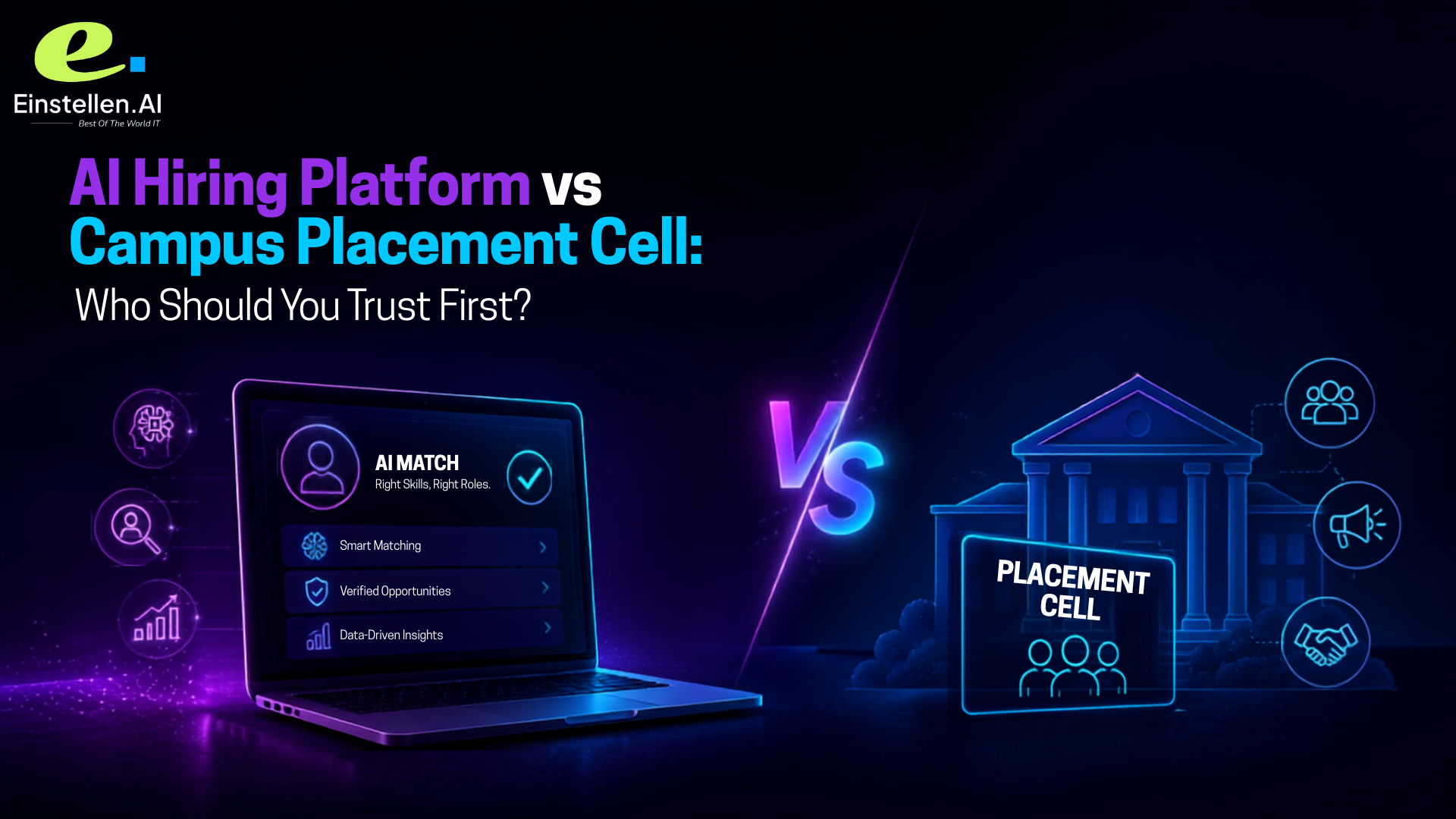
Quick Answer: Trust whichever channel gives you visibility into why a decision was made. Campus placement cells are limited by which companies visit your campus and often use subjective shortlisting. AI hiring platforms with explainable scoring show you exactly which answer drove your result, giving you a second, self-serve path when your placement cell can't reach the company or role you actually want.
Say you're a third-year student at a Tier-2 engineering college. Your placement cell has tied up with six companies this season. Three of them are staffing firms. None of them is the product company you actually want to work at. Meanwhile, a friend at a Tier-1 campus gets fifteen company visits and picks from four offers. That's the real gap behind the question "AI hiring platform vs campus placement." It was never really about the technology. It's about who controls your access to opportunity, and whether you can even see why you were or weren't selected.
This article breaks down where each system genuinely helps you, where it quietly limits you, and how an explainable AI interview changes the calculation when your placement cell can't get you in the room.
Campus Placement Cell vs AI Recruitment: Where Each One Actually Helps
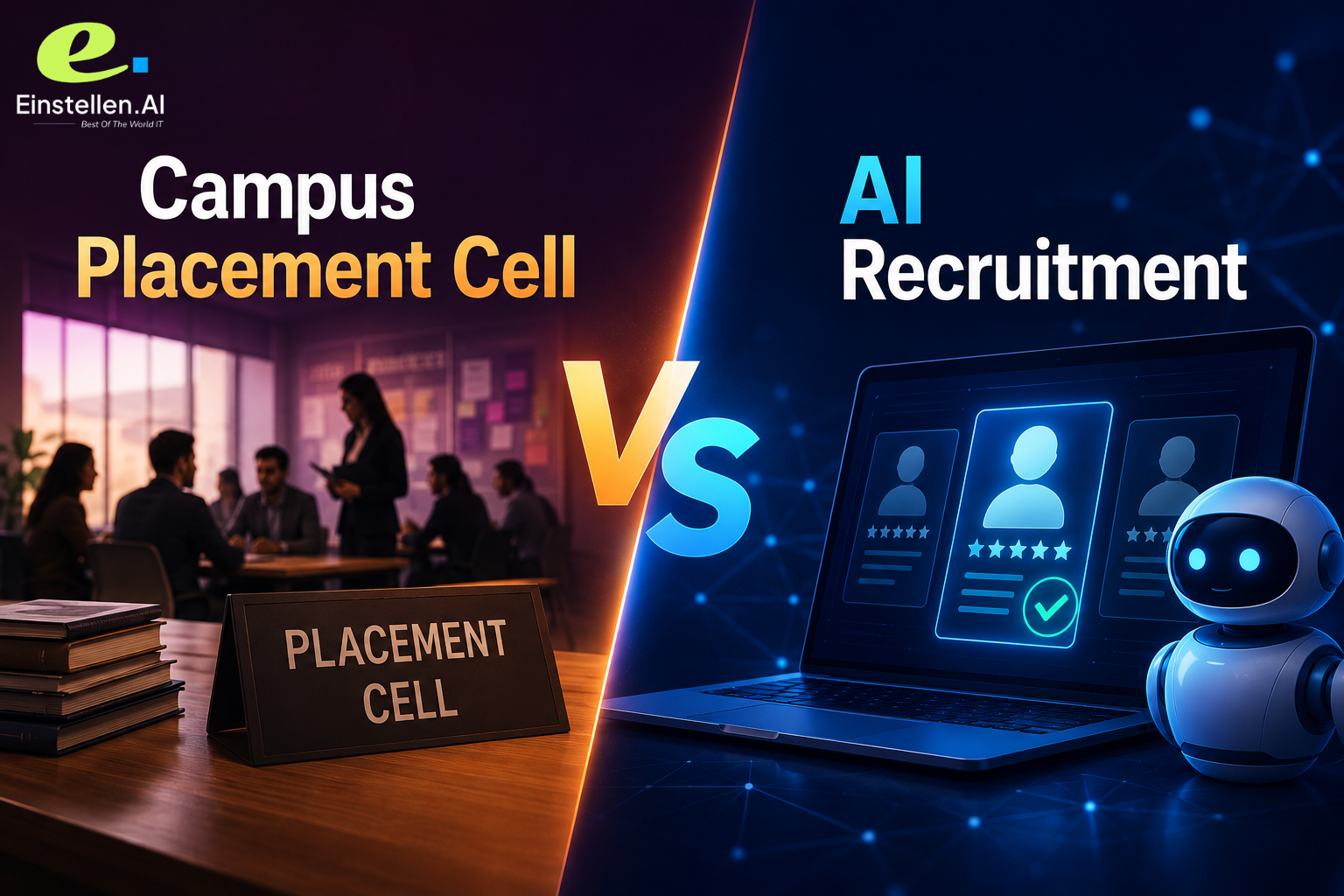
A placement cell's real value is logistics. It brings recruiters physically or virtually to your campus, handles the paperwork, and gives you a structured season with dates you can actually prepare for. For students at well-ranked institutions with strong recruiter relationships, this works well, because company volume is high and the competition is contained to your own batch.
The limitation shows up fast once you leave the well-connected colleges. Your placement cell can only invite companies willing to recruit from your tier of institution, and shortlisting inside that pool is often manual and subjective, run by a Training and Placement Officer working through hundreds of resumes with limited tools. An AI recruitment platform doesn't care which campus you're from. It evaluates the answer you actually gave. Industry commentary increasingly frames this as a shift toward skills-based evaluation over pedigree, and that shift matters most for students whose college brand isn't opening doors on its own.
Neither system is inherently better. A placement cell with genuinely strong company relationships and a TPO who fights for you is hard to beat. But when that's not your situation, an AI hiring platform becomes the alternative path. Not a replacement for the placement season. A supplement to it.
AI-Powered Campus Hiring India: What's Actually Changing
AI-powered campus hiring in India is moving in two directions at once. Institutions are adopting AI tools to make placement drives more efficient for recruiters and placement staff, screening resumes faster and running virtual interview rounds so companies can evaluate students across more campuses without physically visiting each one. That's a genuine improvement in reach for students at colleges that previously got skipped entirely.
The second direction gets talked about a lot less: fraud and integrity at scale. When interviews move online, and volume goes up, proxy candidates and answer-copying become a real risk, particularly in high-volume rounds like bulk campus placements. This is exactly the kind of use case fraud and proxy detection within the interview process is built for. A scoring system is only as trustworthy as the interview data feeding it.
What's missing from most of this shift is anything explaining the decision to the student. A resume gets auto-screened, a virtual interview gets auto-scored, and the candidate sees a result with no visibility into the reasoning behind it. That's the exact gap a structured justification report is designed to close, showing which answer drove which part of the score rather than handing back an unexplained number.
The Trust Gap Nobody's Addressing
A BestColleges survey found that only 34% of college students say they would trust potential employers to use AI tools in hiring decisions, while 41% actively disagree. Research from NACE notes that much of the reaction maps to a lack of authenticity and trust, with students believing employers use AI more heavily than most employers actually admit to.
That trust gap isn't irrational, either. A candidate rejected by an opaque algorithm has no way to learn what went wrong. That's not so different from being rejected by a placement cell's shortlisting process with zero feedback given. The common thread in both systems is the absence of a visible reason.
This is precisely the problem an adaptive interview engine paired with explainable scoring is meant to solve. If a candidate gives a vague answer about a specific project, the system probes further on that project rather than jumping to an unrelated scripted question. The resulting report shows a hiring manager and the candidate exactly which answer drove which part of the outcome. Closing the trust gap requires showing your work. Not asserting fairness and hoping people believe you.
Tier-2, Tier-3 College Placement Rates and the Access Problem
Placement rate disparity between Tier-1 and Tier-2/Tier-3 colleges is a well-known pain point, and honestly, it comes down to companies accessing more than student quality. A Tier-1 campus with strong recruiter relationships gets visited by product companies like Flipkart, Razorpay, or Swiggy directly. A Tier-2 or Tier-3 campus often sees only regional staffing agencies or a handful of service-company recruiters running the same standard aptitude tests year after year.
This is where a self-serve AI hiring platform becomes genuinely useful rather than a nice-to-have. A student whose placement cell has no tie-up with the product company they want can still complete an AI-driven interview independently and get evaluated on the same structured criteria as any other candidate, regardless of campus tier. The evaluation isn't gated by which companies happened to choose your specific institution this season.
Cost matters here too. Enterprise AI interview platforms are typically sold through institution-level contracts rather than candidate subscriptions.
TPO AI Tools and the AI Hiring Platform: What They Mean for You as a Candidate
TPOs are increasingly adopting AI tools for resume shortlisting, mock interview practice, and employer outreach automation. If your placement cell has adopted these tools, it's worth asking directly what they measure, and whether you actually get to see your own results, not just a pass or fail outcome dropped on you with no context.
Here's the practical advice: don't treat your placement cell's AI tools and an independent AI hiring platform as competing options. Use your placement season fully. Separately, use a self-serve platform for roles or companies your TPO's network just doesn't cover. The two aren't mutually exclusive, and the second path costs you nothing in placement-season standing.
Comparing the Two Paths
| Factor | Campus Placement Cell | AI Hiring Platform |
|---|---|---|
| Company access | Limited to campus tie-ups | Open to any active listing on the platform |
| Cost to student | Free (bundled in fees) | Free for candidates |
| Evaluation basis | Often subjective shortlisting | Structured, per-answer justified scoring |
| Feedback visibility | Usually none | Full transcript and scored report |
| Fraud safeguards | Varies by institution | Built-in fraud and proxy detection |
Proof point: A BestColleges survey found only 34% of college students say they would trust employers to use AI tools in hiring decisions. On the other hand, 41% of college students disagree with this decision. The trust gap is explainable; per-answer scoring is specifically built to close it by showing candidates exactly what was asked, what they answered, and why they scored as they did. Einstellen.AI has conducted 30,000+ AI interviews across 1,200+ institutions, backed by IIM Lucknow and NASSCOM, giving students access to an interview process validated at meaningful scale, not an experimental tool.
FAQ
Is AI hiring fair for students without top-tier college placement support?
It can be fairer in one specific way: evaluation isn't gated by which companies your campus managed to attract. An AI hiring platform evaluates the interview you actually give, and a structured justification report shows exactly why you scored as you did, instead of leaving you to guess whether campus tier affected the outcome.
Can I use an AI interview platform instead of my college placement cell?
You can use one alongside your placement cell, not instead of it. Your placement season gives you access to companies your college already has relationships with. A self-serve platform lets you go after companies and roles your placement cell doesn't cover, without waiting around for your TPO to arrange a tie-up.
How does an AI hiring platform decide if I'm a good fit for a job?
An adaptive interview engine asks questions based on what you actually said, going deeper where an answer is vague or reveals something worth exploring further. Scoring runs on a structured evaluation framework, so every result comes with a report showing which specific answers drove which part of your score.
What is an explainable AI interview report and why does it matter?
It's a per-answer scored report with a full transcript, showing exactly what was asked, what you answered, and why a given score was assigned. It matters because a score with no reasoning behind it, which is the norm with many AI interview tools, gives you nothing to learn from and nothing to push back on.
Find the Roles Your Placement Cell Can't Reach
If your placement cell's company list doesn't include the role or company you actually want, an AI hiring platform gives you a self-serve path that doesn't require waiting for next season. Create your profile on Einstellen AI; registration and applying are completely free for candidates. Complete an adaptive AI interview, get a structured and explainable report, and start applying to active listings your campus tie-ups don't cover.




Leave a Comment
Share your perspective. Comments are moderated before publishing.