
With technological advancements such as AI in Recruitment, the hiring ecosystem has changed. It is undergoing the most dramatic transformation in its history and AI hiring platforms are undertaking it. For decades, companies relied on humans, heuristics, and fragmented tools to evaluate talent. Today, the acceleration of AI in Recruitment from rule-based assistants to autonomous evaluation systems has exposed both the inefficiencies of traditional hiring and the vast potential of intelligence-driven workflows.
The old hiring ecosystem was built for a slower world: fewer applicants, predictable skill paths, and stable job roles. Modern hiring, however, operates on a completely different scale. Technical roles can attract thousands of applicants. Recruiters face crushing administrative overheads. Interviewers lack time. Bias remains pervasive. Workforce agility demands faster and more precise decisions.
This blog explores how hiring evolved from simple recruiter assistants to Vertical AGI systems capable of evaluating skills, use of AI in recruitment, reasoning about human potential, and executing entire hiring pipelines autonomously.
CHROs will understand what is coming next. VCs will see why Vertical AGI is the most investable category in HR tech. Enterprises will understand why “autonomous hiring” is not a buzzword and there are various benefits of AI in recruitment, it is the next operating system for talent.
Introduction: A Broken Hiring Ecosystem
Hiring today is fundamentally misaligned with the speed and complexity of modern business. Applications are at an all-time high, yet companies consistently struggle to fill critical roles. The paradox is striking, there is more talent in the market than ever before, but it has never been harder to identify the right talent.
Across industries, the hiring funnel is collapsing under pressure. According to Glassdoor, a single corporate job now attracts 250+ applications. LinkedIn reports that 55% of recruiters spend most of their time screening unqualified candidates.
Meanwhile, SHRM data shows that technical roles now take 44-63 days to fill, and the cost of a bad hire range between 3x-5x the role’s salary.
Traditional systems are not built to handle this scale. Keyword-based screening often rewards noise rather than skill. Manual interviews introduce inconsistencies and bias. Recruiters are overworked, not because talent is scarce, but because companies don’t know how to leverage AI in recruiting.
The problem isn’t the absence of automation. It’s the poor understanding of the role of AI in recruitment. The hiring ecosystem is saturated with tools that execute tasks but lack the ability to reason. What employers need is not another workflow automation, but a new category of intelligence.
This evolution from assistants to autonomous evaluators to Vertical AGI is not incremental, it is foundational. And it is redefining the future of work.
The First Wave: Recruiter Assistants & Automation Tools
The first major evolution in hiring came in the form of operational automation. These systems didn’t “understand” candidates, they helped recruiters manage volume.
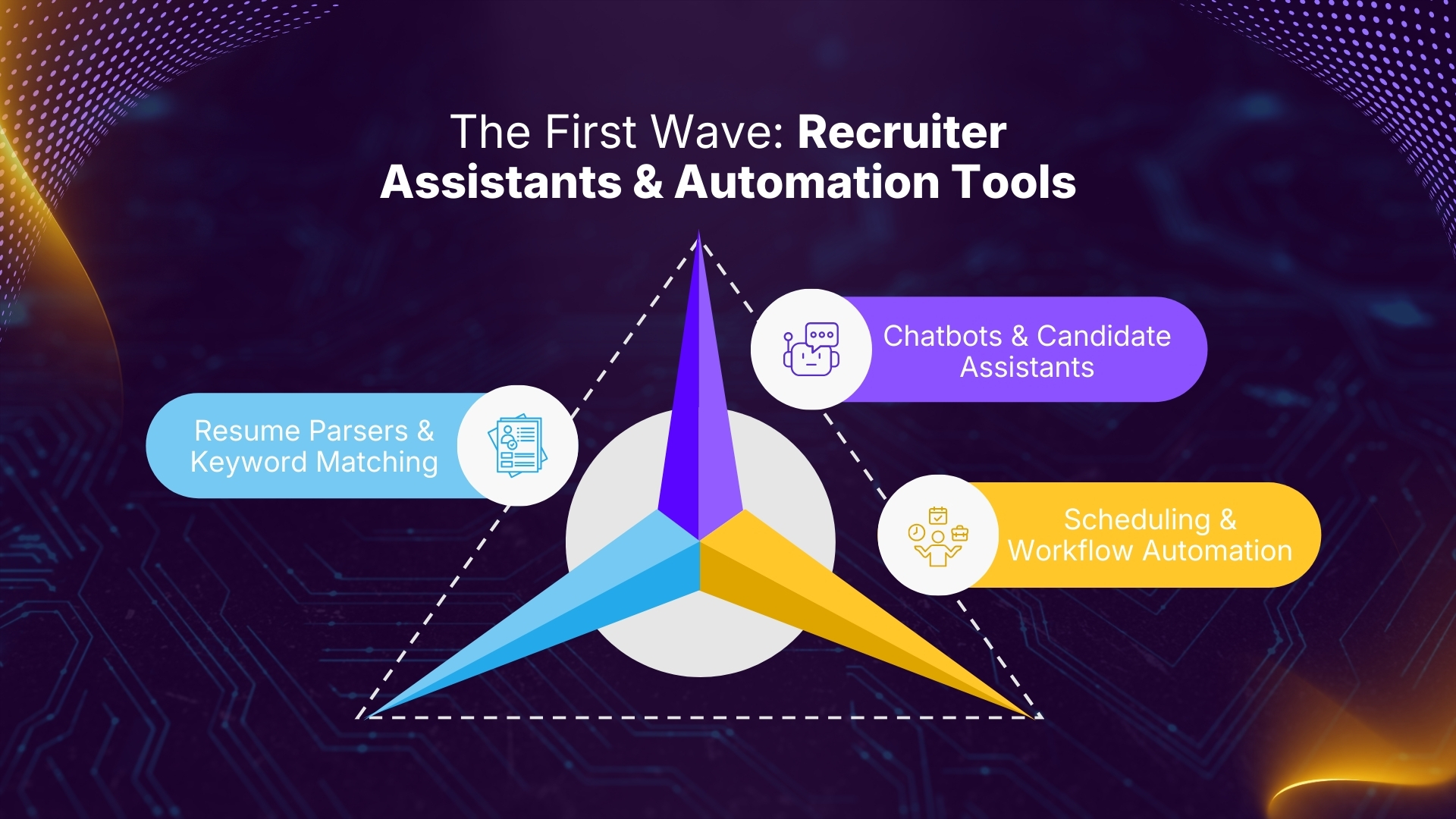
Resume Parsers & Keyword Matching
Early ATS platforms scanned resumes for keywords, experience years, and skills. Their logic was shallow, as it does not incorporate best ways to use AI in recruitment, but it was useful for basic filtering.
Limitations included with recruiter assistants & automation tools are:
- High false positives (keyword stuffing).
- Inability to differentiate real skills from listed skills.
- No understanding of context, nuance, or intent.
- No predictive capability.
In practice, many skilled candidates were overlooked simply because they didn’t phrase their experience in the “correct” way.
Chatbots & Candidate Assistants
Chatbots became common on career pages: answering FAQs, helping with applications, scheduling calls.
They provided convenience but no real intelligence. They acted as UI upgrades, not ai driven recruitment and evaluation engines.
Scheduling & Workflow Automation
Automation with integration of AI in recruitment helped manage high-volume administrative work:
- Scheduling interviews
- Sending reminders
- Moving candidates through pipeline stages
Triggering assessments
While useful, these tools did not solve the root problem: No system could evaluate talent deeply or consistently. The first wave was defined by efficiency, not intelligence.
The Second Wave: AI Hiring Platforms & Autonomous Evaluation
The second major evolution began when ethical use of AI in recruitment started, not just to manage hiring, but to participate in hiring. This is where the industry transitioned from operational automation to cognitive automation and utilized benefits of AI in recruiting.
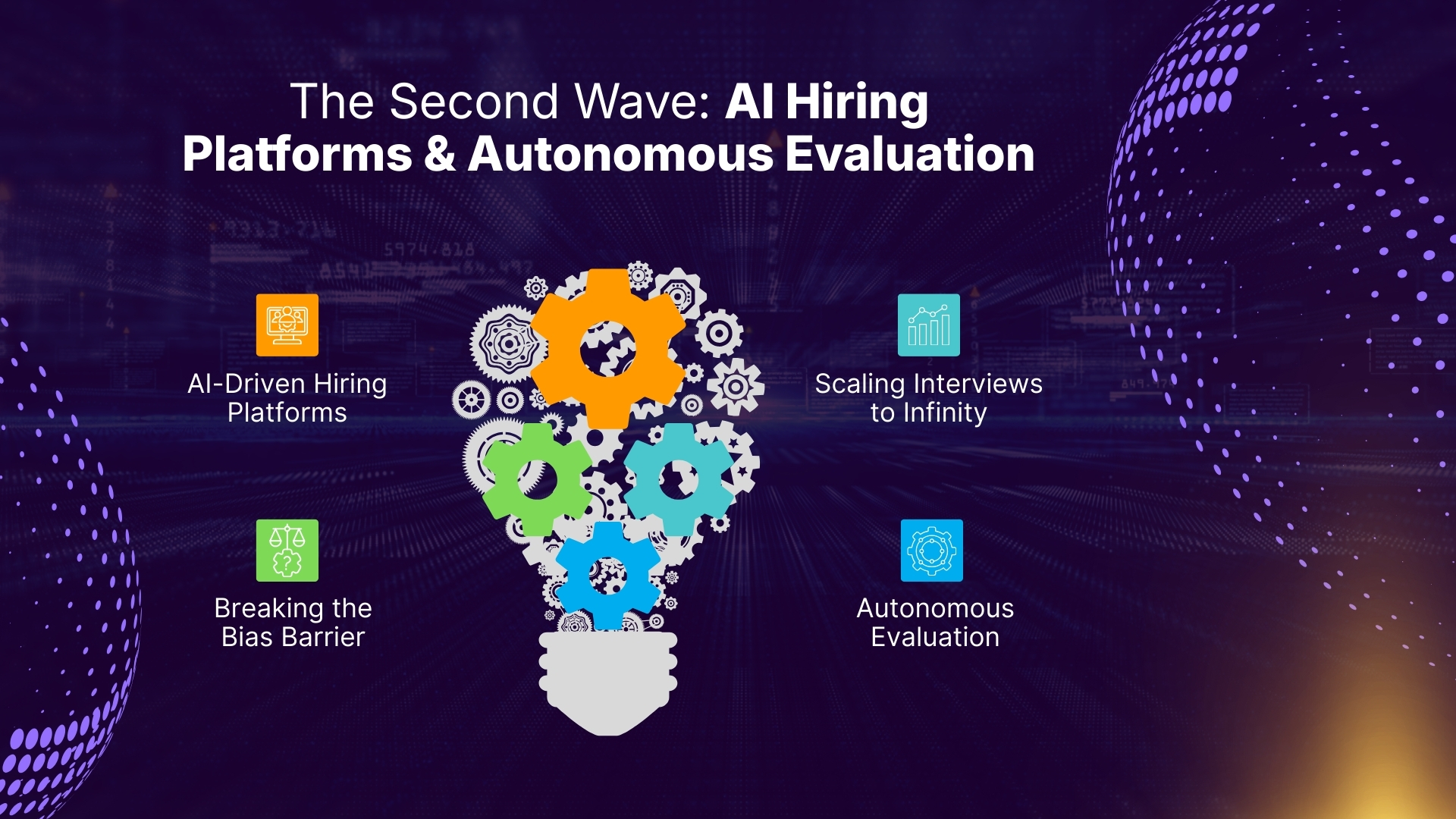
AI-Driven Hiring Platforms
AI Hiring platforms introduced structured, consistent, bias-resistant interviews:
- Technical coding interviews
- Behavioral interviews
- Scenario simulations
- Real-time analysis of responses
Automated scoring and evaluation
These AI hiring platforms didn’t just conduct interviews, they analyzed patterns.
Breaking the Bias Barrier
AI allowed standardized evaluation by:
- Asking identical questions
- Scoring based on skills, not personal impressions
- Removing interviewer variability
- Eliminating fatigue-based misjudgments
Studies show the companies that use AI in recruitment and structured interviews improve predictive hiring accuracy by up to 40%.
Scaling Interviews to Infinity
Unlike human interviewers, AI in recruiting operates without constraints:
- 24×7
- No fatigue
- No scheduling limits
- No cognitive overload
- No bias accumulation
This directly impacted metrics such as:
- 70% reduction in initial screening time
- 30-50% improvement in time-to-fill
- Significant drop in early-stage attrition
Autonomous Evaluation
The breakthrough wasn’t speed, it was depth.
AI could analyze:
- Code quality
- Problem-solving patterns
- Knowledge gaps
- Communication clarity
- Behavior under pressure
Hiring finally moved beyond surface-level resume screening through conversational AI in recruitment.
The second wave introduced the idea that ethical use of AI in recruitment can evaluate talent with better consistency than humans. But it was still narrow, the next wave changed everything.
The Third Wave: Vertical AI Systems for Hiring
As general-purpose models (GPT, Claude, Gemini) matured, companies began training them on domain-specific datasets. This sparked the rise of Vertical AI for hiring models specialized in talent intelligence.
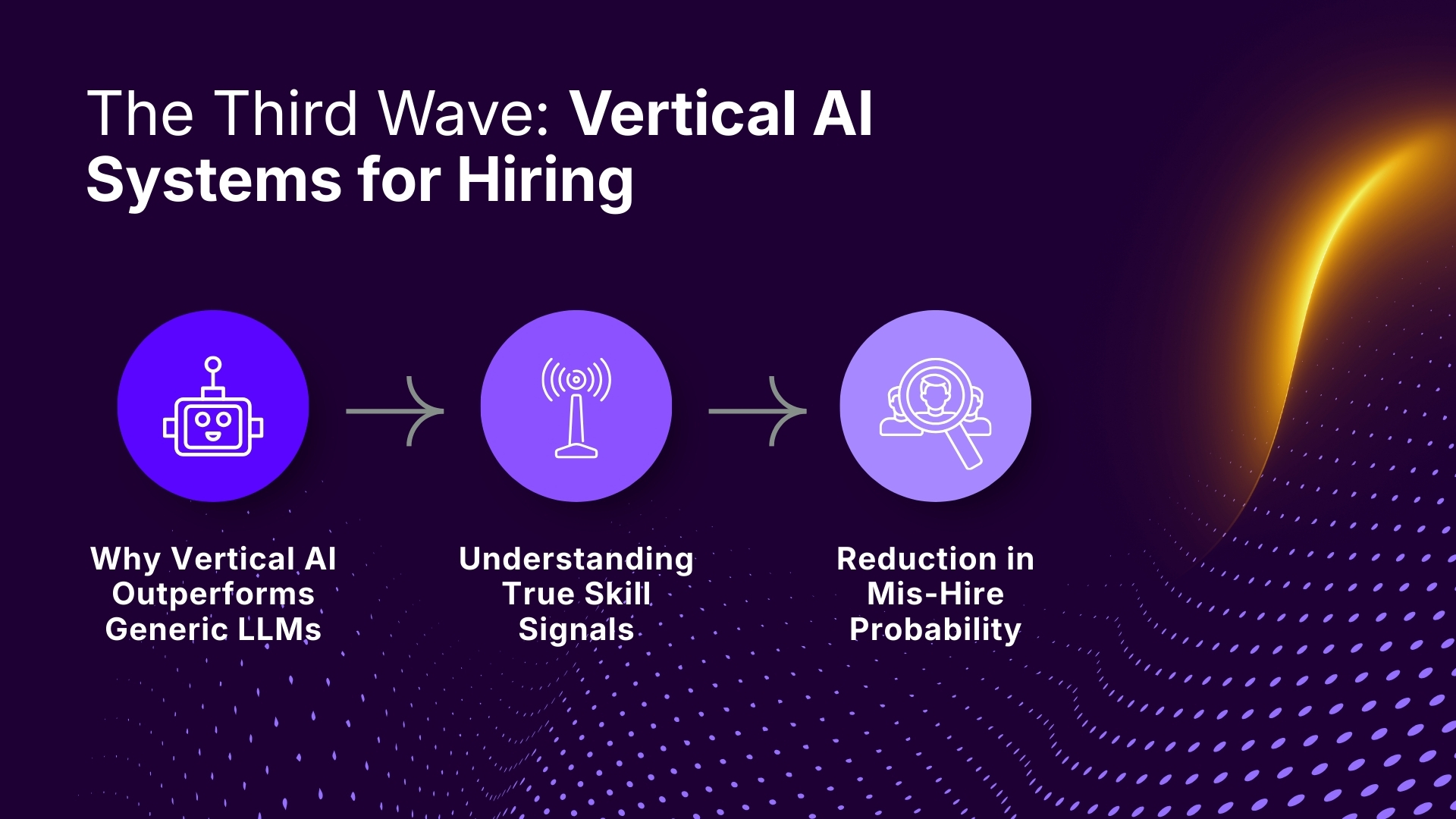
Why Vertical AI Outperforms Generic LLMs
Hiring is not a general problem. It is deeply contextual:
- Skill proficiency varies by industry
- Job levels require different reasoning
- Candidate signals vary across domains
- Interview evaluation requires historical benchmarks
- Coding ability requires understanding complex logic
Vertical AI models outperform general LLMs because they:
- Are trained on job-specific data
- Use proprietary talent benchmarks
- Understand role hierarchies and skill ontologies
- Decode behavioral nuances relevant to hiring
- Detect cheating or scripted answers
- Adapt to real-world performance patterns
Understanding True Skill Signals
Vertical AI can analyze:
- Real reasoning patterns
- Depth vs. breadth of experience
- Problem-solving frameworks
- Technical fluency
- Project-based authenticity
- Seniority markers
These insights allow far more accurate candidate matching.
Reduction in Mis-Hire Probability
Because Vertical AI understands actual job performance signals, it reduces mis-hire risk, a metric costing companies $17,000-$40,000 per hire according to SHRM. This marked the transition from AI-assisted hiring to AI-intelligent hiring. But the next phase is even more transformative: Vertical AGI for hiring.
The Emergence of Vertical AGI in Hiring: A Major Breakthrough
Vertical AGI (Artificial General Intelligence, specialized by domain) represents the next frontier. Unlike general AGI, Vertical AGI does not try to solve everything. It masters one domain deeply, in this case, talent acquisition.
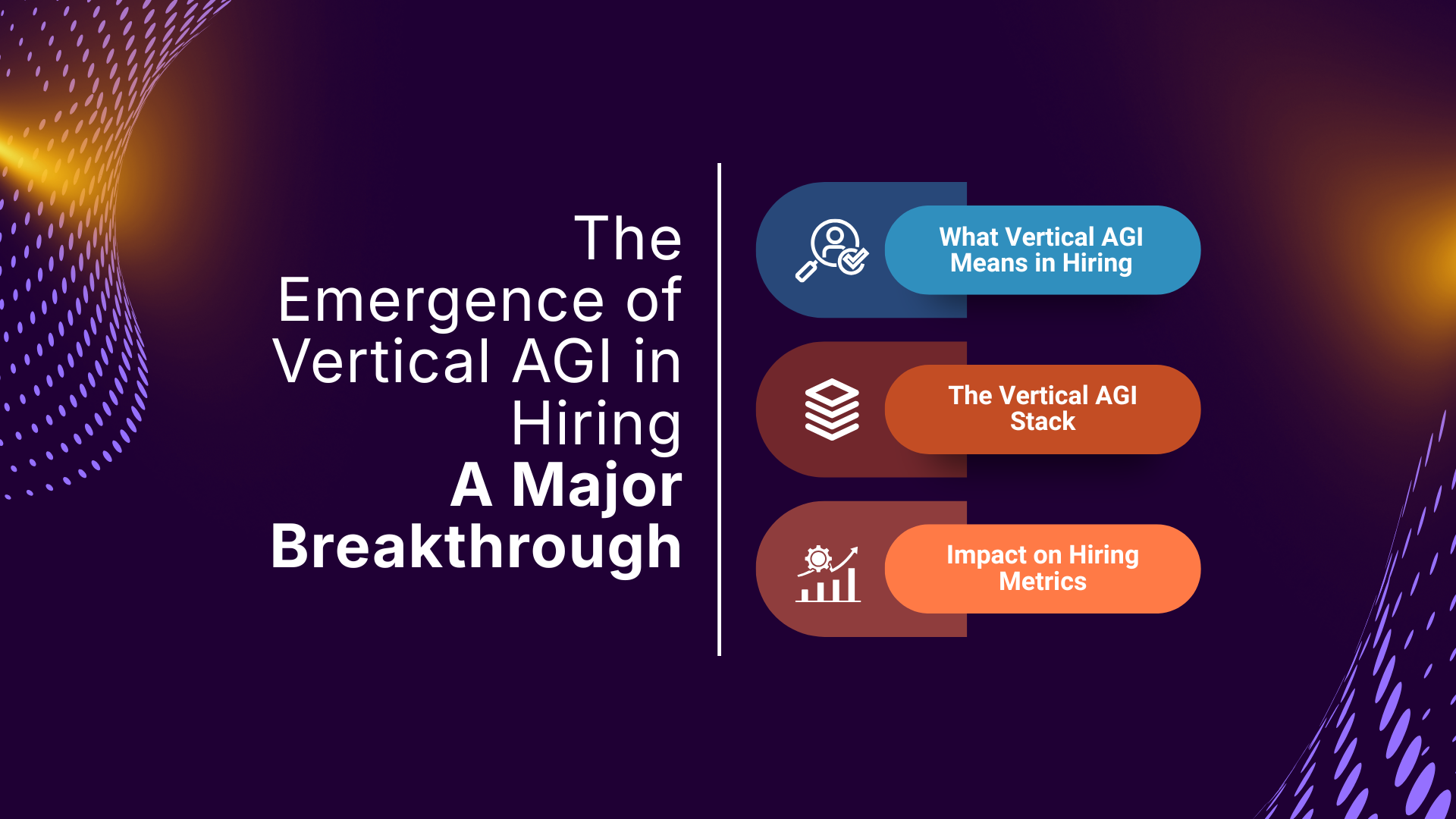
What Vertical AGI Means in Hiring
Vertical AGI systems can:
- Understand job requirements like a hiring manager
- Ask deep, contextual, intelligent questions
- Evaluate technical and behavioral signals
- Simulate real job tasks
- Predict future performance
- Make consistent, explainable hiring decisions
This becomes possible because the model is trained specifically on:
- Hiring outcomes
- Job expectations across levels
- Historical candidate performance data
- Skill progression trends
- Industry-specific role completion signals
- Behavioral competence frameworks
The Vertical AGI Stack
Vertical AGI for hiring operates through four layers:
Perception Layer
Analyzes signals from:
- Video
- Audio
- Text
- Code
- Behavioral cues
Reasoning Layer
Understands:
- Skill depth
- Problem-solving logic
- Communication clarity
- Leadership indicators
- Cultural compatibility
Decision Layer
Produces:
- Fit score
- Ranking
- Strengths & risks
- Predicted job success
- Benchmarked performance
Autonomy Layer
Executes hiring tasks:
- Conduct interviews
- Completes assessments
- Evaluate results
- Generate reports
- Moves candidates through pipeline
Vertical AGI turns hiring into a self-operating system.
Impact on Hiring Metrics
Vertical AGI enables:
- 5x faster hiring cycles
- Up to 90% reduction in early-stage bias
- 50-70% lower screening cost
- Higher offer-to-join ratio
- Stronger job performance predictability
This is not automation. This is human-level reasoning at machine scale.
The Future: Autonomous Hiring Systems That Run Entire Pipelines
The next decade will move beyond assistance or AI augmentation in Recruitment. Hiring pipelines will run by themselves.
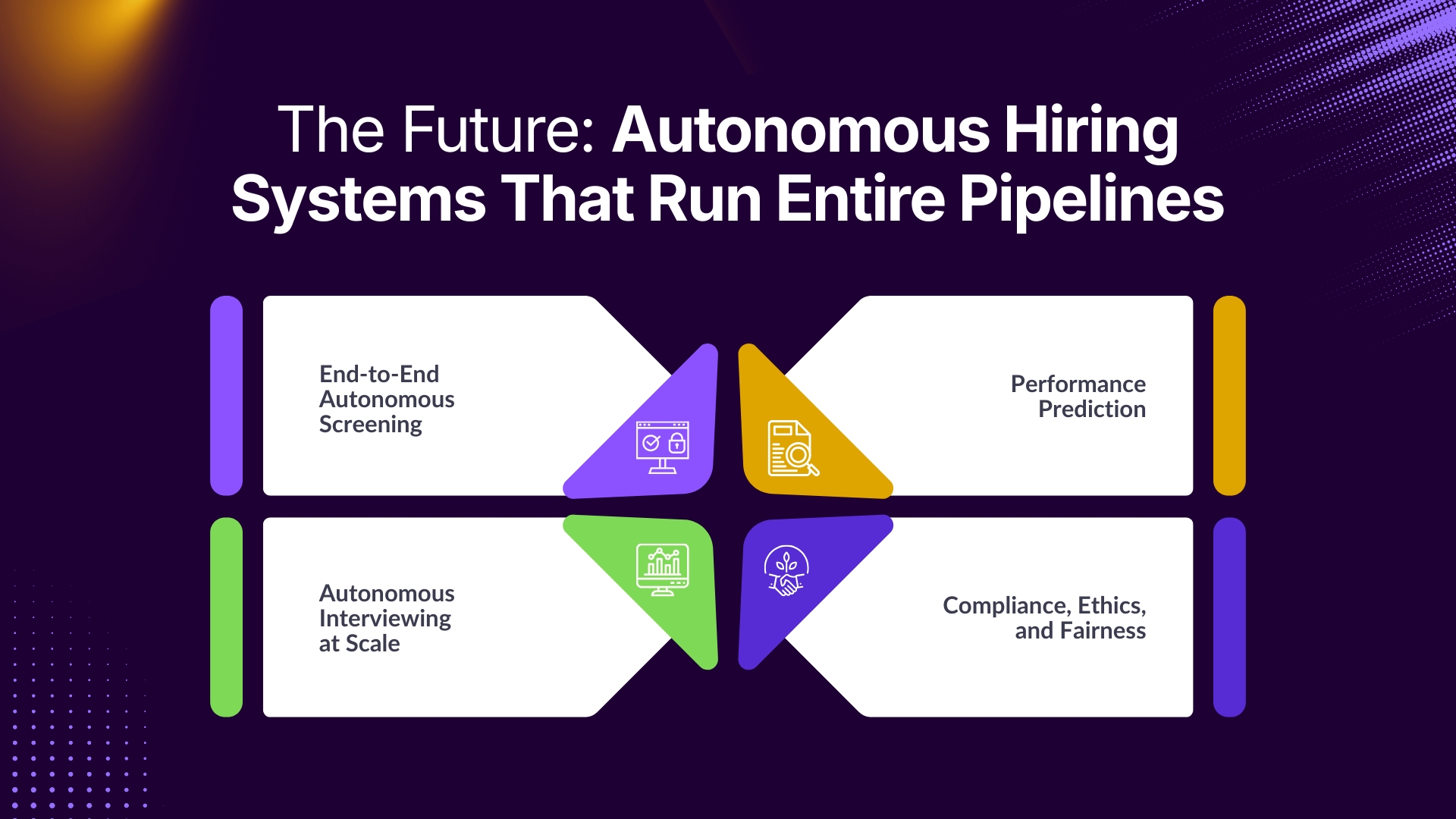
End-to-End Autonomous Screening
Vertical AGI systems will:
- Read resumes
- Extract meaningful signals
- Evaluate skill claims
- Benchmark candidates against top performers
- Predict fit for each role
And do so in a few minutes.
Read More: Introducing humAIn Advance: The First Fully Autonomous Interview Agent
Autonomous Interviewing at Scale
Imagine 500 interviews running in parallel, each:
- Personalized
- Contextually adaptive
- Skill-aligned
- Consistently evaluated
- Cheating-proof
- Bias-free
This is already emerging through technical hiring workflows.
Performance Prediction
The biggest breakthrough will be predictive analytics:
- Future job success
- Cultural adaptability
- Ramp-up speed
- Retention likelihood
It moves hiring from reactive to predictive then to autonomous.
Compliance, Ethics, and Fairness
AGI-driven hiring systems will come with:
- Transparent scoring
- Bias audits
- Explainable evaluation logs
- Data governance controls
- GDPR + EEOC compliant workflows
Enterprises get intelligence and governance.
Industry Use Cases & Real-World Impact
Vertical AGI transforms hiring across multiple industries:
Technology & Engineering
Problem: high application volume, complex skill evaluation
AGI impact:
- Automated tech interviews
- Code analysis
- Seniority detection
- Better hiring accuracy
BPO, Support & Customer Service
Problem: high attrition, repetitive interviews
AGI impact:
- Mass interview automation
- Soft-skill evaluation
- Cheating detection
- Consistent onboarding
Startup Hypergrowth Teams
Problem: need for rapid scaling
AGI impact:
- 5x faster hiring
- Role-specific intelligence
- Zero capacity limits
Enterprise Global Operations
Problem: large, distributed hiring teams
AGI impact:
- Standardized interviews globally
- Unified evaluation frameworks
- Bias-free decision systems
Challenges & Ethical Considerations
Though promising, Vertical AGI presents real concerns.
Bias & Fairness
AI can reduce bias, but only if trained responsibly.
Transparency & Explainability
CHROs must understand:
- Why a candidate was rejected
- How scoring was derived
- Whether models meet compliance
Data Governance
Hiring involves sensitive personal data. Vertical AGI must ensure:
- Encryption
- Secure storage
- Regulated access
- Audit trails
Human Oversight
AI will make decisions, but humans must remain accountable. Vertical AGI doesn’t eliminate recruiters. It eliminates repetitive cognitive overhead, allowing recruiters to focus on strategy, experience, and relationship-building.
Strategic Recommendations for CHROs & VCs
For CHROs
- Build an AI-first hiring architecture
- Invest in systems that evaluate talent, not just manage workflows
- Demand transparency, fairness audits, and explainability
- Choose platforms with proprietary datasets and domain-specific intelligence
- Begin transitioning from AI-assisted to AI-led then to AI-autonomous hiring
For VCs
- Prioritize Vertical AGI over generic AI tools
- Invest in companies with defensible datasets
- Look for AI systems that own the full evaluation stack
- Bet on platforms solving large-scale hiring bottlenecks
- Assess ability to expand horizontally across industries
Key Takeaways: The Decade of Autonomous Hiring
The evolution of hiring intelligence from recruiter assistants to autonomous interview platforms to Vertical AGI represents a fundamental shift in how companies evaluate human potential.
We are not moving toward a future where AI supports hiring. We are moving toward a future where AI in Recruitment is leading. Just as CRMs redefined sales and cloud redefined infrastructure, Vertical AGI will become the operating system of talent acquisition.
The companies that adopt integration of AI in Recruitment early will hire faster, smarter, and more fairly than their competitors. The companies that resist it will fall behind. Evolution is already in motion. The next decade belongs to autonomous hiring.
Really a great take on AI in Recruitment and how a good AI Hiring Platform can act as a powerful automation tool for hiring. I must say, it is a very insightful article on the shift from basic automation to intelligent hiring systems.